How to Spot AI Disruption Risk Before the Market Does
Surmount Blogs
Learn how to spot AI disruption risk early, from fading switching costs to customer inertia that won't last.
How to Spot AI Disruption Risk Before the Market Does
In September 2026, a newly launched personal AI agent from META sent a jolt through Wall Street. The agent can compare prices, make bookings, and walk users through cancelling services. Investors quickly asked what happens to businesses that profit when customers don't shop around.
The market's first answer was a selloff. A Goldman Sachs basket of "consumer inertia" stocks fell 2.6% in a single session, its worst day since February, and was down more than 7% over six sessions
This is a new kind of AI disruption risk. It isn't about chatbots replacing software, or even about agentic AI reshaping wealth management. It's about agents removing the friction that quietly supports revenue.
Why AI Disruption Risk Is Suddenly in Focus
Earlier waves of AI anxiety mostly targeted business software. This one points at consumer-facing companies. According to Bloomberg, the worry centers on businesses that benefit when people keep buying out of habit even though a better option exists.
Categories flagged in the coverage include:
Telecom carriers
Insurers
Streaming services
Online travel agencies
Banks and brokers, which were caught in the same selloff
The S&P 500 Financials Index dropped as much as 2.4% that day, hitting its lowest level since July while the broader market was roughly flat.
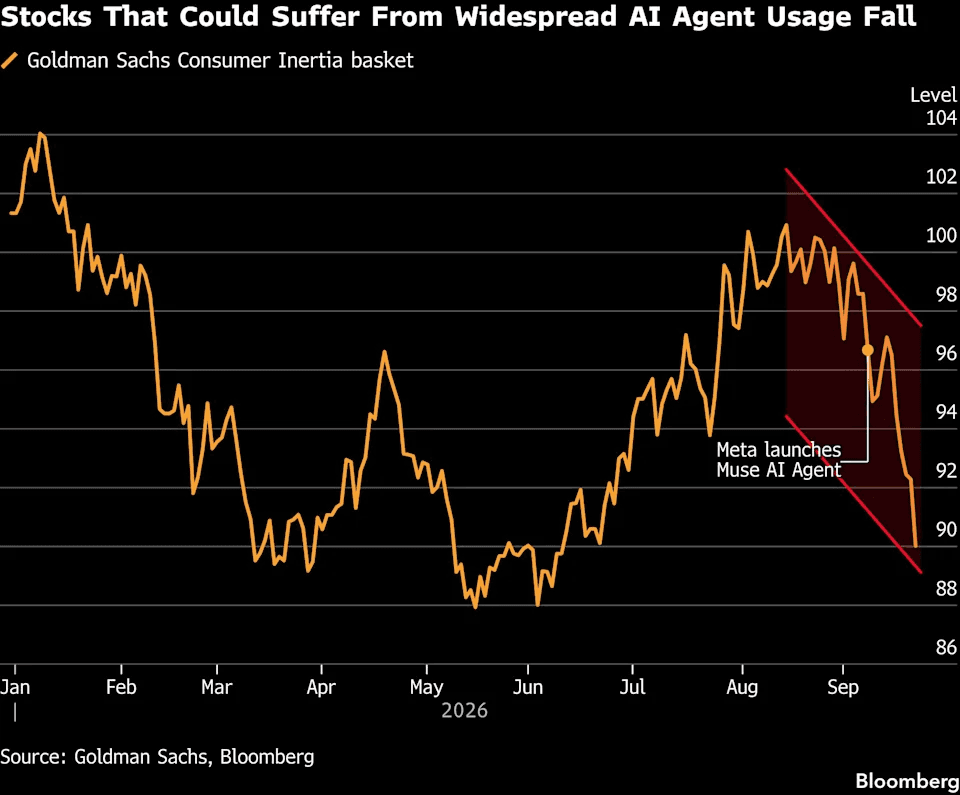
The key word is exposure, not collapse. Markets often price a theme well before there is real usage data to confirm it, which is one reason volatility can be a feature rather than a bug for long-term investors.
The Economic Moat Test: What Makes a Business Vulnerable?
An economic moat is a durable advantage that protects a company's profits from competitors, and Morningstar rates companies on how durable that advantage is. AI agents force a sharper question: is the moat built on value, or on friction?
Switching Costs Built on Friction
Not all switching costs are the same:
Real barriers: migrating years of data, retraining staff, or rebuilding integrations.
Manufactured friction: long hold times, buried cancel buttons, and plans that are hard to compare.
An agent that handles the phone call and the comparison shopping wears down the second kind far faster than the first.
Customer Inertia and the "Forgotten" Customer
Customer inertia can be measured. In a C+R Research survey reported by CNBC, consumers guessed they spent $86 a month on subscriptions, but their itemized totals averaged $219. In the same survey, 42% had forgotten about a subscription they were still paying for.
That gap is revenue, and it is exactly what a personal agent, like the AI tools already improving personal finances, could surface in seconds.
The Subscription Business Model Under Pressure
The subscription business model is also facing regulatory pressure. The FTC's "click-to-cancel" rule was vacated in 2025, but the agency moved to revive it in March 2026, and roughly 30 states have their own automatic-renewal laws (Jones Day).
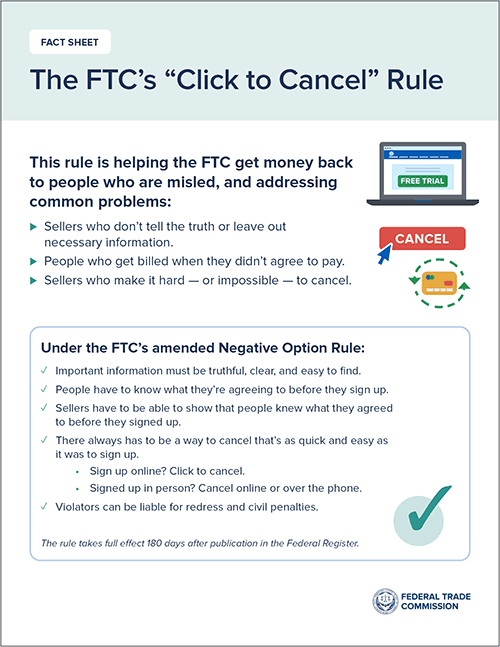
AI agents and regulators are now pushing in the same direction: toward easier exits.
A 3-Layer Framework for Screening AI Disruption Stocks
One practical way to assess AI disruption stocks is to split the customer journey into three layers and ask whether an agent could complete each one without human help.
Layer 1: Discovery
Can an agent find and compare alternatives? Businesses that rely on opaque pricing or hard-to-compare plans are most exposed here.
Layer 2: Transaction
Can an agent complete the purchase? Signals to watch include:
Standardized, easy-to-compare products
Open booking or checkout systems
Little need for human judgment at the point of sale
Layer 3: Switching
Can an agent cancel and move the customer? This is where friction-based moats are thinnest. As a rule of thumb, the more layers an agent can clear, the higher the AI disruption risk.
Moats AI Can't Easily Automate
Not every advantage is friction. Some tend to hold up better:
Regulated approvals: licenses and permits can take years to secure.
Proprietary data: an agent can compare prices, but it can't recreate unique data.
Liability: when something goes wrong, customers want an accountable party.
Distribution contracts: exclusive agreements an agent can't route around.
Genuine product quality: customers stay because the product is better.
The dividing line is simple. Does the customer stay because they want to, or because leaving is annoying?
Where a Systematic Investing Strategy Fits
Headline-driven selloffs are hard to navigate by feel. Some reactions overshoot, while others are early signals of real business change. Telling them apart in the moment is where emotional decisions creep in.
A systematic investing strategy replaces gut calls with predefined rules, one of the core differences in algorithmic vs. traditional investing. It can:
Apply the same screening criteria to every holding
Rebalance on a set schedule rather than on the news
Reduce the pull to react to a single scary headline
There's an irony here too. Investors have their own inertia, a pattern researchers call status quo bias, in the form of positions held out of habit and allocations nobody has reviewed in years. It's a big part of why deciding when to sell is so often gotten wrong.
Evaluating AI disruption risk with consistent rules is one way to keep portfolios from running on autopilot. Rules-based approaches still carry market risk and can't eliminate losses, but they do make the decision process more consistent.
Frequently Asked Questions
What is AI disruption risk?
It's the chance that AI tools, especially personal AI agents, weaken a company's revenue or competitive position. The risk tends to be highest where profits depend on customers not comparing or switching.
Which industries are most exposed to AI disruption risk?
Recent coverage flagged telecom, insurance, streaming, and online travel, where customer inertia supports recurring revenue. Exposure isn't the same as decline, so fundamentals still matter.
How do AI agents affect a subscription business model?
Agents can surface forgotten charges and handle cancellations in seconds, which removes the friction many subscriptions rely on. Businesses that keep customers through real value are less affected.
What makes an economic moat resistant to AI?
Durable moats rest on things an agent can't replicate or route around, like regulated approvals, proprietary data, liability, and exclusive contracts. Moats built on manufactured switching costs tend to be weaker.
How can a systematic investing strategy help when evaluating AI disruption stocks?
It applies the same rules to every holding and rebalances on a schedule, which can reduce headline-driven decisions. It doesn't eliminate market risk or guarantee results.

Automate any portfolio using data-driven strategies made by top creators & professional investors. Turn any investment idea into an automated, testable, and sharable strategy.