Agentic AI & the Future of Wealth Management in 2026
Surmount Blogs
Agentic AI is revolutionizing wealth management with 600% adoption growth in 2026. Discover how autonomous agents transform advisor productivity and ROI.

OpenClaw (the viral open-source AI agent formerly known as Clawdbot and Moltbot) has captured global attention with over 145,000 GitHub stars and sparked intense debate about autonomous AI systems. This "AI that actually does things" isn't just managing emails and calendars. It's autonomously browsing the web, scheduling meetings, and making decisions without constant human oversight.
This explosion of interest in agentic AI isn't confined to tech circles. Wealth management is experiencing its own transformation, and the numbers tell a compelling story.
The Shift From Chatbots to Autonomous Agents
The fundamental difference between traditional AI and agentic AI defines the future of wealth management:
Traditional AI:
Responds to queries
Provides recommendations
Requires constant human direction
Agentic AI:
Anticipates client needs
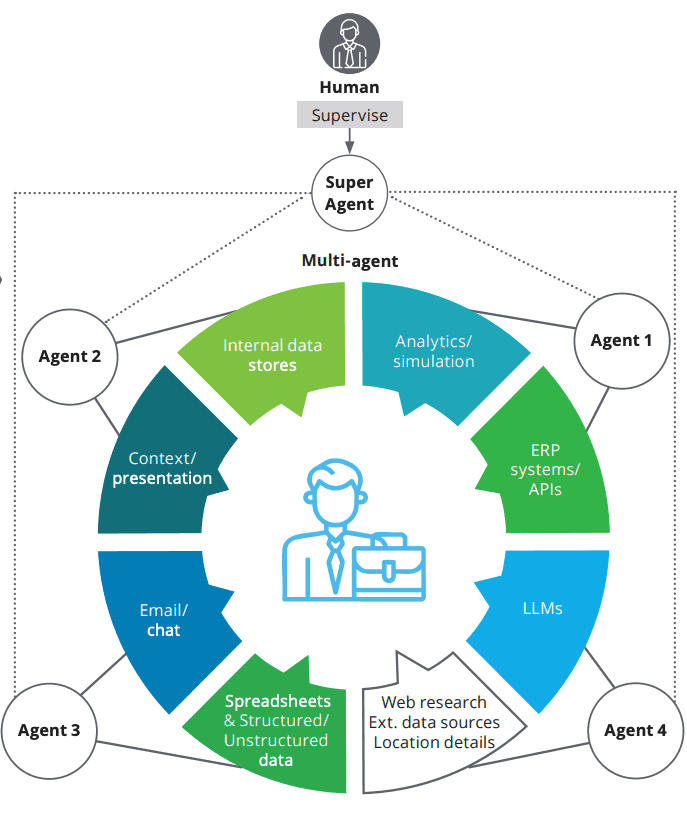
Orchestrates complex workflows
Takes autonomous action within defined parameters
Wolters Kluwer research reveals that 44% of finance teams will deploy agentic AI in 2026—a staggering 600% increase from 2025. This isn't incremental improvement; it's a fundamental reimagining of how wealth management operates.
InvestSuite describes the evolution perfectly: wealth management is shifting "from generative text and reactive chat to agentic systems that monitor, decide, and act." Bank of America's Erica exemplifies this transition—moving beyond answering questions to proactively managing client finances, detecting opportunities, and executing pre-approved transactions.
The Productivity Revolution Advisors Actually Need
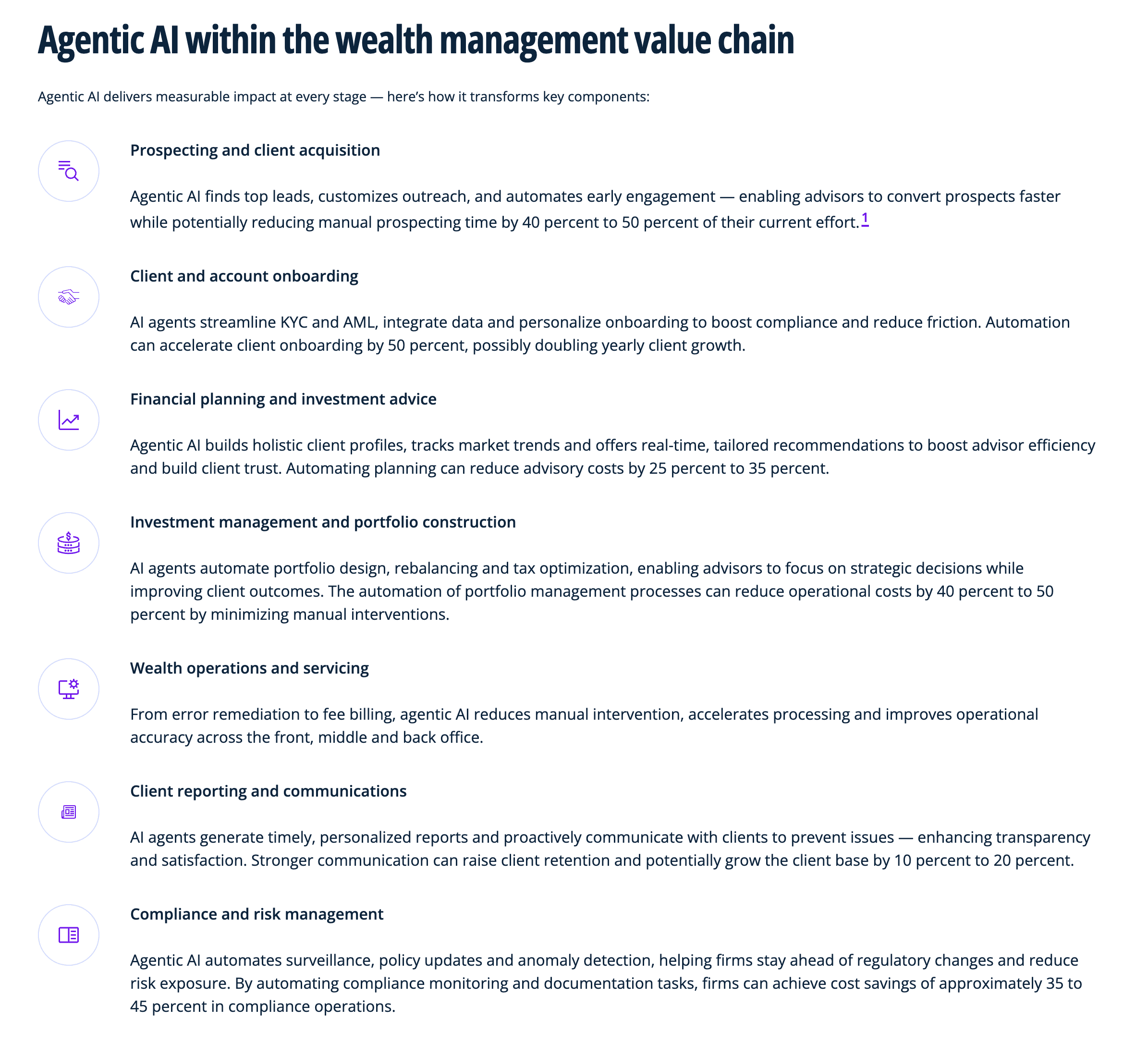
KPMG's comprehensive research demonstrates measurable impact across the wealth management value chain:
For Advisors:
40-50% reduction in manual prospecting time
30-40% increase in net new AUM through efficiency gains
50% faster client onboarding while cutting costs 30-40%
50% reduction in meeting preparation time
For Operations:
40-50% cost reduction in portfolio management automation
35-45% savings in compliance operations
10-20% improvement in client retention through proactive communication
KPMG's case study with a top-10 investment manager demonstrates real-world results: their agentic AI assistant analyzes advisor profiles and meeting notes to generate personalized agendas, saving 20,000 hours annually.
Real Firms, Real Deployments
These aren't pilot programs—they're production systems handling actual client interactions. AWS's Forrester study reports one financial services VP revealed their organization already has 60 agentic agents in production, with plans to deploy 200 more by year-end 2026.
Current Deployments:
Wells Fargo: Partnering with Google Cloud on Agentspace for investment bankers, handling FX post-trade processes
Top-5 Wealth Managers: KPMG implementation cut analyst time by 66% through AI analyzing customer interactions
Major RIAs: Using single-step agents to automate contract searches, data population, and routing workflows
Neurons Lab's research compilation shows that in 2025 alone, the 50 largest banks announced over 160 agentic AI use cases. Early implementations demonstrate 20-60% productivity increases and 30% improvements in turnaround times.
What Agentic AI Actually Does
The practical applications span the entire client lifecycle:
Client Acquisition & Onboarding:
Automated prospect research and relationship mapping
Intelligent data extraction from statements and KYC documents
Real-time suitability and mandate eligibility checks
Pre-filled custodial forms with automatic validation
Portfolio Management:
Autonomous rebalancing based on market conditions and client goals
Daily tax-loss harvesting capturing micro-dips humans miss
Proactive opportunity detection and recommendation generation
Direct indexing optimization for accounts over $100K
Compliance & Risk:
Continuous transaction monitoring and anomaly detection
Automated policy updates as regulations change
Real-time documentation and audit trail generation
Cross-border rule navigation
Client Service:
Personalized report generation with forward-looking insights
Proactive communication before issues arise
Voice-activated advisor assistants for instant analysis
"Digital financial twins" managing routine decisions
Financial institutions using agentic AI achieve 100% precision in decisioning, compared to under 95% for humans with four-eyes review processes.
The OpenClaw Moment: What It Means for Finance
OpenClaw's viral success signals a fundamental shift in how autonomous AI reaches consumers. Its open-source, modular design proves that AI agents can work across platforms while adapting to individual needs.
Why This Matters for Wealth Management:
Client expectations are evolving: Digital-native heirs inheriting trillions expect Spotify-style personalization and real-time responsiveness
Platforms must interoperate: The future isn't walled gardens but hybrid systems that integrate deeply while remaining flexible
Trust requires transparency: Open-source approaches address the 60% of professionals worried about AI accuracy
But OpenClaw also exposes critical challenges. Security researchers warn about prompt injection vulnerabilities, exposed administrative interfaces, and supply chain risks from poorly audited modules. For regulated wealth management, these aren't theoretical—they're existential.
The Governance Challenge
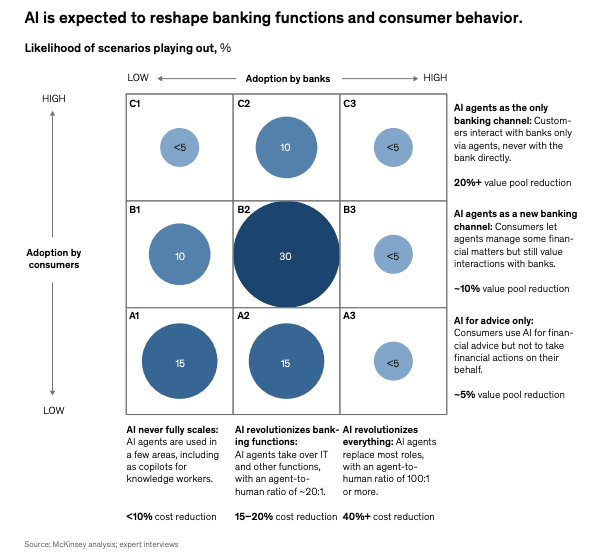
Deloitte's 2025 research reveals the sobering reality: while 30% of organizations explore agentic options and 38% pilot solutions, only 11% have systems actively in production. The gap between promise and execution is governance.
Critical Implementation Requirements:
Explainability: Every recommendation must trace to documented rationale
Human-in-loop protocols: Clear triggers for when agents must defer to human judgment
Data quality: Agents magnify poor data as readily as accurate data
Security architecture: Zero-trust frameworks and isolated sandbox environments
Change management: Education and training for non-technical advisors
Organizations planning agentic AI implementation cite these top challenges:
63%: Security and risk concerns
55%: Lack of interoperability across technology ecosystem
55%: Technical debt
48%: Poor data governance
KPMG estimates global agentic AI spending hit $50 billion in 2025. Organizations achieve an average 2.3x return on investment within 13 months, with frontier firms reaching 2.84x compared to just 0.84x for laggards.
The Strategic Imperative for Modern Platforms
Firms that thrive won't be those with the most sophisticated AI—they'll be those whose infrastructure enables seamless agent integration while maintaining governance and transparency.
Modern wealth management platforms must provide:
Automated rebalancing engines that agents can orchestrate across portfolios
Tax-optimization layers enabling daily loss harvesting and direct indexing
Compliance frameworks with built-in guardrails and audit trails
No-code strategy builders allowing advisors to define rules agents execute
Transparent documentation showing how every decision was made
For investors, this means access to institutional-grade portfolio management previously cost-prohibitive. For advisors, it means liberation from administrative burden to focus on high-value relationship building. For platforms, it means the difference between scaling efficiently and drowning in operational complexity.
What's Next
Agentic AI isn't coming to wealth management—it's here. The OpenClaw moment proves autonomous AI has reached mainstream consciousness. Wealth management firms that succeed will embrace this technology not as a replacement for human advisors but as an amplifier of their expertise—automating the routine to enable the remarkable.
The competitive advantage shifts from technology ownership to cognitive orchestration—blending human judgment with AI capabilities across every client touchpoint. With adoption accelerating and early movers capturing 4% ROTE advantages over slow movers, the question isn't whether to implement but how quickly and how well.

Automate any portfolio using data-driven strategies made by top creators & professional investors. Turn any investment idea into an automated, testable, and sharable strategy.