Warren Buffett Passive Income Strategy: The Snowball Method
Surmount Blogs
Master Warren Buffett's passive income strategy: dividend growth, compounding, and automated investing to build lasting wealth

Warren Buffett Passive Income Strategy: The Snowball Method
Most investors understand compounding in theory. Few go on to actually build a system around it. Warren Buffett's passive income strategy is that system. A disciplined, decades-long framework for turning capital allocation into exponential wealth.
Here's how it works, and how strategy-focused investors are implementing it today. If you are interested, be sure to check out our piece on Ray Dalio's All Weather Strategy.
Why Serious Investors Study the Buffett-Munger Compounding Framework
Investment legends like Buffett and Munger didn't build Berkshire Hathaway on hot tips or macro calls. They built it on a repeatable process:
identify businesses with durable advantages,
buy them at rational prices, and
let compounding do the rest.
For investors focused on passive income, this framework is the most battle-tested blueprint in existence, nearly doubling the S&P 500's annualised return over six decades.
What separates it from generic "buy and hold" advice is precision. Every decision flows from a clear set of criteria, applied consistently, without emotional interference.
The Charlie Munger $100K Rule: Why Your Starting Capital Is Everything
Munger was direct about the first milestone:
"The first $100,000 is a b**ch, but you gotta do it."
The reasoning is quite mathematical.
Early in your investing life, your principal is too small to generate meaningful passive income. But once capital crosses a critical threshold, the income it generates begins compounding on itself, and the snowball starts moving faster than your contributions.
Getting to $100K quickly is the single highest-leverage move an early investor can make.
The Snowball Investing Strategy Explained
Buffett's favourite metaphor for compounding is a snowball rolling downhill: as it gains size, it collects more snow, which makes it larger, which collects even more, and so on.
The critical variables are the size of the snowball at the start and the length of the hill — starting capital and time horizon.
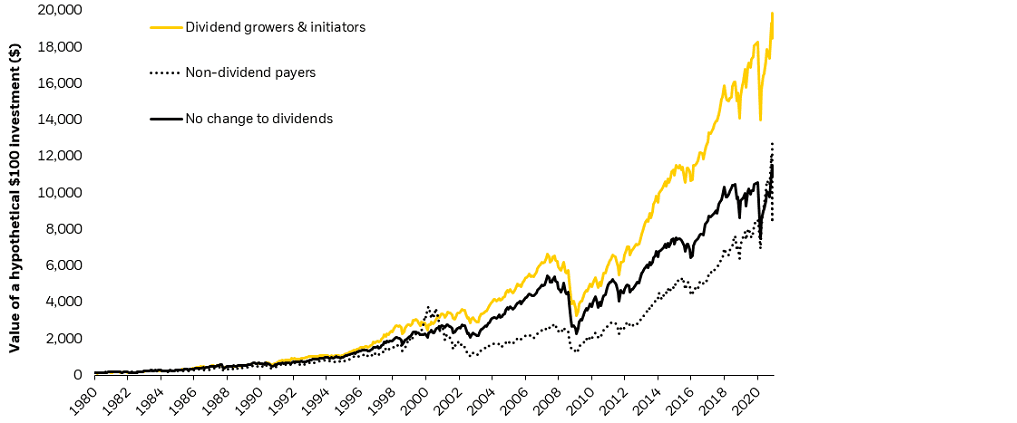
For dividend investors, the hill is time and the snow is reinvested income. Every dividend reinvested expands the surface area of the snowball. Panic-sell during a correction, or undermine the process with inconsistent execution, and the snowball loses momentum in ways that compound negatively over decades.
How to Build a Compounding Dividend Strategy Like Buffett
While the mechanics may be straightforward, the discipline behind it rarely ever is.
The Math Behind the Snowball: What $100K Actually Becomes
Starting Capital | CAGR | 10 Years | 20 Years | 30 Years |
$100,000 | 7% | $196,715 | $386,968 | $761,226 |
$100,000 | 9% | $236,736 | $560,441 | $1,326,768 |
$100,000 | 12% | $310,585 | $964,629 | $2,995,992 |
The difference between a 7% and 12% compounding dividend strategy over 30 years is a $2.2 million gap on identical starting capital. That is massive. Stock selection and reinvestment discipline are not minor details. They are the entire game.
What Buffett Looks for in a Dividend Stock
The criteria for Warren Buffett dividend stocks are specific:
consistent earnings across business cycles,
high return on equity sustained over multiple years,
low debt relative to cash flow, and
a durable competitive advantage — what he calls an economic moat.
This framework maps closely to the dividend investing safety checklist serious investors use before committing capital.
Critically, he demands a rational entry price: a margin of safety that protects against analytical error and improves long-term returns.
Coca-Cola, American Express, and Chevron sit in Berkshire's portfolio not because they're exciting, but because they reliably generate cash, defend their market position, and return capital to shareholders year after year. This is the same criteria at the heart of any sound dividend growth investment strategy.
Dividend ETF vs Dividend Stocks: What Does the Strategy Actually Require?
This is the decision most dividend investors face, and the answer depends on how much active involvement you're prepared to commit.
The Case for SCHD, VYM, and JEPI: Passive, Reliable, but Limited
ETFs like SCHD, VYM, and JEPI offer instant diversification, low management overhead, and consistent income. SCHD in particular has earned strong recognition for dividend growth investing through its quality-focused methodology. For investors who want a truly hands-off approach, these instruments will likely compound at 7%–9% annually over the long run.
The trade-offs are real, however. Passive ETFs hold hundreds of positions regardless of individual quality — a phenomenon Buffett's philosophy would call diworsification.
Expense ratios create drag that compounds negatively over decades. And crucially, ETFs cannot replicate the valuation discipline central to Warren Buffett's passive income strategy.
Individual Dividend Stocks: Higher Reward, Higher Discipline Required
Stocks like Realty Income (O), Enterprise Products Partners (EPD), and Ares Capital (ARCC) represent the best dividend strategy for passive income at the individual security level — higher yields, greater selectivity, and the ability to concentrate in genuinely undervalued positions. With valuations shifting in their favour, the case for dividend stocks in 2026 is stronger than it has been in years.
A well-constructed individual dividend portfolio has historically outperformed broad ETFs over a full market cycle.
The cost here, however, is consistency. Earnings analysis, valuation work, and rebalancing all require ongoing attention. One poorly-timed decision — panic-selling during a drawdown or holding a deteriorating position too long — can meaningfully impair long-term returns. It's the sell decision that most investors consistently get wrong, and it's where the greatest value of systematic rules lies.
Automated Dividend Investing: The Missing Piece Most Investors Overlook
This is where most implementations of Warren Buffett's passive income strategy break down. The framework is clear. The logic is airtight. But execution over decades requires a consistency that human psychology routinely undermines. This is for the same reason dollar-cost averaging alone isn't enough to build a compounding snowball without a disciplined strategy underneath it.
How To Position For It
Understanding Buffett's passive income framework is one thing. Having the discipline to execute it without deviation, across decades, through corrections and euphoria alike, is another entirely.
The T. Rowe Price Dividend Growth Tracker on Surmount AI does the heavy lifting for you. It mirrors the holdings of T. Rowe Price's Dividend Growth Fund — one of the most respected dividend-focused strategies in institutional asset management — automatically. No manual stock selection. No emotional rebalancing. No missed reinvestment cycles. Just systematic, rules-based exposure to exactly the kind of high-quality, consistently growing dividend businesses that sit at the heart of Buffett's snowball framework.
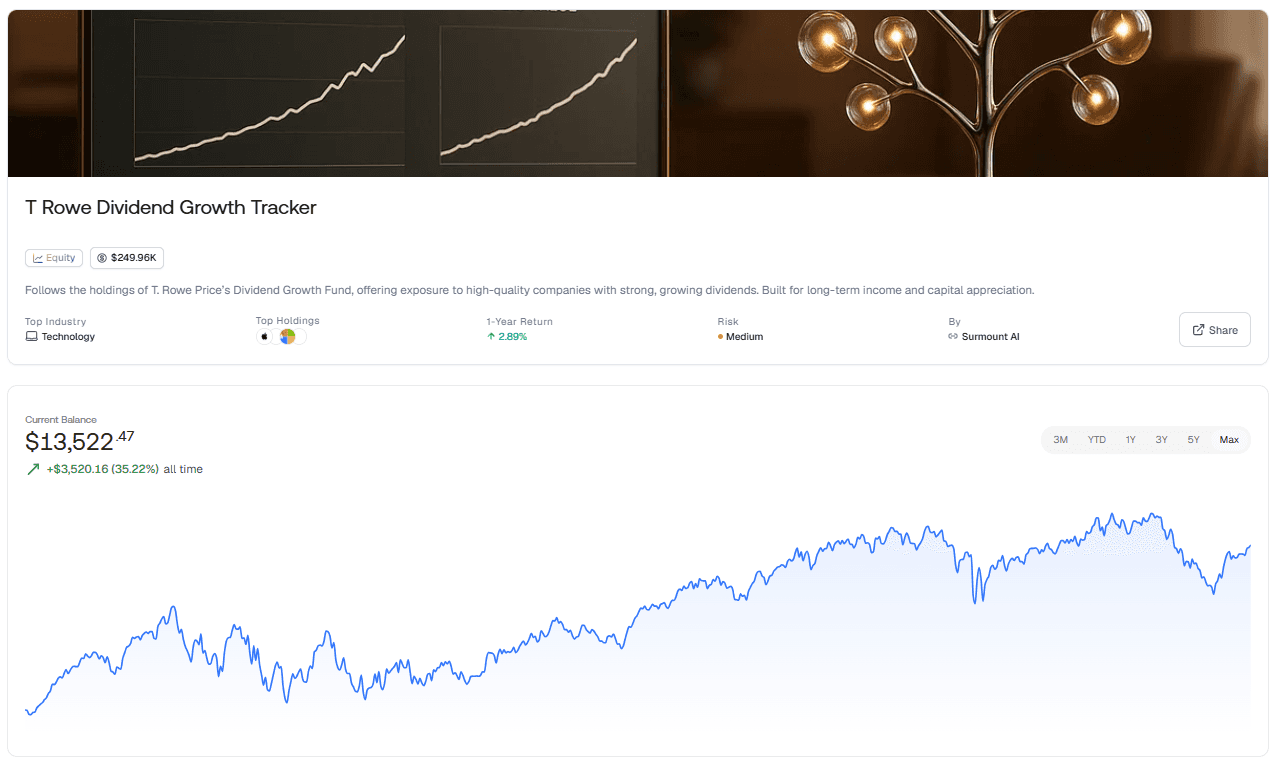
This is the compounding dividend strategy built for investors who understand the math in the table above and want to act on it — without dedicating hours each week to earnings calls and valuation work.
The fund's DNA is Buffett-aligned by design: it targets companies with durable competitive advantages, reliable cash flows, and a track record of growing their dividends year over year. These are not high-yield traps or overleveraged income plays. They are the kind of businesses Berkshire Hathaway would hold — selected and monitored by one of Wall Street's most rigorous research teams, now available to deploy in minutes.
Every day you delay starting the snowball is a day of compounding you never get back. The hill only gets shorter.
[Deploy the T. Rowe Dividend Growth Tracker to your portfolio on Surmount AI →]
Key Takeaways for Strategy-Focused Investors
Warren Buffett's passive income strategy is built on compounding dividend income from moat-protected businesses — not diversification for its own sake.
The Charlie Munger $100K rule underscores that early capital accumulation has exponential long-term impact.
The gap between 7% and 12% CAGR on $100K over 30 years exceeds $2.2 million — stock selection is the primary lever.
SCHD and VYM offer reliable compounding with low effort; individual dividend stocks offer higher potential with greater discipline requirements.
Automated investing removes the execution inconsistency that derails most long-term dividend strategies.
Frequently Asked Questions
What is Warren Buffett's passive income strategy in simple terms?
Buffett's passive income strategy means buying dividend-paying stocks with durable competitive advantages and reinvesting income until compounding accelerates wealth exponentially. Discipline and time in the market matter more than timing it.
How does the snowball investing strategy actually work for dividend investors?
Every dividend you reinvest increases your capital base, which generates more dividends, which compounds further — exactly like a snowball growing as it rolls downhill. The larger your starting capital and the longer your horizon, the more dramatic the result.
Is a dividend ETF vs dividend stocks better for building passive income?
ETFs like SCHD and VYM offer reliability and zero stock-picking effort, but individual dividend stocks offer higher yields and greater selectivity for investors willing to apply Buffett's quality filters. Your choice depends on how much execution discipline you can commit to consistently.
How do I implement a Warren Buffett dividend growth strategy without analysing stocks manually?
Automated investing platforms like Surmount AI apply Buffett-style moat and valuation filters algorithmically, executing and rebalancing your dividend growth strategy without emotional interference. It delivers the selectivity of individual stock investing without the manual workload.

Automate any portfolio using data-driven strategies made by top creators & professional investors. Turn any investment idea into an automated, testable, and sharable strategy.