What Does a Strong Dollar Mean for Investment Portfolios?
Surmount Blogs
What does a strong dollar mean for investment portfolios? Learn how traders position and automate their edge.

What Does a Strong Dollar Mean for Investment Portfolios?
When the US dollar strengthens sharply, most portfolios feel it — even those with no direct currency exposure. The DXY climbing isn't a minor footnote in a market update. For serious traders and allocators, it's a regime signal that demands a response. Understanding that signal, and acting on it systematically, separates disciplined investors from reactive ones. Interestingly enough, this works in both directions: if you've been following how a weakening dollar reshapes portfolios, a dollar strength regime is the mirror image of that trade.
How the DXY Drives Risk-Off Market Rotation
The DXY — the Dollar Index — measures the dollar against a basket of major currencies. When it rises sharply, it almost always coincides with a risk-off trading strategy being adopted across institutional desks globally. Capital flows out of growth assets and into perceived safe havens. Liquidity tightens. Volatility picks up.
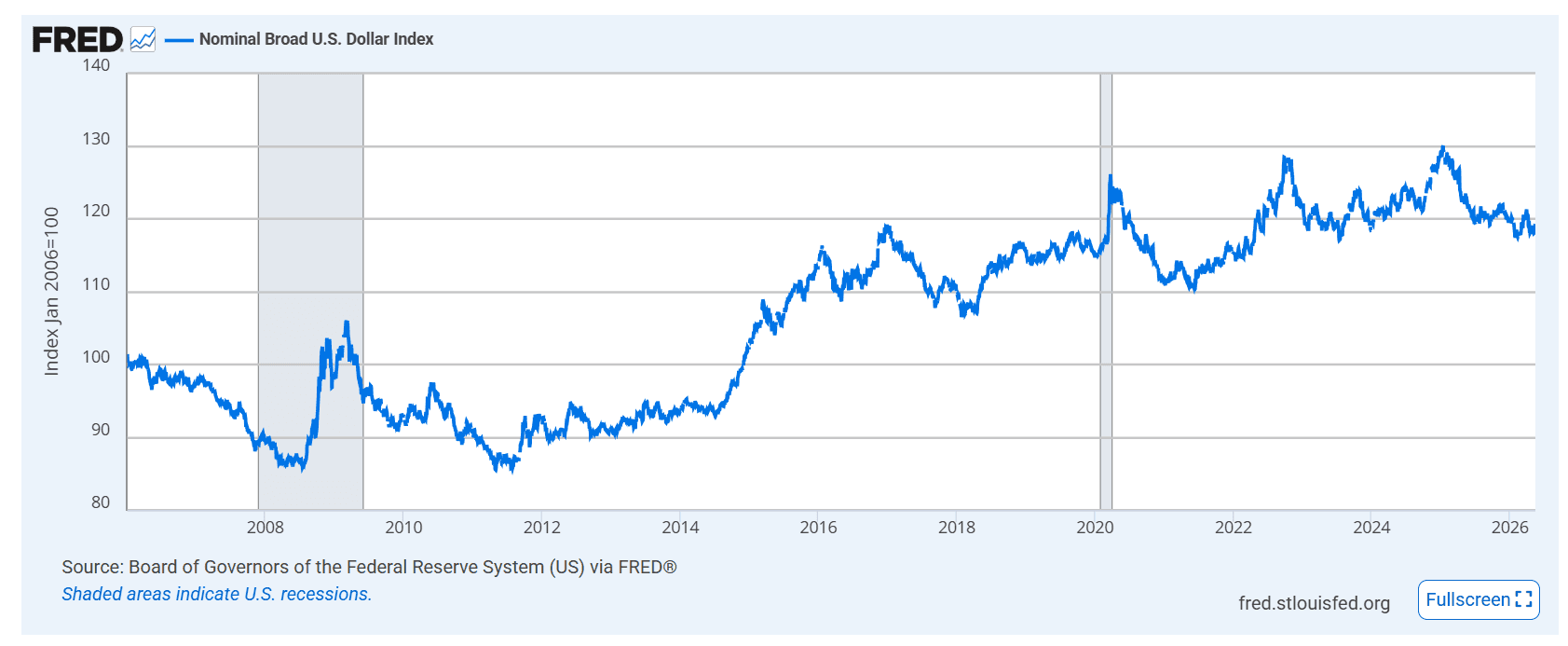
The mechanism is straightforward: a stronger dollar raises the real cost of dollar-denominated debt for foreign borrowers, tightens global financial conditions, and signals that investors are pricing in either Fed hawkishness, geopolitical stress, or both. The result is a broad de-risking across asset classes that plays out in a predictable, though rarely perfectly timed, sequence.
A rising DXY is not just a forex story. It is a macro regime shift that re-prices nearly every asset class simultaneously.
Asset Class Impact — What a Dollar Rally Really Costs You
Dollar rallies do not hit all assets equally. Understanding the transmission is the first step to intelligent dollar rally portfolio positioning.
Equities
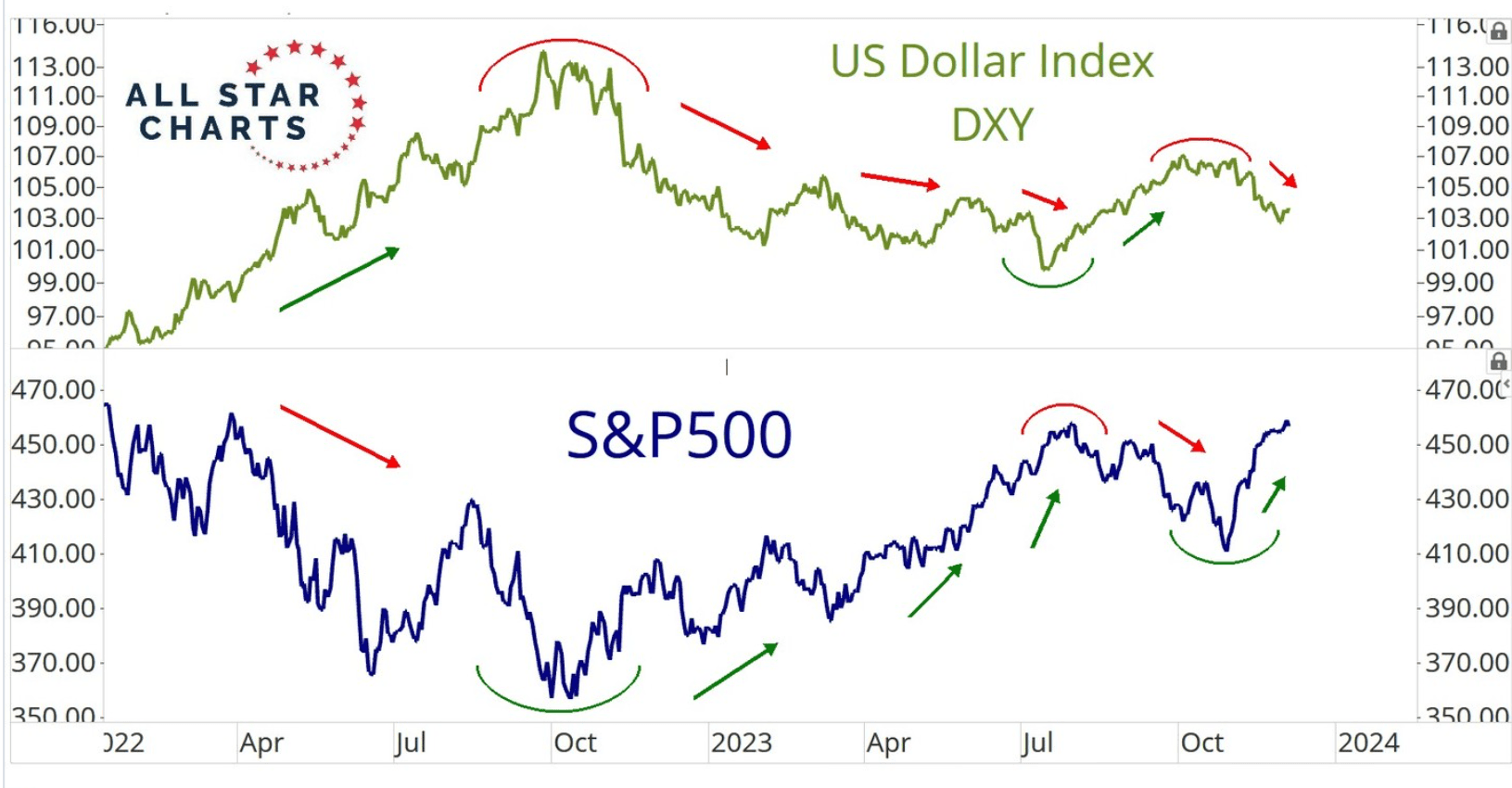
US multinationals with significant overseas revenue are the most direct casualty. A stronger dollar translates foreign earnings back at a discount, compressing margins and EPS without any operational deterioration. Growth and tech stocks — which often carry global revenue exposure and long-duration valuations — tend to underperform, making dollar rallies one of the clearest signals for a sector rotation. Defensive domestics are comparatively insulated.
Commodities
Commodities priced in dollars — oil, gold, copper, agricultural products — face mechanical downward pressure as the dollar rises. They become more expensive for non-dollar buyers, suppressing demand and weighing on spot prices. This is one of the most consistent and well-documented relationships in macro markets.
Emerging Markets
EM assets typically take the hardest hit. Dollar-denominated debt becomes more expensive to service, capital exits in search of higher-yielding dollar assets, and local currencies weaken further — compounding losses for unhedged investors. EM equities and sovereign bonds can sell off sharply even when domestic fundamentals are sound. This is why the case for shifting toward emerging markets looks very different depending on where the dollar is heading.
Forex
For traders with multi-asset exposure, currency impact on equity portfolio returns becomes impossible to ignore. EUR/USD, GBP/USD, and commodity currencies like AUD and CAD all tend to weaken against a surging dollar. Unhedged international equity positions can lose as much from currency as from the underlying asset moves themselves.
How Sophisticated Investors Reposition During Dollar Strength
A strong dollar investment strategy is not about panic selling. It is about systematic rotation. Experienced macro traders typically shift toward domestically-focused equities, short-duration assets, and commodity shorts during sustained dollar rallies. Some add direct DXY trading strategy exposure — going long the index itself or using inverse commodity ETFs as a proxy hedge.
The key insight is that dollar rallies, while directionally consistent in their market impact, are highly variable in duration and velocity. Timing discretionary repositioning accurately, consistently, and without emotional interference is extraordinarily difficult — even for professionals.
Why Discretionary Repositioning Breaks Down in Fast-Moving Markets
The problem with manual, discretionary responses to macro regime shifts is threefold. First, by the time the move is obvious enough to act on, much of it has already happened. Second, the cognitive load of simultaneously monitoring the DXY, adjusting equity exposure, reviewing commodity positions, and managing forex risk is genuinely overwhelming. In fact, even investors who manage that load correctly often stumble on the exit decision itself. Third, emotional anchoring — reluctance to exit a position at a loss even when the macro case has shifted — is nearly universal and nearly always costly.
This is where most high-net-worth investors, despite their sophistication, leave significant performance on the table.
Automated Portfolio Rebalancing — The Systematic Trader's Edge
Automated Portfolio Rebalancing — The Systematic Trader's Edge
Macro investing strategy for traders increasingly points in one direction: automation. Rules-based systems do not hesitate, do not anchor, and do not miss a signal because it arrived at 2am. An automated portfolio rebalancing strategy can be designed to detect dollar strength conditions and reposition accordingly — without human intervention, without emotional drag, and without the latency that costs discretionary traders their edge.
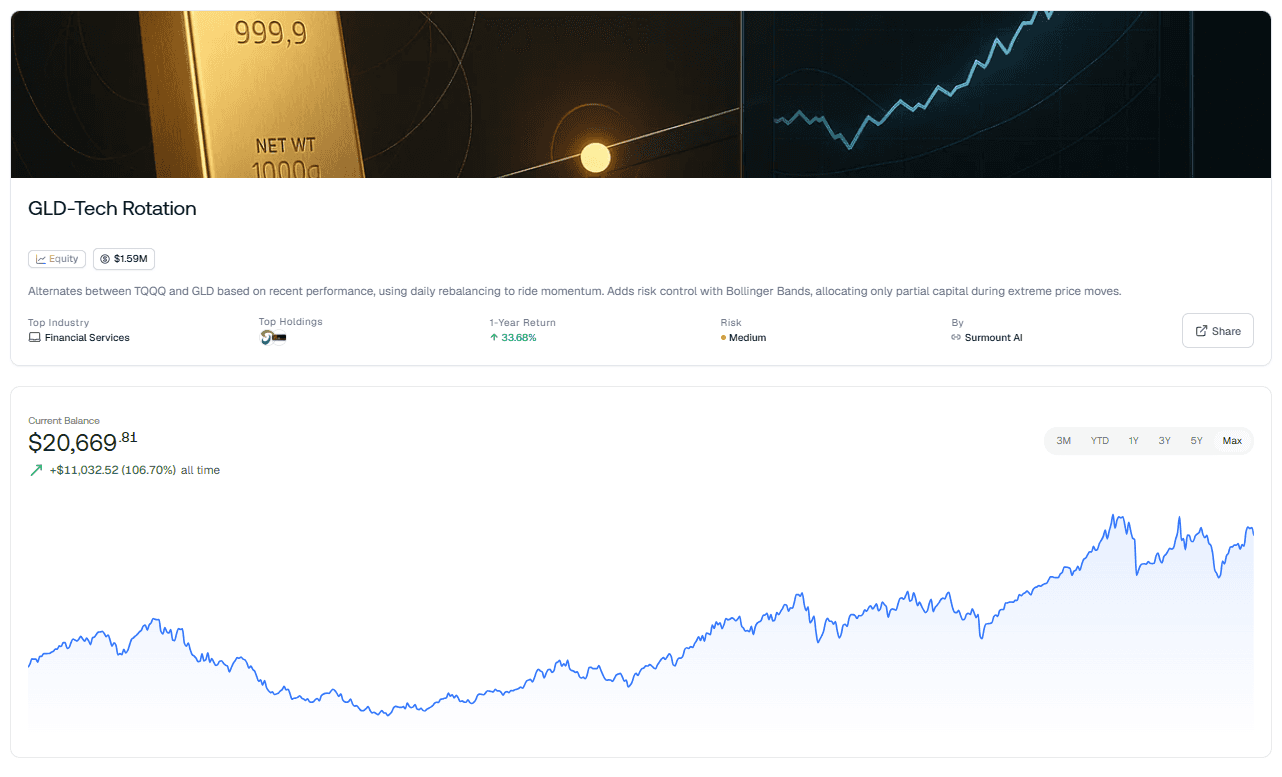
This is exactly where the GLD-Tech Rotation strategy on Surmount AI becomes compelling — and the logic flows directly from everything discussed above.
Here is what you now know from this analysis:
A surging dollar crushes tech and growth equities, particularly those with global revenue exposure. TQQQ — a 3x leveraged ETF tracking the Nasdaq-100 — is about as exposed to that dynamic as any instrument in the market.
At the same time, dollar strength and risk-off rotation historically drive capital into gold as a store of value and safe haven. GLD is the cleanest, most liquid expression of that trade for most investors.
These two assets — tech and gold — do not just move differently during dollar regimes. They often move in opposite directions. That divergence is the edge.
The GLD-Tech Rotation strategy is built to exploit exactly that divergence algorithmically. Here is how it works:
Every day, the strategy evaluates the recent performance of TQQQ and GLD and increases its allocation to whichever is outperforming. It is not predicting the future — it is riding documented momentum, systematically and without hesitation.
It does not go all-in blindly. When recent prices move more than 1.5 standard deviations from the 20-day moving average — a Bollinger Band breach signalling an extreme, potentially unsustainable move — the strategy automatically reduces deployed capital to 50%. This is tail risk management built into the logic, not bolted on as an afterthought.
The result is a strategy that naturally rotates toward gold during dollar strength and risk-off environments, and back toward tech when momentum shifts — without you having to watch a single chart or make a single discretionary call.
This is not a generic "set and forget" allocation. It is a dynamic, momentum-driven, risk-aware rotation engine designed for exactly the kind of macro volatility that a strong dollar environment produces. For investors who have just watched a dollar rally quietly erode their tech-heavy portfolio while gold climbed, the GLD-Tech Rotation strategy is the systematic answer to a problem most are still trying to solve manually.
Deploy the GLD-Tech Rotation strategy directly to your portfolio on Surmount AI — no coding required.
Final Thoughts — Turning Dollar Volatility Into a Repeatable Strategy
Dollar strength is not a random event. It follows identifiable macro conditions — Fed policy divergence, global risk aversion, geopolitical stress — and it produces identifiable market outcomes. The investors who benefit from it are not the ones who react fastest. They are the ones who have already defined their rules and trusted a system to execute them.
Volatility in the DXY is not a problem to endure. With the right strategy, it is an edge to exploit.
Surmount AI lets you build and automate macro-aware trading strategies — no coding required. Explore pre-built strategies designed for exactly these market conditions, or build your own using our strategy library.
Frequently Asked Questions
What does a strong dollar mean for investment portfolios?
A strong dollar typically pressures international equities, commodities, and emerging market assets by tightening global financial conditions and compressing foreign earnings. It signals a risk-off environment where portfolio positioning needs to shift accordingly.
Why does a dollar rally hurt commodity prices?
Commodities are priced in dollars, so when the dollar strengthens, they become more expensive for foreign buyers — suppressing demand and pushing spot prices lower. This makes dollar rally portfolio positioning critical for anyone with commodity exposure.
How should traders adjust their strategy during a DXY uptrend?
A solid DXY trading strategy involves rotating toward domestically-focused equities, reducing EM and commodity exposure, and considering short-duration assets. Automating this rotation removes the emotional drag that makes discretionary repositioning unreliable.
When does dollar strength become a risk-off signal for markets?
Dollar strength becomes a risk-off signal when it accelerates sharply — often driven by Fed policy divergence, geopolitical stress, or a flight to safety. A risk-off trading strategy anticipates these conditions rather than reacting to them after the damage is done.
How can I automate my portfolio rebalancing during volatile macro conditions?
Automated portfolio rebalancing strategy tools like Surmount AI let you set rules-based triggers that reposition your portfolio in response to macro signals — without manual intervention or emotional decision-making.

Automate any portfolio using data-driven strategies made by top creators & professional investors. Turn any investment idea into an automated, testable, and sharable strategy.