The Sector Rotation ETF Strategy: How to Move With the Market Cycle
Surmount Blogs
Sector rotation ETF strategy explained: how to shift between sectors across the economic cycle to reduce risk and actually stay ahead of the market.

The Sector Rotation ETF Strategy: How to Move With the Market Cycle
A sector rotation ETF strategy is one of the most actionable ways to align your portfolio with where the economy is heading — not where it's been. Instead of holding the same mix regardless of conditions, you shift exposure between sectors based on the economic cycle, using ETFs to move in and out quickly and cheaply.
This isn't a passive approach. It requires understanding the cycle, monitoring signals, and acting before the crowd. Done right, it can meaningfully outperform a static allocation over a full cycle.
Why Sector Rotation ETF Strategy Works
Different sectors of the economy don't move in sync. Financials boom when credit loosens. Energy surges when demand peaks. Healthcare holds up when everything else falls. These patterns repeat — not perfectly, but consistently enough to trade.
The reason sector rotation investing has endured as a strategy is structural: it maps to how capital flows through a real economy. Interest rates, inflation, consumer confidence, and corporate earnings all behave differently across cycle phases — and markets price those differences into sector performance before they show up in the data.
ETFs make the strategy practical. Without them, you'd have to buy dozens of individual stocks to get sector exposure. With a single ETF like XLE (Energy) or XLV (Healthcare), you're in — and you can rotate out just as fast.
The Four Phases of ETF Sector Rotation
The economy moves through a cycle. Each phase rewards different sectors. Here's how to map them:
Phase | Conditions | Favored sectors | ETF examples |
Early expansion | Rates falling, credit loosening, consumer confidence rising | Financials, Consumer Discretionary, Industrials | XLF, XLY, XLI |
Late expansion | Inflation rising, demand near peak, tight labor market | Energy, Materials, Commodities | XLE, XLB, GLD |
Contraction | Growth slowing, earnings falling, risk-off sentiment | Consumer Staples, Healthcare, Utilities | XLP, XLV, XLU |
Recovery | Stimulus kicks in, expectations rebound before data does | Technology, Cyclicals | XLK, XLC |
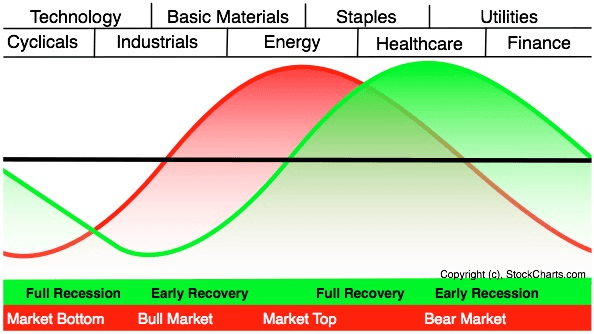
The tricky part is when the market starts pricing in the next phase 3–6 months before it officially begins. You're not rotating based on current headlines, but on where the cycle is going.
How to Rotate Sectors: Three Approaches
1. Macro-driven rotation
You read the economic signals, such as yield curve, Fed rate decisions, PMI data, credit spreads, and then manually decide which phase you're in. Then you tilt toward the sectors that historically outperform in that phase.
This is the most intellectually involved approach. It rewards research and punishes overconfidence. The cycle doesn't follow a script.
2. Momentum-based rotation
Rather than forecasting the cycle, you follow price. You hold the sectors with the strongest relative performance over the past 1–3 months and rotate into new leaders as rankings shift.
This is more systematic. It doesn't require you to predict anything. You would generally just measure and rebalance. The downside of this approach is that momentum strategies can be late to turn at cycle inflection points.
3. Relative strength rotation
Similar to momentum, but you explicitly compare sectors against each other or a benchmark. You hold the top 2–4 sectors by relative strength and exit when they fall out of ranking.
All three approaches benefit from automation. Manually tracking 11 sectors, recalculating rankings, and executing trades on schedule is error-prone. That's where a platform like Surmount.ai and its library of prebuilt strategies makes the difference. The logic runs without you having to remember to run it.
Signals to Watch for Sector Rotation Investing
No single indicator predicts the cycle perfectly, but these are the most reliable inputs:
Yield curve shape: A steepening curve typically signals early expansion. An inverted curve warns of contraction ahead.
Fed funds rate direction: Rising rates tend to pressure rate-sensitive sectors (Utilities, REITs) and support Financials. Falling rates do the opposite.
ISM Manufacturing PMI: Above 50 signals expansion; below 50 signals contraction. Watch the direction of change, not just the level.
Consumer confidence: Surges before Consumer Discretionary outperformance; tends to collapse before defensive sectors take over.
Earnings revision trends: When analysts are upgrading estimates in a sector, institutional money is often already flowing in.
You don't need all signals to align. A weight-of-evidence approach (where 3 of 5 signals point the same direction) is more reliable than waiting for certainty that never comes.
The Risks of a Sector Rotation ETF Strategy
This strategy has real edges — and real failure modes. Know both before deploying capital.
Timing risk
The cycle doesn't announce itself. You'll rotate into Energy right as inflation peaks, or into Financials right before a credit event. No strategy eliminates this. The goal is to be right more often than wrong over a full cycle.
Transaction costs and taxes
Frequent rotation generates short-term capital gains, which are taxed at ordinary income rates if you're in a taxable account. Running this strategy inside a tax-advantaged account (IRA, 401k) eliminates that drag. Check Surmount's pricing for account options.
Concentration risk
If you rotate aggressively, you may end up with 60–80% in one or two sectors. That's a feature when you're right — and painful when you're not. Most practitioners cap any single sector at 30–40% of the portfolio.
Over-trading on noise
Economic data is noisy. Rebalancing too frequently — weekly or even monthly — often captures noise, not signal. Quarterly rebalancing is the most common cadence for macro-driven approaches. Momentum strategies may rebalance monthly but with stricter rules to avoid whipsawing.
Building Your Own Sector Rotation ETF Strategy
If you want to run this yourself, here's a simple framework to start:
Pick your universe: the 11 SPDR Select Sector ETFs (XLB, XLC, XLE, XLF, XLI, XLK, XLP, XLRE, XLU, XLV, XLY) cover the S&P 500 by sector.
Choose your signal: macro signals for a fundamentals-driven approach, 3-month returns for momentum.
Set your allocation rules: hold the top 3 sectors by your signal, equally weighted, rebalanced monthly or quarterly.
Set your exit rules: if a sector falls below its 200-day moving average, exit regardless of relative ranking.
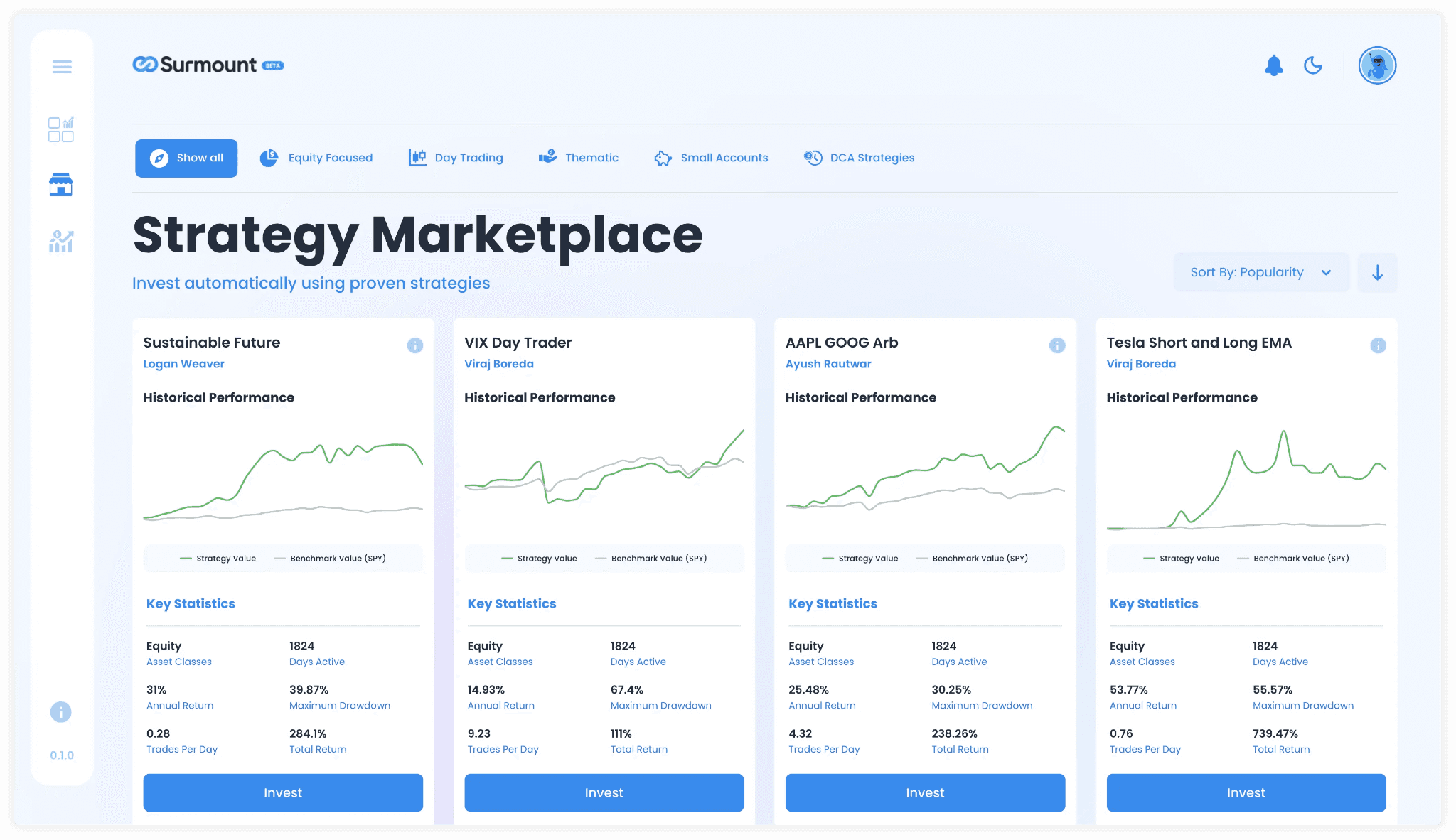
Automate it: a rules-based strategy running on autopilot removes emotion from the rotation decisions. Explore pre-built ETF rotation strategies on Surmount if you'd rather deploy a tested approach than build from scratch.
Frequently Asked Questions
What is sector rotation in ETF investing?
Sector rotation is the practice of shifting your portfolio between different stock market sectors — like Technology, Energy, or Healthcare — based on where you are in the economic cycle. ETFs make this practical by giving you low-cost, single-trade access to each sector.
How often should you rotate sectors?
Most macro-driven strategies rebalance quarterly. Momentum-based strategies often rebalance monthly. More frequent rotation usually captures noise rather than genuine signal, and increases transaction costs and tax drag.
What ETFs are used for sector rotation?
The SPDR Select Sector ETFs (XLK, XLE, XLF, XLV, XLP, XLU, XLI, XLB, XLC, XLRE, XLY) are the most commonly used. They're liquid, low-cost, and cover the full S&P 500 sector breakdown.
Does sector rotation actually outperform a simple index?
Historically, well-designed momentum-based and macro-driven rotation strategies have shown long-term outperformance versus a static S&P 500 allocation — but not in every market environment. Performance depends heavily on the signal used, rebalancing frequency, and whether you're in a trend-driven or choppy market.
Can you automate a sector rotation strategy?
Yes — and it's often better that way. Automation enforces discipline, removes emotional override, and ensures you rebalance on schedule. Platforms like Surmount let you deploy rules-based rotation strategies directly from the marketplace without coding anything yourself.

Automate any portfolio using data-driven strategies made by top creators & professional investors. Turn any investment idea into an automated, testable, and sharable strategy.