Should Investors Shift Focus From U.S. Stocks to Emerging Markets in 2026?
Surmount Blogs
Emerging markets surged 30%+ in 2025 while trading at 40% discounts to U.S. stocks. Discover why 2026 may mark a turning point in global equity leadership.

For the first time in nearly a decade, emerging markets are commanding serious attention. After years of watching U.S. equities dominate global returns, institutional investors are asking a question that seemed almost heretical 18 months ago: has the investment landscape fundamentally shifted?
The numbers demand attention. CNN Business reports that while the S&P 500 gained 16.39% in 2025, the MSCI All Country World ex-USA surged 29.2%. Countries from Greece to South Korea posted extraordinary gains, driven by semiconductor strength, dollar weakness, and attractive valuations that made even skeptical wealth managers reconsider their portfolios.
The Valuation Gap Has Reached Historic Extremes
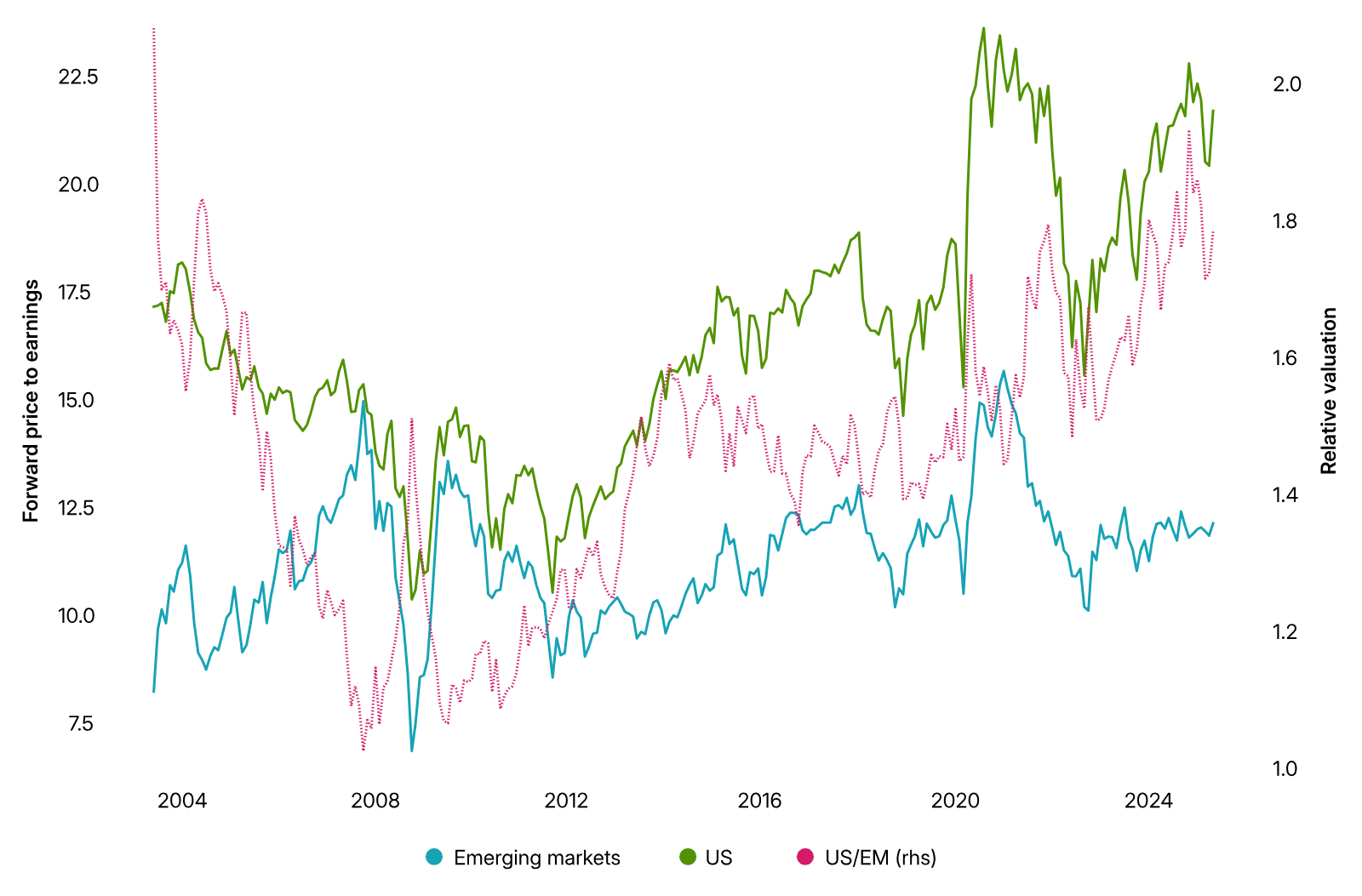
MSCI's research shows that as of May 2025, U.S. equities traded at over 21 times forward earnings compared to 12 times for emerging markets—one of the widest spreads in two decades.
Key valuation metrics:
U.S. forward P/E: 22x (matching 2021 peaks)
Emerging markets forward P/E: 12x (40% discount)
S&P 500 equity risk premium: Just 0.02% above 10-year Treasuries
Goldman Sachs projects S&P 500 earnings will grow roughly 12% in 2026—solid, but from historically expensive levels. When investors accept equity volatility without adequate compensation above bonds, it suggests either irrational exuberance or expectations of flawless execution. History suggests betting on perfection rarely works.
The Dollar's Decline Is Reshaping Capital Flows
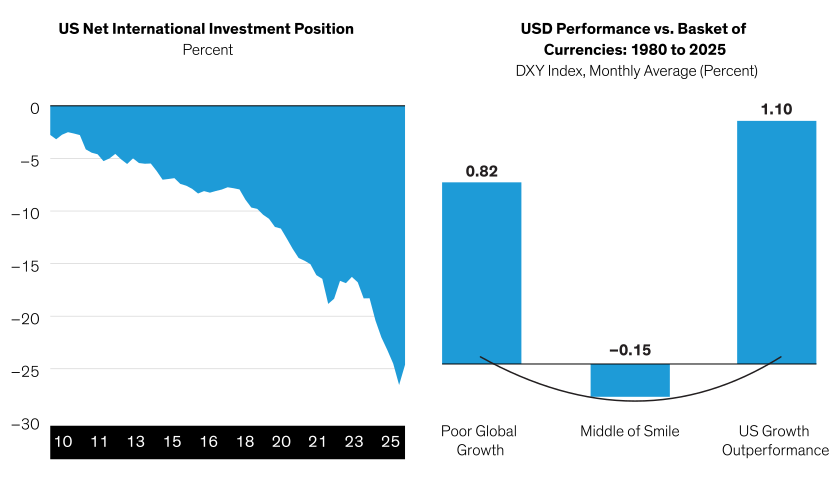
Perhaps the most structurally significant shift involves the U.S. dollar itself. Morningstar's analysis shows the dollar fell nearly 10% through September 2025, driven by narrowing interest rate differentials, persistent fiscal deficits, and diminishing confidence in "U.S. exceptionalism."
Why this matters for emerging markets:
Historical pattern: EM equities outperform developed markets during dollar weakness
Debt servicing: Cheaper dollar reduces burden of dollar-denominated debt
Capital flows: AllianceBernstein estimates a 1% dollar decline triggers $360-440 million in EM inflows
Currency translation: For U.S. investors, weak dollar enhances foreign equity returns
Despite 2025's decline, the dollar remains elevated relative to long-term averages. Among 34 major currencies tracked by Morningstar, only nine are more overvalued than the U.S. dollar—suggesting further room for depreciation.
Beyond China: A More Nuanced Story
The conversation inevitably leads to China—and this requires sophisticated analysis rather than broad brushstrokes.
China's reality:
Structural headwinds: property sector contraction, weak private consumption
Growth stabilizing at slower pace than historical norms
DeepSeek AI breakthrough shows continued technological competitiveness
Emerging markets ex-China tell a different story:
South Korea & Taiwan: Core of AI semiconductor supply chain, trading at significant discounts to U.S. tech
India: 6.7% projected 2026 growth, driven by demographics and domestic consumption
Brazil: Improved inflation outlook and political shifts restoring confidence
Indonesia: Pro-growth reforms creating opportunities in consumer sectors
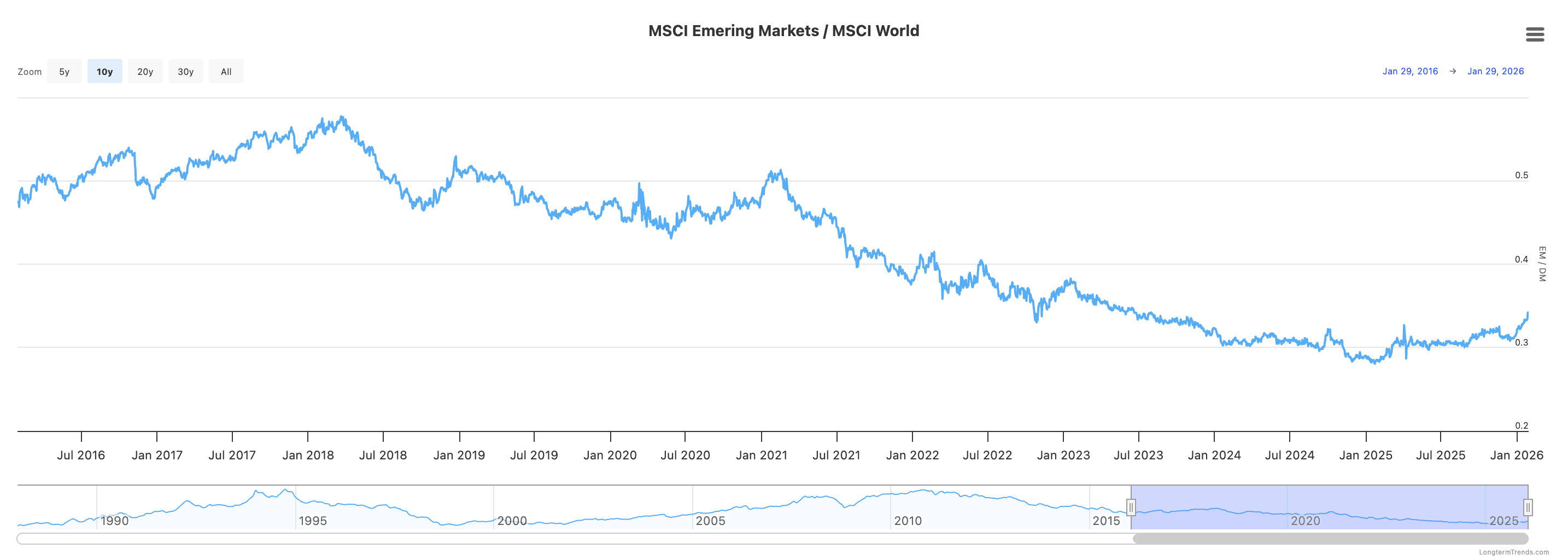
MSCI data shows rolling six-month correlations between EM and developed market equities fell below 0.45 by May 2025—the lowest level in five years. This suggests forces moving EM prices are distinct from developed markets, offering genuine diversification benefits.
The Risks Remain Real
None of this suggests emerging markets are without serious risks:
U.S. tech concentration reflects genuine advantages:
Magnificent 7 posted 28% earnings growth vs. 12% for broader S&P 500
Fortress balance sheets with massive free cash flow
If AI capex continues delivering productivity gains, current multiples may be justified
Geopolitical uncertainties:
China-Taiwan tensions
India's balancing act between U.S. and Chinese interests
Trade policy forcing binary alignment rather than multi-system positioning
Country-level challenges:
Performance dispersion across emerging markets
Credit quality still lags developed markets
Institutional weaknesses in some economies
What This Means for Portfolio Construction
The evidence suggests 2026 isn't about choosing between U.S. and emerging markets—it's about recognizing that overconcentration in either represents distinct risk.
Goldman Sachs notes that geographic diversification benefited investors in 2025 for the first time in nearly 15 years, and they expect this trend to continue. When one market trades at historically high multiples while another sits at 40% discounts with comparable growth prospects, rebalancing becomes mathematical rather than speculative.
The challenge most investors face:
Emotional attachment to recent winners
Home country bias
Complexity of evaluating individual EM securities
Behavioral friction preventing optimal allocation
This is where modern portfolio automation delivers value. Platforms enabling rules-based rebalancing, tax-loss harvesting across global positions, and systematic exposure management remove behavioral barriers. The ability to design custom strategies that automatically adjust geographic allocations based on valuation metrics, momentum signals, or macroeconomic indicators means capturing emerging market opportunities without constantly monitoring political developments.
For financial advisors, demonstrable methodology matters. Automated investment platforms that document allocation rationale, backtest scenarios, and execute rebalancing with precision provide infrastructure making sophisticated global diversification scalable.
The Bottom Line
Should investors shift from U.S. stocks to emerging markets? The precise answer: shift from concentration to diversification. For the first time in years, emerging markets offer compelling risk-adjusted return potential that makes geographic balance prudent rather than speculative.
Wall Street consensus projects roughly 9% upside for U.S. markets in 2026, while emerging markets could deliver mid-teens returns. Even if both estimates prove optimistic, the directional implication is clear: automatic U.S. outperformance has ended.
What hasn't changed is the fundamental truth about long-term wealth creation: diversification, systematic rebalancing, and disciplined execution consistently beat market timing. The investors who thrive in 2026 won't perfectly predict which market wins—they'll be those whose portfolio infrastructure captures value wherever it emerges, with transparency and automation that modern technology makes possible.

Automate any portfolio using data-driven strategies made by top creators & professional investors. Turn any investment idea into an automated, testable, and sharable strategy.