How to Invest Like George Soros: Risking Little to Win Big
Surmount Blogs
Learn how to invest like George Soros using asymmetric bets, macro thinking, and high-conviction position sizing.

How to Invest Like George Soros: Risking Little to Win Big
What if you could make a billion dollars in a single day — not by luck, but by being systematically right when everyone else was wrong? That's exactly what George Soros did on September 16, 1992. He shorted the British pound, the Bank of England pushed back, and walked away with over $1 billion in profit. Knowing how to invest like George Soros starts with understanding the logic behind that trade — and why it was anything but a gamble.
Investors who want to know how to invest like George Soros aren't chasing a legend — they're learning a repeatable framework for finding structural mispricings, building asymmetric bets, and sizing positions with conviction.
Who Is George Soros and Why Should Investors Study Him?
Born in Budapest in 1930, Soros built one of the most successful hedge funds in history. His Quantum Fund averaged roughly 30% annual returns over several decades — a record almost no institutional investor has matched.
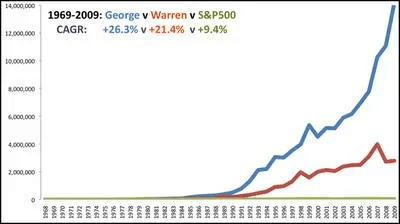
What makes Soros worth studying isn't his wealth. It's his method. While most investors react to markets, Soros built a framework for anticipating how they would move — structuring trades to profit when right and cap the damage when wrong. His approach differs sharply from the passive diversification of investors like Ray Dalio's All Weather Strategy, or the patient compounding of Warren Buffett's Snowball Method — both of which prioritise stability and time in the market over high-conviction, asymmetric bets
The Theory Behind the Trades: Soros' Reflexivity Explained
Most investment theory assumes markets are rational. Soros rejected this entirely. His theory of reflexivity argues that investors don't just observe reality — they shape it. Beliefs influence prices, and those prices feed back into fundamentals, creating self-reinforcing cycles of boom and bust.
This isn't academic. It's a trading edge. If markets overshoot because of feedback loops rather than fundamentals, a disciplined investor can position ahead of the correction.
Why Markets Are Always Wrong (And How Soros Profited From It)
When the British pound was pegged to the Deutsche Mark at an unsustainable rate, most participants assumed the government would hold the line. Soros recognised that reflexive pressure — speculators selling, reserves depleting, confidence eroding — made the peg structurally self-defeating. Understanding that mechanism, not just the imbalance, is how to invest like George Soros at his most dangerous.
The Asymmetric Bet: Soros' Core Trading Philosophy
The asymmetric bet is the clearest answer to the question of how to invest like George Soros. Every trade starts with one question: what is my worst case, and is the best case worth it? An asymmetric risk reward structure is one where potential upside far exceeds defined downside. In 1992, the worst case was the cost of carrying a short position. The best case — the complete collapse of the peg — he assessed as near-inevitable.
Sizing Your Position: How Soros Knew When to Go Big
Soros' position sizing strategy was directly tied to conviction. The more clearly he saw the imbalance, the more capital he committed — his short sterling position reportedly reached $10 billion. That wasn't recklessness; it was the logical consequence of high confidence in a bounded downside. This is the same principle that underpins modern drawdown control in algorithmic systems.
The lesson: size small when your thesis is developing, size large when the evidence is overwhelming and the downside is well-defined.
High-Conviction Investing: When to Back Your Thesis Fully
Soros has said it's not whether you're right or wrong that matters — it's how much you make when right and how little you lose when wrong. High conviction investing isn't about certainty. It's about the quality of your reasoning relative to market consensus. When that gap is large and your downside is capped, that's when to act.
Soros' Global Macro Strategy: Reading the World Before the Market Does
Soros operates top-down. Before a single instrument is considered, he forms a view on currencies, interest rates, capital flows, and geopolitics. Global macro investing strategies require a different skill set to stock-picking — you're looking for mispriced regimes, not undervalued companies.
How to Build a Macro Trading Strategy Inspired by Soros
A Soros-inspired macro trading strategy has four elements: a structural thesis, a catalyst, a trade expression, and a pre-defined exit. Without that fourth element, the first three are speculation, and knowing when to exit a position is where most investors systematically fail.
Ultimately, the discipline of knowing in advance when you're wrong is what separates a real macro trading strategy from macro storytelling.
Automating the Soros Approach: Algorithmic Macro Trading on Surmount
The hardest part of a Soros-style strategy isn't finding the opportunity — it's maintaining discipline when the trade moves against you before it moves in your favour.
Surmount's algorithmic macro trading tools let you encode your thesis as a rules-based strategy, defining entry conditions, position sizing, and exit triggers in advance. Our macro strategy library includes pre-built global macro approaches you can connect to your existing portfolio and backtest across different market regimes before committing capital.
This is how to invest like George Soros with the discipline he applied — and the consistency most discretionary traders struggle to maintain.
How to Position for It: The GLD-Tech Rotation Strategy
Everything Soros built his edge on — reading macro regimes, rotating capital toward the strongest opportunity, and pulling back when conditions turned extreme — is exactly what Surmount's GLD-Tech Rotation strategy is engineered to do automatically.
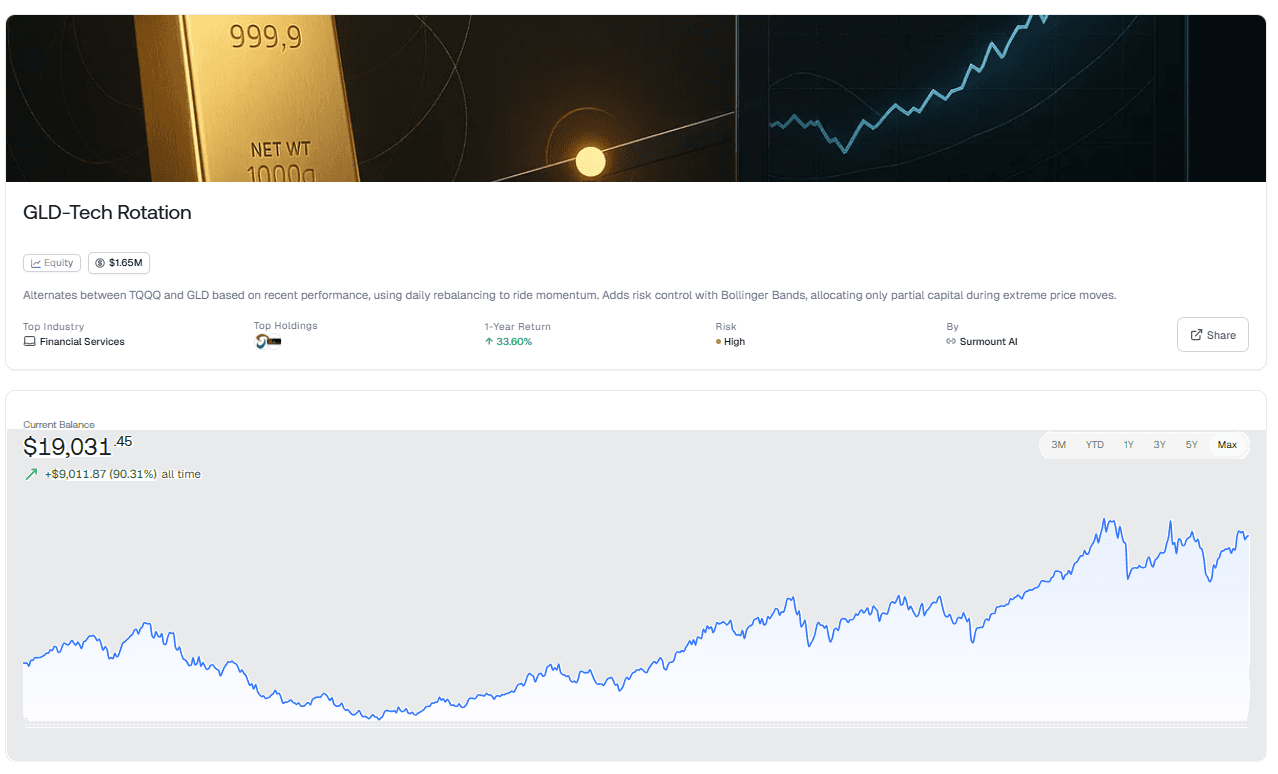
Here's how the logic maps directly to what you've just learned.
The strategy rotates daily between TQQQ (leveraged tech exposure, the high-conviction growth bet) and GLD (gold, the defensive anchor when uncertainty spikes) based on which asset is showing stronger recent performance.
When tech momentum is dominant, the strategy presses into it — Soros-style conviction sizing.
When the macro environment shifts and risk rises, it rotates into gold, capping the downside before it compounds.
The Bollinger Band filter is where it gets particularly Soros-like: if prices move more than 1.5 standard deviations from their 20-day average, the strategy automatically reduces its exposure to just 50% of capital.
That's a built-in reflexivity check — recognising when market conditions have become extreme, and refusing to chase the crowd into a mispricing. Soros called this kind of discipline the difference between a good trade and a catastrophic one.
What makes this strategy worth deploying right now is the macro backdrop itself. Tech valuations remain stretched by historical standards while gold continues to attract institutional safe-haven flows — exactly the kind of structural divergence that Soros built his career identifying. The GLD-Tech Rotation strategy doesn't ask you to predict which way the regime breaks. It positions you to profit from either outcome, dynamically, with risk controls already built in.
This is asymmetric investing in its most accessible form. You don't need a billion-dollar fund or a team of macro analysts. You need a rules-based system that thinks the way Soros does — and the discipline to let it run.
Deploy the GLD-Tech Rotation Strategy on Surmount →
What Soros Would Say About Today's Markets
Soros' framework is more relevant now than at almost any point since 1992. Central bank policy remains unconventional. Emerging market currencies are under pressure. Reflexive sentiment cycles — amplified by automated trading strategies for investors and social media — are producing faster mispricings than ever.
The playbook is unchanged: find the structural imbalance, map the feedback loop, define your downside, and act with high conviction investing discipline when the evidence is overwhelming. The instruments change. The logic doesn't.
FAQ: How to Invest Like George Soros
What is George Soros' investment strategy?
Soros built his returns on reflexivity theory and asymmetric bets — identifying structural market mispricings where the downside was capped and the upside was open-ended.
How to invest like George Soros without a billion-dollar fund?
The core of how to invest like George Soros is disciplined position sizing and a pre-defined exit — principles any investor can apply through a rules-based macro trading strategy.
What is reflexivity theory and why does it matter for traders?
Reflexivity means market participants don't just reflect reality — they shape it, creating feedback loops that produce predictable mispricings a prepared investor can exploit.
Why does Soros use asymmetric risk reward instead of diversification?
High conviction investing, sized aggressively when the downside is bounded, generates far greater returns than spreading capital thinly across many positions with average conviction.
How can I automate a global macro investing strategy today?
Platforms like Surmount AI let you encode a macro trading strategy as a rules-based algorithm — removing emotional decision-making and executing with the same discipline Soros applied manually.

Automate any portfolio using data-driven strategies made by top creators & professional investors. Turn any investment idea into an automated, testable, and sharable strategy.