Is the AI Bubble Going to Burst? What to Know
Surmount Blogs
Is the AI bubble going to burst? We break down circular financing risks and how to protect your portfolio.

Is the AI Bubble Going to Burst? What to Know
If you've spent any time in investing forums lately, you've likely seen the same question surface again and again: is the AI bubble going to burst? It's a fair question. AI stocks have driven a massive share of market gains over the past two years, and the companies at the center of it all — OpenAI and Anthropic — are burning through cash at a staggering rate while the cloud giants funding them keep raising their spending targets. So is the AI bubble going to burst, or is this just what a new technology cycle looks like from the outside? Let's look at what the data actually shows.
What's Fueling AI Bubble Fears in 2026
The core worry isn't that AI doesn't work — it clearly does, and demand keeps climbing. The worry is about who's actually paying for it. A growing share of cloud revenue at Google, Microsoft, and Amazon now traces back to just two companies: OpenAI and Anthropic. Neither is profitable in any traditional sense. Critics call this "AI circular financing" — cloud providers investing in AI labs, which then spend much of that capital right back on cloud infrastructure from the same providers. It's a tight, self-reinforcing loop, and any weak link could ripple outward fast.
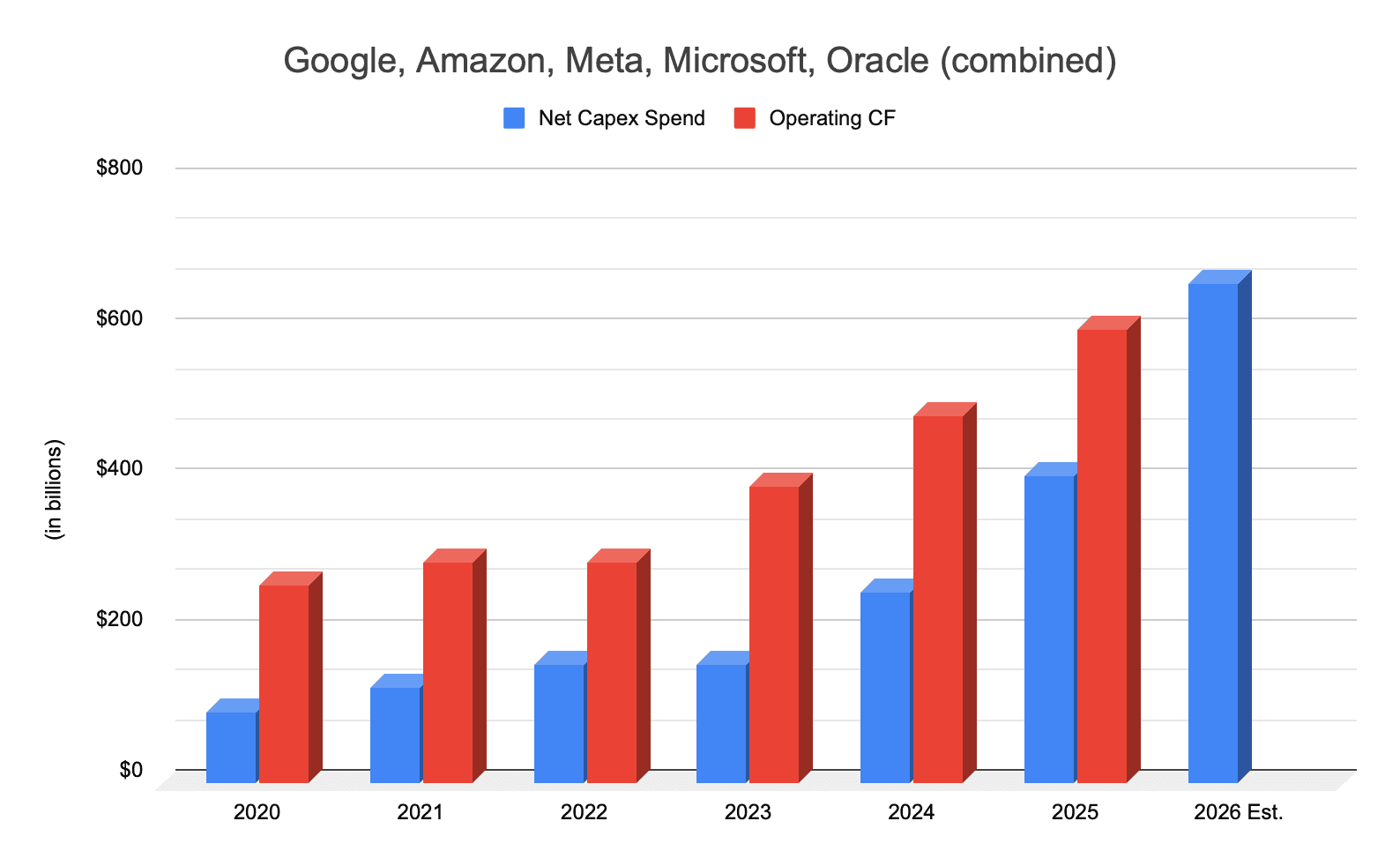
Why Investors Are Worried About AI Circular Financing
How Hyperscaler AI Revenue Is Concentrated in Two Companies
Estimates from UBS and Barclays suggest a meaningful chunk of Google Cloud and Microsoft Azure's growth is now tied to OpenAI and Anthropic specifically, with that share projected to climb further into 2027. Microsoft's cloud segment growth has reportedly leaned heavily on OpenAI alone. Meanwhile, OpenAI has posted losses in the tens of billions, and neither company generates the cash flow needed to cover its own infrastructure bills without repeatedly raising outside capital — some of which comes from the very cloud providers they're paying.
That's the concentration risk skeptics point to when asking whether the AI bubble is going to burst: two customers, both unprofitable, representing an outsized and growing slice of hyperscaler AI revenue.
Are AI Stock Valuations Justified by Real Demand?
The counterargument leans on backlog data. Hyperscalers have reported hundreds of billions of dollars in committed customer contracts — a figure that's grown by double digits quarter over quarter, a trend visible in S&P Dow Jones Indices' market concentration research.
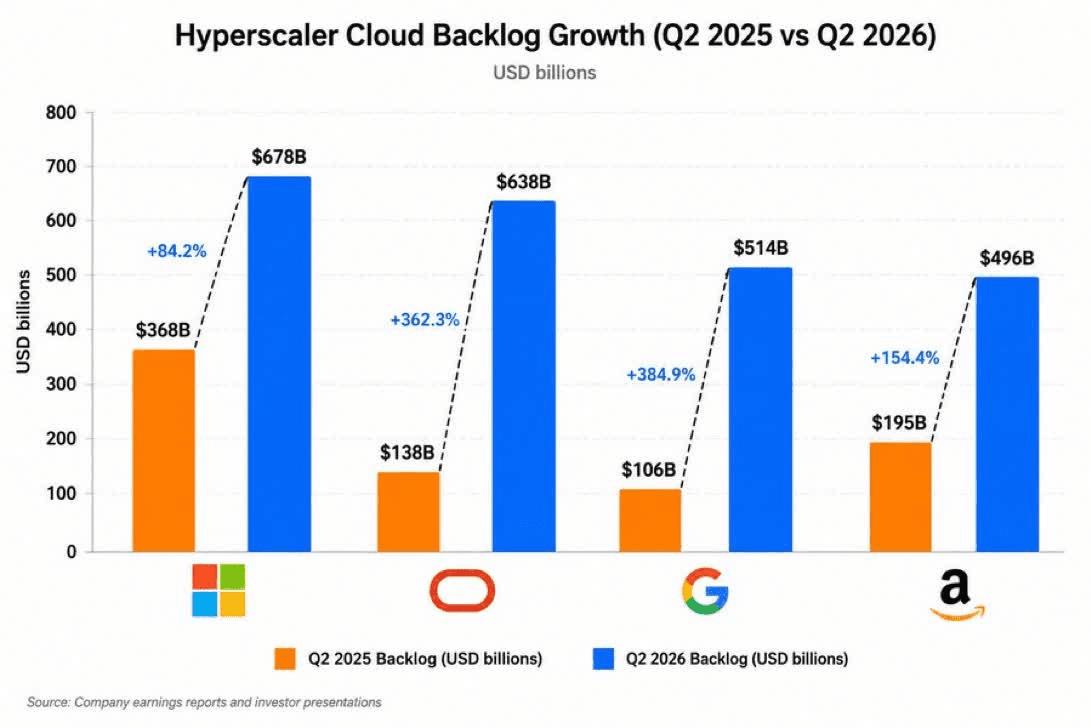
Cloud providers describe themselves as supply-constrained, not demand-constrained — and learning to read capex signals early can help investors spot which companies are genuinely growing into their spending. This means that they're struggling to build data centers fast enough rather than struggling to fill them. That's a materially different picture than a bubble with no real underlying revenue.
Still, backlog isn't cash in hand, and current AI stock valuations largely assume that today's customers keep raising money indefinitely to pay their bills. The CFA Institute's research on equity valuation risk points to exactly this kind of assumption-dependent pricing as a red flag worth monitoring — learning to read capex signals early can help investors spot which companies are genuinely growing into their spending.
The Case Against an Imminent AI Bubble Burst
Why AI Capex Spending May Be More Sustainable Than It Looks
It's worth separating "risky" from "about to collapse." Recent hyperscaler earnings show AI capex spending climbing toward the trillion-dollar range over the next two years — a trend we've examined in detail before, against a broader backdrop of rising corporate capital investment tracked by
FRED's data on nonresidential fixed investment, but increasingly backed by long-term customer commitments rather than speculative bets. Much of the new capital raised has come through long-dated debt — often maturing decades out — which analysts have characterized as balance-sheet optimization rather than a sign of funding stress.
Free cash flow margins are expected to dip over the next couple of years as spending ramps, then recover as AI infrastructure investments mature and utilization improves. That's a meaningfully different setup than the dot-com era, where capital was far more speculative and revenue was often theoretical. Here, the infrastructure is being built against real, contracted demand — even if that demand is currently concentrated in a handful of names.
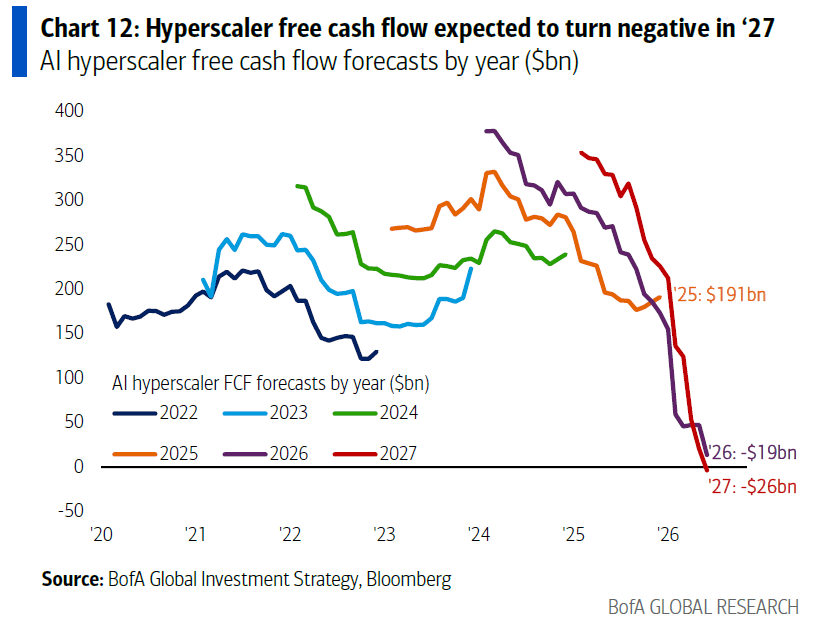
None of this means AI investment risk isn't real. It means the picture is more nuanced than a simple yes-or-no answer to whether the AI bubble is going to burst. McKinsey Global Institute's research on AI's economic impact suggests the productivity gains needed to justify this spending are still an open question — one worth watching closely over the next several quarters.
How to Protect Your Portfolio From a Market Correction
Whether or not this particular bubble pops, concentration risk in a portfolio is always worth managing — especially when so much of the market's recent gains trace back to a small handful of interconnected companies. Investor.gov's guidance on concentration risk reinforces that diversification isn't just good practice — it's foundational risk management. A few practical steps:
Avoid overexposure to any single theme. If AI names make up an outsized share of your holdings, consider whether that concentration matches your actual risk tolerance.
Watch AI capex spending-to-cash-flow trends, not just revenue headlines, when evaluating AI-linked companies.
Build in downside protection rather than trying to time an exact top (this is where proven drawdown control techniques become useful)
Diversify across uncorrelated assets like defensive sectors or hard assets that don't move in lockstep with tech sentiment.
Why Systematic Investors Use Volatility-Based Protection
This is exactly the scenario systematic, rules-based strategies are built for — not predicting whether or when a correction hits, but automatically adjusting exposure based on real-time volatility and momentum signals, so your portfolio isn't fully exposed if sentiment turns quickly. It's also why volatility itself can be treated as an opportunity rather than just a threat, when your portfolio adjusts automatically.
Turn AI Bubble Anxiety Into a Systematic Edge
If the question "is the AI bubble going to burst" has you second-guessing your tech exposure, the answer isn't necessarily to sell everything and sit in cash — it's to stop betting on a single outcome. That's exactly the problem GLD-Tech Rotation is built to solve.
This strategy holds a dynamic position between TQQQ (leveraged tech exposure) and GLD (gold), automatically shifting capital toward whichever asset has been the stronger recent performer. When tech momentum is strong, you're positioned for the upside. When sentiment turns and capital rotates toward safety, the strategy rotates with it — no manual rebalancing, no emotional decision-making, no trying to call the exact top of an AI rally.
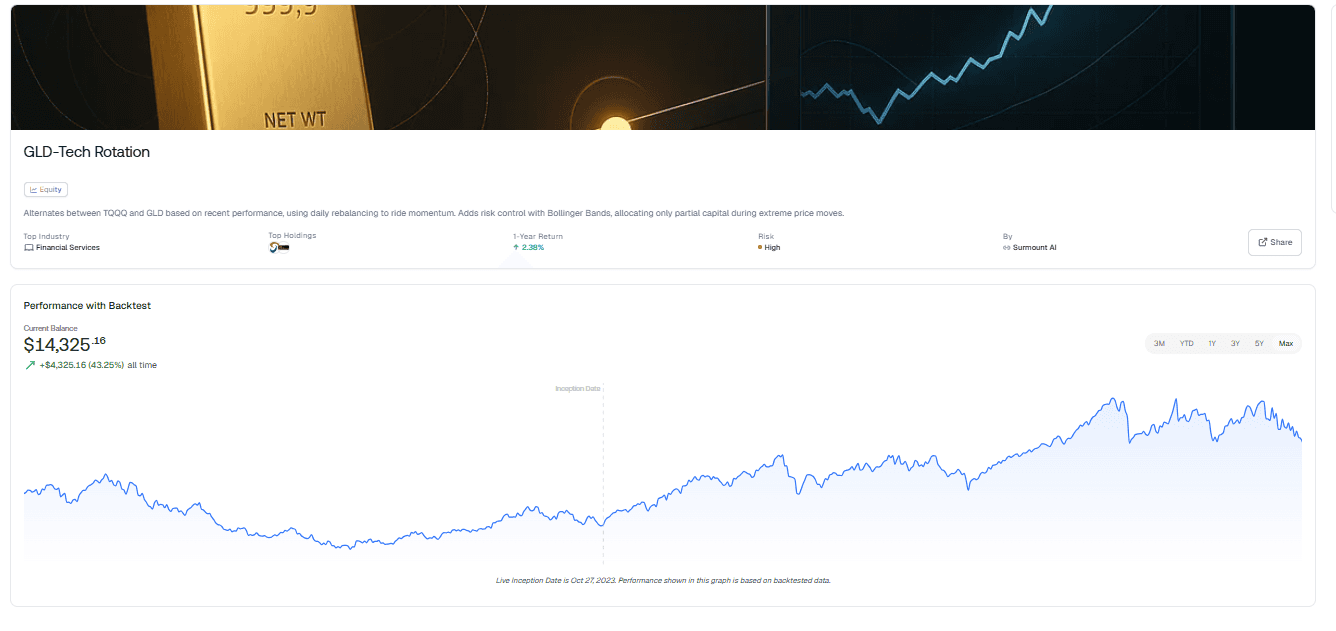
Why it fits this exact moment:
Built-in tech exposure without full concentration risk. You still participate in AI-driven upside, but you're never permanently locked into a single-theme bet the way a pure tech portfolio is.
Automatic rotation into gold during weakness. Gold has historically acted as a hedge during equity drawdowns — this strategy captures that relationship systematically instead of requiring you to time it yourself.
Volatility-aware risk control. The strategy uses Bollinger Bands to detect when prices are unusually stretched, automatically cutting allocation in half during periods of elevated volatility — precisely the kind of environment a bubble-bursting scenario would create.
Daily rebalancing. Positioning adjusts every day based on real performance data, not headlines or forum sentiment.
No guesswork required. You don't need to predict whether OpenAI and Anthropic's financing model holds up — the strategy responds to price action as it happens.
Rather than choosing between "stay all-in on tech" or "get out entirely," GLD-Tech Rotation lets the data make that call for you, every single day. If you've been debating how to protect your portfolio from a market correction without abandoning growth exposure altogether, this is a rules-based way to do exactly that.
Deploy GLD-Tech Rotation to your portfolio →
Frequently Asked Questions
Is the AI bubble going to burst in 2026?
No one can say for certain, but current data shows real contracted demand, not just speculation — though revenue concentration risk remains a genuine concern.
What is AI circular financing?
It's when cloud providers invest in AI labs that then spend much of that capital back on the same providers' infrastructure, creating a self-reinforcing loop.
Are current AI stock valuations too high?
AI stock valuations largely assume continued growth and easy access to financing — if either slows, those valuations could face real pressure.
How concentrated is hyperscaler AI revenue right now?
A large and growing share of hyperscaler AI revenue comes from just two unprofitable companies, which is the core concentration risk investors are watching.
How can I protect my portfolio from an AI market correction?
Diversify beyond AI-heavy holdings and consider strategies that automatically adjust exposure based on volatility, rather than trying to time the market.

Automate any portfolio using data-driven strategies made by top creators & professional investors. Turn any investment idea into an automated, testable, and sharable strategy.