How to Spot Great Stocks With ROIC Investing
Surmount Blogs
Discover how ROIC investing helps you find high-quality stocks others miss. Learn to screen smart.

How to Spot Great Stocks With ROIC Investing
Most investors judge a stock by its price-to-earnings ratio, its recent chart, or a headline. Experienced value investors, Warren Buffett among them, tend to look somewhere else entirely: return on invested capital. If you’re new to ROIC investing, this single metric could tell you more about a company’s underlying quality than almost any other number on the balance sheet.
The idea is simple. A business that consistently generates high returns on the capital it invests is compounding value for shareholders quietly, year after year. A business that does not will not, no matter how exciting the story sounds.
Return on Invested Capital, Explained Simply
Return on invested capital measures how efficiently a company turns the money it has, debt and equity combined, into profit. The basic formula:
ROIC = Net Operating Profit After Tax ÷ Invested Capital
In plain terms: for every dollar a company puts to work, how many cents of profit does it generate? A company earning 20% ROIC generates 20 cents of operating profit for every dollar of capital it puts to work. A company earning 4% is barely keeping pace with its own cost of capital.
This is the foundation of ROIC investing. Rather than asking whether a stock is cheap, you ask whether the business is actually good at making money with the capital it controls.
ROIC vs ROE: What’s the Difference?
Return on equity is the more commonly cited metric, but it has a blind spot: debt. A company can artificially inflate its ROE just by piling on leverage, since ROE only measures returns against shareholder equity and ignores the debt used to generate those returns.
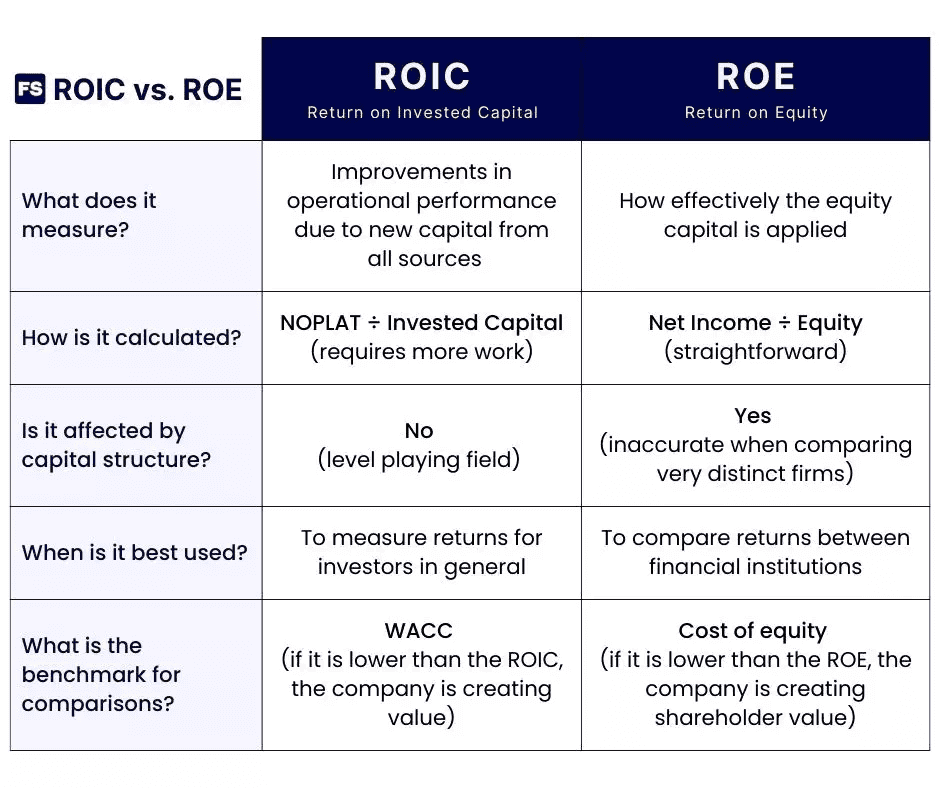
ROIC vs ROE comes down to this: ROIC includes the full capital structure, debt and equity alike, which makes it much harder to game. A heavily leveraged company might post an impressive ROE while its ROIC, the truer measure of operational quality, tells a very different story. For investors trying to separate genuine business quality from balance sheet engineering, ROIC is the more honest number.
Why ROIC Persistence Matters More Than a Single Good Year
A single great year of ROIC doesn’t mean much on its own. What separates a genuinely high-quality business from a company having a good cycle is ROIC persistence, the ability to sustain strong returns over many years, through different market conditions.
The One-Year Trap: Why a Single Strong ROIC Can Mislead
A company can post an unusually high ROIC because of a one-time gain, a temporary pricing surge, or a competitor’s stumble. Screening on a single year’s data alone can lead you straight into a value trap, a stock that looks statistically cheap and high-quality but is actually reverting toward mediocrity.
What a Decade of High ROIC Actually Signals
When a company maintains a high ROIC for ten years or more, it usually indicates something structural: a durable competitive advantage, pricing power, or a moat that competitors haven’t been able to erode. This is the reasoning behind quality factor investing, a principle we break down further in our guide to factor-based investing.
How to Screen for High ROIC Stocks
Once you understand why persistence matters, the next question is practical: how do you actually find high ROIC stocks in a market of thousands of companies?
Manual Screening: What to Look For
Pulling ROIC data across a five to ten year window, not just the trailing twelve months
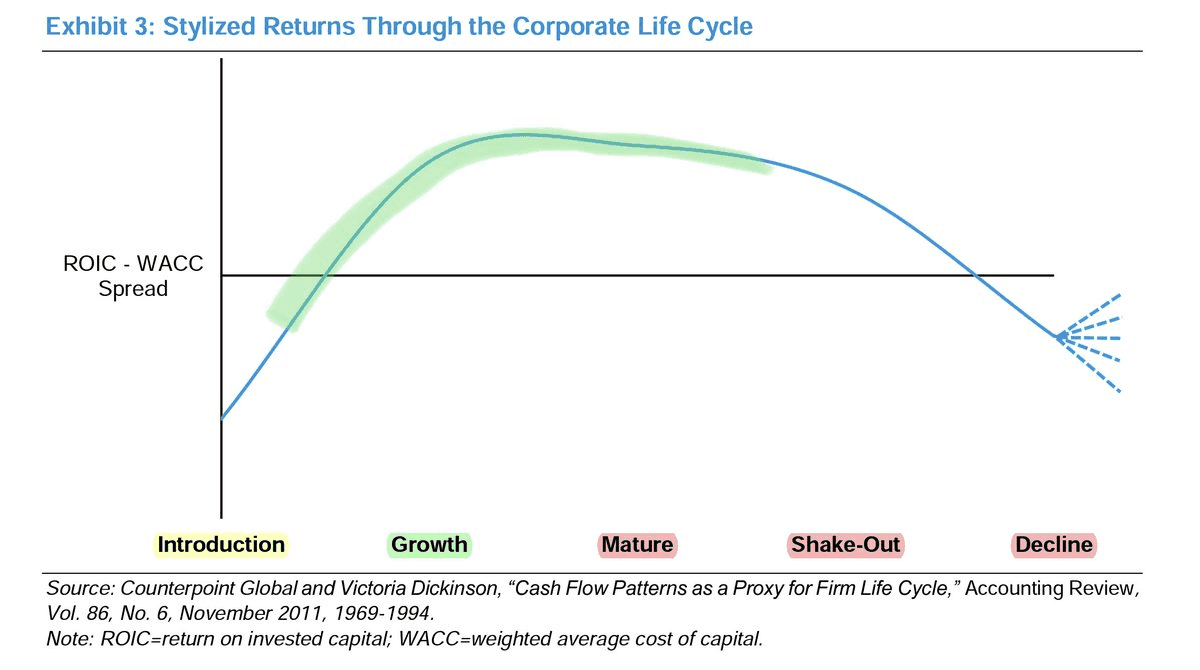
Comparing ROIC to the company’s cost of capital (WACC), since a business only creates value if ROIC exceeds WACC
Cross-checking against sector averages, since capital intensity varies widely between industries
Watching for consistency rather than peaks, favoring steady compounding over volatile spikes
For a deeper walkthrough of the other financial health indicators worth checking alongside ROIC, see our guide to evaluating a company’s financial health.
Why Manual ROIC Screening Breaks Down at Scale
Doing this properly for even a handful of stocks takes hours. Doing it for a full watchlist, updated as new earnings data rolls in, quarter after quarter, is where most individual investors quietly give up. ROIC screening by hand simply doesn’t scale, and stale data means you’re often making decisions on numbers that are already several months old.
Turning ROIC Into a Repeatable, Automated Strategy
This is the gap that separates investors who understand quality investing in theory from those who actually apply it consistently. The logic of ROIC investing is sound, but manually re-running the screen every quarter, across a wide enough universe of stocks to matter, isn’t realistic for most people.
Before deploying any systematic screen, it’s worth understanding how backtesting validates a strategy against historical data first. A systematic, rules-based approach addresses the screening problem by continuously checking for capital efficiency alongside other quality signals, which can reduce the lag, the inconsistency, and the emotional decision-making that creeps into manual stock-picking. It does not eliminate investment risk.
Automating the ROIC Screen With Signal 47
You now know what separates a genuinely high-quality business from a company having a lucky year: ROIC persistence. The problem is doing that screening properly, across enough companies to matter, quarter after quarter, without it eating your weekends.
Signal 47 Multi-Factor Strategy on Surmount was designed to address this gap. It continuously screens 25 U.S. large-cap companies for:
Quality: resilient balance sheets and durable business models, applying the same capital-efficiency logic behind ROIC persistence
Value: attractive valuations backed by strong free cash flow rather than a low headline multiple
Dividend strength: stable or growing distributions from established payers
Momentum: consistent price strength and market leadership
Instead of manually pulling ROIC data, comparing it to WACC, and re-checking it every quarter, Signal 47 runs this discipline automatically, equally weighted and rebalanced every quarter to keep factor exposure current.
If the idea of a systematic, quality-driven approach to stock selection resonated with you in this piece, Signal 47 is a direct way to put that logic to work in your own portfolio, without the manual screening grind. Signal 47 is available through the Surmount platform. Surmount AI, Inc. is a financial technology company and is not a registered investment adviser.
Disclosure: Factor strategies can and do underperform the broader market for extended periods, and a rules-based screen does not protect against loss. Screening criteria are applied systematically and do not account for your individual circumstances. Quarterly rebalancing may generate taxable events in a taxable account. All investing involves risk, including the possible loss of all principal invested. Access to Surmount strategies requires a paid subscription. See surmount.ai/pricing for current plans and pricing.
Disclosure: Jason Jones is a compensated host on the Surmount platform. Surmount pays Jason Jones an AUM fee in connection with the Signal 47 Multi-Factor Strategy on the Surmount platform. This compensation creates a conflict of interest in that Jason Jones has a financial incentive to promote his strategy on the Surmount platform. Surmount AI, Inc. is a financial technology company and is not a registered investment adviser. Investing involves risk, including potential loss of principal. Past performance does not guarantee future results.
[Explore the Signal 47 Strategy]
Frequently Asked Questions
What is a good ROIC for a stock?
A ROIC comfortably above the company’s cost of capital (WACC), often cited as 15% or higher, is generally considered strong, though this varies by industry.
Is ROIC investing better than value investing?
ROIC investing does not replace value investing. It works as a quality filter that helps you avoid statistically cheap stocks that are cheap for good reason.
How is ROIC different from ROE?
ROIC accounts for both debt and equity, while ROE only measures returns against shareholder equity, making ROIC harder to inflate with leverage.
Why does ROIC persistence matter more than one strong year?
A single high-ROIC year can result from a one-time gain, while years of sustained high ROIC usually signal a durable competitive advantage.
Can I automate ROIC screening?
Yes. Rules-based strategies can continuously screen for quality and capital efficiency, which reduces the need for manual, quarter-by-quarter screening. Automating a screen does not reduce investment risk.
Surmount AI, Inc. ("Surmount") is a financial technology company and is not a registered investment adviser. Surmount provides an automated investing platform and software tools that enable self-directed investors to discover, build, and execute investment strategies. Nothing in this blog constitutes investment advice, a recommendation to buy or sell any security, or a solicitation of an offer to buy or sell securities. Past performance is not indicative of future results. Any historical returns, expected returns, or probability projections are hypothetical in nature and may not reflect actual future performance. All investing involves risk, including the possible loss of all principal invested. Automated strategies do not guarantee a profit or protect against loss. For more information, see our terms and conditions.
Automate any portfolio using data-driven strategies made by top creators & professional investors. Turn any investment idea into an automated, testable, and sharable strategy.