How to Follow Berkshire Hathaway's Portfolio (13F Guide)
Surmount Blogs
Learn how to follow Berkshire Hathaway's portfolio using 13F filings — and automate the tracking.

How to Follow Berkshire Hathaway's Portfolio (13F Guide)
Warren Buffett's investment moves have shaped decades of market thinking, and plenty of investors want in on the same playbook. The good news: you don't need billions in capital to see what Berkshire Hathaway is buying. You just need to know how to read the paperwork, and how to act on it before it goes stale.
This guide breaks down exactly how to follow Berkshire Hathaway's portfolio, what the filings actually tell you, and why most investors who try to do this manually end up frustrated.
What Is a 13F Disclosure and Why It Matters
Every institutional investment manager with over $100 million in assets is required by the SEC to file a 13f disclosure each quarter. This filing lists every U.S. equity holding above a certain size, giving the public a snapshot of what major funds, including Berkshire Hathaway, own.
For everyday investors, this is one of the few legal windows into institutional strategy. But there's a catch:
13F filings are backward-looking. They show positions as of the end of the previous quarter, not real-time holdings.
Filings are due 45 days after quarter-end, so by the time you see the data, it may already be outdated.
They only show U.S. long equity positions, with no shorts, options, or international holdings.
Understanding these limits is the first step before you try to follow Berkshire Hathaway's portfolio in your own account.
How to Follow Berkshire Hathaway's Portfolio
Once you understand what a 13F actually contains, the next step is putting that information to use. There are two ways to do this: manually, or through automation.
Reading Berkshire Hathaway's 13F Filing Step by Step
If you want to try this yourself, here's the basic process:
Go to the SEC's EDGAR full-text search database and search for Berkshire Hathaway's latest 13F-HR filing.
Compare the new filing against the prior quarter to identify new positions, increased stakes, trimmed positions, and full exits.
Cross-reference the dollar value of each position against total portfolio value to gauge conviction.
Check for accompanying commentary, such as Berkshire Hathaway's shareholder letters or interviews, that may explain the rationale.
Decide which holdings are practical for your own account size and risk tolerance.
How to Copy Berkshire Hathaway Trades Manually
Once you've identified the positions worth mirroring, actually executing the trades requires more than just buying the same tickers. If you want to learn how to copy Berkshire Hathaway trades in a way that reflects real conviction, you'll need to weight your purchases proportionally to how Berkshire itself is allocated rather than buying an equal amount of everything. Doing so still leaves you exposed to the same market risk as any other equity position, including the possible loss of principal.
This is where most DIY investors run into trouble. Precise position sizing across a dozen or more names, updated every quarter, by hand.
The Problem With Manual 13F Tracking
Manually tracking and replicating institutional filings has real limitations:
Time lag risk: by the time a 13F is public, the market may have already moved on the news.
Execution complexity: replicating proportional position sizes across multiple tickers takes real spreadsheet work.
No ongoing maintenance: you'd need to repeat this entire process every single quarter, indefinitely.
Emotional interference: manual investors often second-guess a position Berkshire holds but the market has already reacted negatively to.
Research from the CFA Institute has published commentary on proposed changes to 13F reporting and the transparency trade-offs involved. It is a useful reminder that 13F data is a lagging disclosure rather than a real-time buy list.
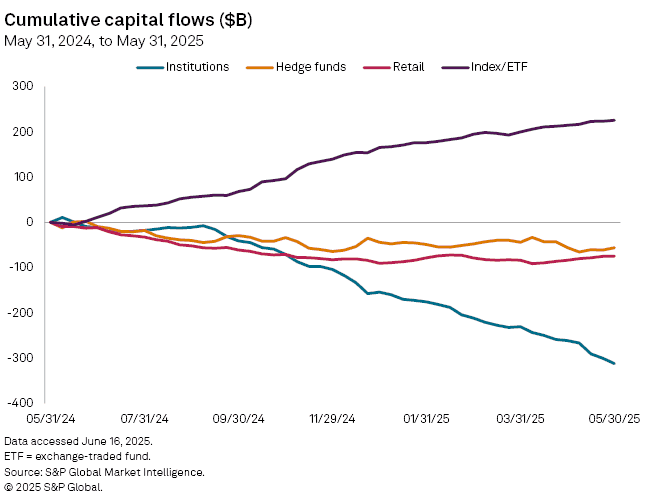
Source: S&P Global Market Intelligence, data accessed June 16, 2025, covering May 31, 2024 through May 31, 2025. Shown for general market context only. This chart does not represent the performance of any Surmount or Quantbase strategy, and past market activity does not indicate future results.
Automating a Warren Buffett Portfolio Tracker
This is exactly the kind of repetitive, data-driven task that automation handles well. Instead of manually parsing SEC filings every quarter, a warren buffett portfolio tracker can pull filing data, calculate proportional weightings, and rebalance a portfolio automatically whenever new filings are reported. Automation changes how a portfolio is maintained. It does not change whether that portfolio can lose value.
What an Automated Institutional Investor Strategy Does Differently From DIY Tracking
An institutional investor strategy built on automation works differently from doing it by hand in a few practical ways:
Speed: positions update automatically when new data is reported, on a set schedule rather than whenever you get around to checking.
Discipline: reduces the temptation to second-guess or selectively follow only the trades you personally like.
Consistency: the same rules-based logic applies every quarter, which limits the position sizing errors that come with manual tracking.
Third-party research from Morningstar covers how Berkshire's recent filings have been read and offers context on the limits of ownership data. No tracking method, automated or manual, can be said to outperform another as a general rule, and rules-based tracking carries its own risks, including holding a position after the underlying manager has already exited it.
Should You Mirror a Stock Portfolio Like Berkshire's?
Whether it makes sense to mirror a stock portfolio like Berkshire Hathaway's depends on your goals. If you're looking for a long-term, business-quality-focused approach without spending hours poring over SEC filings, automating the process gives you exposure to that discipline without the manual workload.
It won't replicate Berkshire's exact risk profile, and no retail investor can, but pairing it with disciplined risk management techniques can help align exposure with your own tolerance. Position sizing matters here too, since concentrating too heavily in a handful of names carries hidden costs many investors underestimate. Mirroring a single institution's holdings concentrates your outcome in that institution's decisions, and all investing involves risk, including the possible loss of all principal invested.
For readers who want to explore Buffett's own investing philosophy directly, we've broken down his core principles in depth here. And for a different angle on public disclosure data, see how insider and congressional trade data offers its own edge.
Once you've identified positions worth mirroring, the execution challenge is real, a topic we cover in copy trading vs. building your own strategy. Below is one example of a systematic strategy available through the Surmount platform, along with the disclosures that apply to it.
A Systematic Alternative: How the Analyst Long Strategy Works
Reading 13F filings by hand is a useful exercise in understanding how institutional conviction works, though it takes real time to keep up with. By the time you've cross-referenced position sizes, calculated proportional weightings, and double-checked which names Berkshire trimmed versus added, the market may have already moved on.
Analyst Long is an equity strategy available through the Surmount platform. It applies a systematic approach to a different data set than the one described above: Wall Street analyst price targets rather than 13F holdings. It does not track Berkshire Hathaway's portfolio or the holdings of any other 13F filer. The strategy is based on publicly available information and is not based on insider knowledge, and its methodology can be validated by referencing public information.
Disclosure. Quiver Quantitative is a compensated partner of Quantbase, LLC. Quantbase pays Quiver Quantitative a percentage of advisory fees collected on assets invested in the Analyst Long strategy on the Quantbase platform. This compensation creates a conflict of interest in that Quiver Quantitative has a financial incentive to promote its strategy on the Quantbase platform. Quantbase is an SEC-registered investment adviser. Investing involves risk, including potential loss of principal. Past performance does not guarantee future results.
Here is how the strategy works:
Weighted by analyst track record. The strategy uses Quiver's proprietary Analyst Scoring method, which rates Wall Street analysts on the accuracy of their historical price targets. Those scores are used to weight each analyst's most recent forecasts, giving stronger weight to analysts with historical success and lower, or in some cases negative, weight to analysts with poor historical accuracy. Accuracy in past price targets does not predict future accuracy.
Built on a full year of forecasts. All forecasts made over the past year are combined into an average weighted forecast for every ticker, so no single call drives the result on its own. Because the window covers a full year, some of the underlying forecasts are up to twelve months old.
Screened by score, then by size. The strategy takes the stocks with the top 100 scores, then narrows to the 10 largest of those by market cap in order to avoid stocks with sparse analyst coverage. A 10 position, equity-only portfolio is concentrated, and concentration increases the effect any single holding has on your results.
Equal-weighted, monthly rebalanced. The strategy takes an equal-weighted position in those 10 companies and rebalances on a monthly basis, which removes the manual position sizing work. Rebalancing may generate taxable events in a taxable account.
A different reporting cadence than quarterly filings. Where 13F filings are quarterly and already dated by the time you see them, this strategy rebalances monthly against a trailing one-year window of analyst forecasts. A different data cadence does not by itself improve results.
Publicly sourced inputs. The strategy is based on publicly available information rather than insider knowledge, and the methodology can be validated by referencing public information. The Analyst Scoring method itself is proprietary to Quiver.
If you would rather not parse filings and analyst notes by hand, this is one systematic option among many. It is not a substitute for deciding whether the strategy fits your own objectives, time horizon, and risk tolerance.
Review the Analyst Long strategy on the Surmount platform to see the full strategy details, fees, and risks before deciding whether it belongs in your portfolio.
Frequently Asked Questions
How do I follow Berkshire Hathaway's portfolio?
You can review Berkshire's quarterly 13F filing on SEC EDGAR, or use an automated stock tracking strategy that updates on a set schedule. Either way, the filing data is backward-looking.
What is a 13F disclosure?
A 13F disclosure is a mandatory SEC filing that institutional managers over $100 million must submit quarterly, listing their U.S. equity holdings.
How often does Berkshire Hathaway's 13F filing update?
13F filings are required quarterly, due 45 days after quarter-end, so the data is never fully real-time.
Can I automate copying Berkshire Hathaway trades?
Yes. Automated tools can pull filing data and rebalance proportionally, which removes the manual work of tracking a warren buffett portfolio tracker by hand. Automation does not reduce market risk.
Is it smart to mirror a stock portfolio like Berkshire's?
It can offer disciplined, long-term exposure, though no retail investor can fully replicate Berkshire's exact risk profile or scale, and mirroring any single portfolio concentrates your outcome in that manager's decisions.
Surmount AI, Inc. (“Surmount”) is a financial technology company and is not a registered investment adviser. Surmount provides an automated investing platform and software tools that enable self-directed investors to discover, build, and execute investment strategies. Nothing in this article constitutes investment advice, a recommendation to buy or sell any security, or a solicitation of an offer to buy or sell securities. Past performance is not indicative of future results. Any historical returns, expected returns, or probability projections are hypothetical in nature and may not reflect actual future performance. All investing involves risk, including the possible loss of all principal invested. Automated strategies do not guarantee a profit or protect against loss. For more information, see our terms and conditions.

Automate any portfolio using data-driven strategies made by top creators & professional investors. Turn any investment idea into an automated, testable, and sharable strategy.