How Does Warren Buffett Invest? His Strategy Explained
Surmount Blogs
Curious how does Warren Buffett invest? Explore his core principles, from valuation to discipline.

How Does Warren Buffett Invest? His Strategy Explained
Warren Buffett has spent over six decades compounding wealth at an average annual return near 20%. So how does Warren Buffett invest, and why has his approach outlasted countless market cycles, fads, and crashes?
The answer isn’t a secret formula or insider access. It’s a small set of principles, applied with relentless consistency — not unlike Ray Dalio’s own systematic approach to risk and diversification. Below, we break down exactly how does Warren Buffett invest — and why the hardest part of his strategy isn’t understanding it, but sticking to it.
Warren Buffett’s Investment Principles, Broken Down
At its core, Buffett’s strategy rests on four pillars:
Buying businesses, not just stocks
Calculating what a company is actually worth (intrinsic value)
Only investing in what he understands (circle of competence)
Demanding a buffer between price and value (margin of safety)
Layered on top of all four is patience — the willingness to do nothing for years while waiting for the right opportunity. This combination is really how does Warren Buffett invest in practice: a repeatable checklist, not a gut feeling.
The Foundation — Intrinsic Value Investing
What Is Intrinsic Value (And Why It Matters)
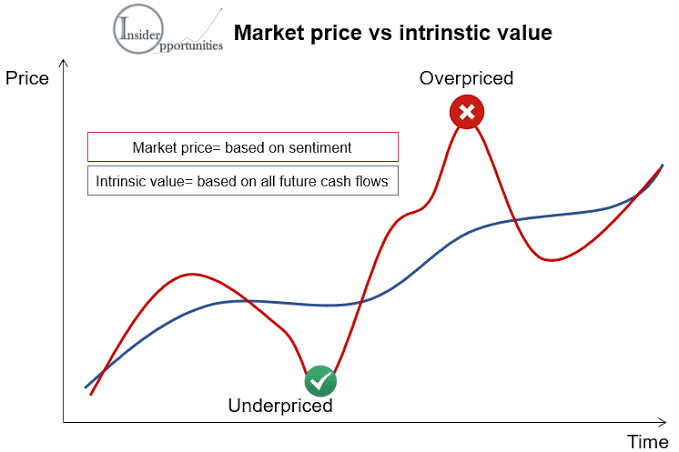
Buffett has often explained valuation using a simple farm analogy. Imagine evaluating a farm 30 miles outside town. You’d estimate how many bushels it produces, subtract costs like fertilizer and labor, and arrive at a profit per acre — say, $70 a year.
Then you ask one question: how much would you pay today to earn $70 a year, indefinitely? If you wanted a 7% return, you’d pay around $1,000. If the farm costs $900, it’s a buy. If it costs $1,200, you walk away.
That’s intrinsic value investing in a nutshell — estimating the cash a business will generate over time, then comparing that to its current price. No price charts, no headlines, no guessing about sentiment. Just cash flow and patience. You can read Buffett’s own explanations of this thinking directly in the Berkshire Hathaway shareholder letters, which he has published annually for decades.
This is also why dividend-paying, cash-generative businesses tend to dominate Buffett’s portfolio. Predictable cash flow is easier to value than speculative growth.
Staying in Your Lane — Circle of Competence Investing
Why Buffett Avoids the “Too Hard” Pile
Buffett doesn’t try to have an opinion on every stock. Most companies, in his view, belong in what he calls the “too hard” pile — businesses whose future earnings are too uncertain to confidently estimate.
Circle of competence investing means sticking to industries and business models you genuinely understand well enough to forecast. For Buffett, that’s historically meant:
Consumer staples and household brands
Insurance and financial services
Simple, durable business models with predictable demand
It’s also why Buffett has historically been cautious around fast-moving tech sectors — not because he doubts their potential, but because reliably forecasting their long-term cash flows is genuinely difficult. He’d rather step over a one-foot bar with certainty than attempt a seven-foot jump on a guess.
Protecting the Downside — Buffett’s Margin of Safety
How Margin of Safety Reduces Risk
Even when Buffett finds a business he understands and can value, he won’t necessarily buy it. He wants a discount — a cushion between what he calculates a company is worth and what he actually pays.
This Buffett margin of safety concept, a principle thoroughly examined by the CFA Institute, protects against two things:
Errors in your own valuation — nobody calculates intrinsic value perfectly
Unexpected bad news — recessions, competition, regulation, or simple bad luck
A wide margin of safety means even if your estimate is somewhat wrong, you’re less likely to lose money. It’s less about being right and more about limiting how badly you can be wrong.
The Real Secret — Discipline Over Time
Why Most Investors Struggle to Replicate Buffett’s Patience
Here’s the uncomfortable truth: none of Buffett’s individual principles are particularly complicated. Calculating intrinsic value, staying within your circle of competence, and demanding a margin of safety are all learnable concepts. For a deeper look at how this discipline compounds over time, see our breakdown of Buffett’s passive income snowball method.
What’s hard is doing it consistently — for years, sometimes decades, without emotional interference. Most investors fail not because they don’t understand value investing, but because they let emotion drive decisions — chasing momentum during bull markets, panic-selling during downturns, and falling into the same behavioral traps that consistently separate emotional traders from disciplined ones.
Chasing momentum during bull markets
Panic-selling during downturns
Drifting outside their circle of competence chasing hype
Abandoning valuation discipline when a stock “feels” too good to pass up
This is really the answer to how does Warren Buffett invest so successfully over time — not superior stock-picking intuition, but superior consistency. He treats investing like running a long-term investing strategy business, not a series of one-off bets. Research from DALBAR’s Quantitative Analysis of Investor Behavior consistently shows that the average investor underperforms the market specifically because of these emotional decisions.
Applying Buffett’s Principles With a Systematic Investing Strategy
If discipline is the differentiator, then the natural next question is: how do you enforce that discipline without relying on willpower alone?
This is where a systematic investing strategy comes in — and you don’t need Buffett-level capital to start; even beginning with as little as $100 is enough to put these principles into practice. Rules-based, automated strategies remove the emotional component entirely — there’s no panic-selling, no chasing headlines, no second-guessing a model that’s already been backtested and validated. The strategy executes the same way, every time, regardless of market noise.
Bring Buffett’s Discipline to Your Portfolio — Automatically
Understanding Warren Buffett’s principles is one thing. Applying them with the same consistency he has for over 60 years is another challenge entirely — and it’s where most investors fall short, not because the ideas are too complex, but because real life gets in the way of perfect discipline.
That’s exactly the gap Signal 47 Multi-Factor ETF is built to close.
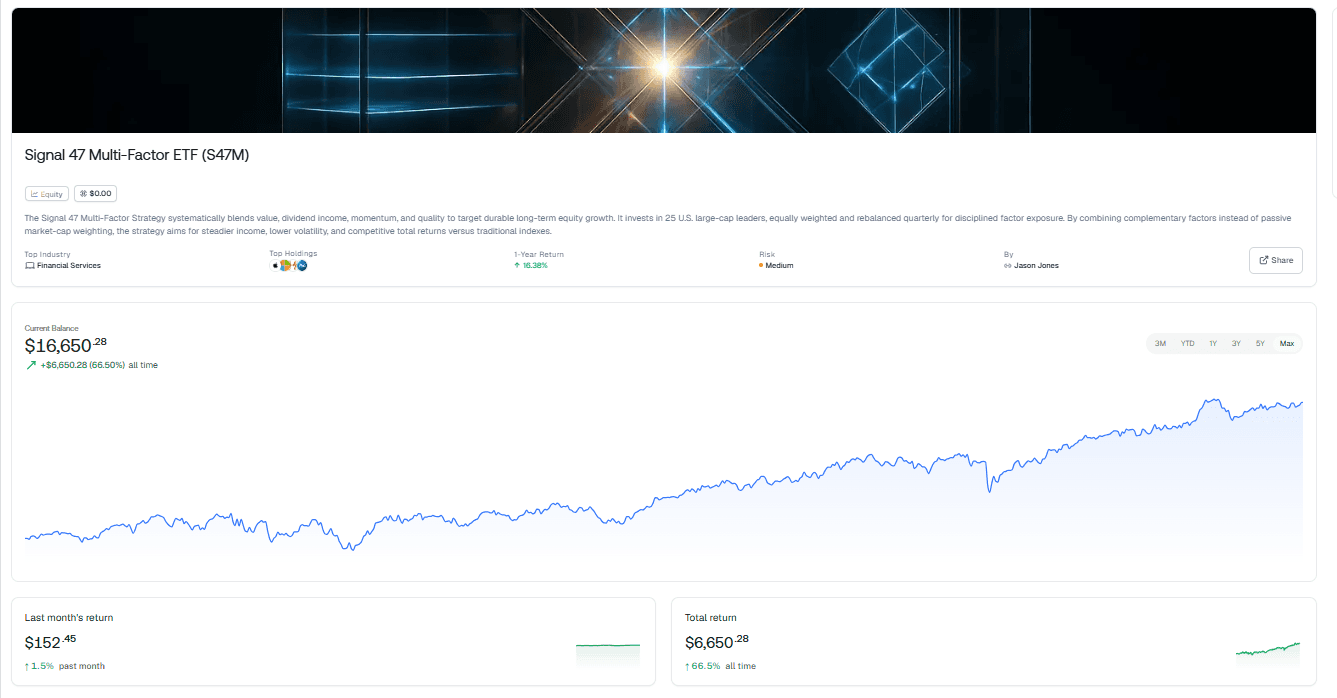
Rather than relying on willpower to “stay disciplined,” Signal 47 encodes Buffett-style principles directly into a rules-based, automated framework:
Value at its core — screens for companies trading at attractive valuations with strong free cash flow, the same fundamental lens Buffett uses to identify a fair price for a quality business
Quality you can count on — favors companies with resilient balance sheets and durable business models, filtering out the speculative “too hard pile” before you ever have to make that judgment call yourself
Dividend strength built in — prioritizes companies with stable or growing payouts, rewarding the kind of steady cash generation Buffett has always valued over hype
Momentum, without the guesswork — adds a momentum overlay to capture market leadership, balancing patience with responsiveness
Enforced discipline, every quarter — 25 U.S. large-cap leaders, equally weighted and rebalanced on a fixed quarterly schedule, so the strategy never drifts from its principles the way an emotional investor might
In short: Signal 47 doesn’t ask you to predict the market or time your entries. It applies a Buffett-style framework — value, quality, and discipline — automatically, every single quarter, regardless of headlines or market noise.
If the lesson from this piece is that the framework is simple but the execution is hard, Signal 47 is how you make the execution simple too.
Ready to invest with the same discipline as the greats? Deploy Signal 47 Multi-Factor ETF to your portfolio today.
FAQs
How does Warren Buffett invest differently from most investors?
Buffett focuses on intrinsic value investing — calculating what a business is actually worth and buying with a margin of safety — rather than reacting to short-term price movements or market sentiment.
What is Warren Buffett’s most important investing principle?
Staying within his circle of competence is arguably his most important rule: he only invests in businesses whose long-term earnings he can confidently understand and predict.
Why does Warren Buffett avoid certain industries?
He places unpredictable businesses, including many fast-moving tech sectors, in what he calls the “too hard pile” — not due to a lack of potential, but because their future cash flows are too uncertain to value reliably.
How can I apply a long-term investing strategy like Buffett’s?
Focus on quality businesses, demand a margin of safety on price, and stay consistent through market cycles — a systematic investing strategy can help enforce that discipline automatically.
Do I need a lot of money to invest like Warren Buffett?
No — Buffett’s principles, like patience and intrinsic value investing, apply at any portfolio size, and platforms like Surmount let you apply systematic strategies starting with a small initial investment.

Automate any portfolio using data-driven strategies made by top creators & professional investors. Turn any investment idea into an automated, testable, and sharable strategy.