Can Big Tech Actually Afford Its AI Spending Spree?
Surmount Blogs
Big tech AI spending is hitting record highs. Here's why the cash flow numbers tell a different story.

Can Big Tech Actually Afford Its AI Spending Spree?
If you've been following markets in 2026, you've seen the headlines: Meta, Amazon, and Google are committing to the largest capital expenditure cycles in corporate history, all in the name of AI infrastructure. The numbers are staggering enough that even seasoned investors are asking a reasonable question — can big tech AI spending at this scale actually be sustained?
Let’s dive a little deeper.
The AI Spending Numbers That Are Raising Eyebrows
The AI capital expenditure commitments from Meta, Amazon, and Google for 2026 are unlike anything the market has seen before. Alphabet is guiding toward $185 billion in CapEx. Amazon is targeting $200 billion. Meta, the leanest of the three, is projecting $135 billion.
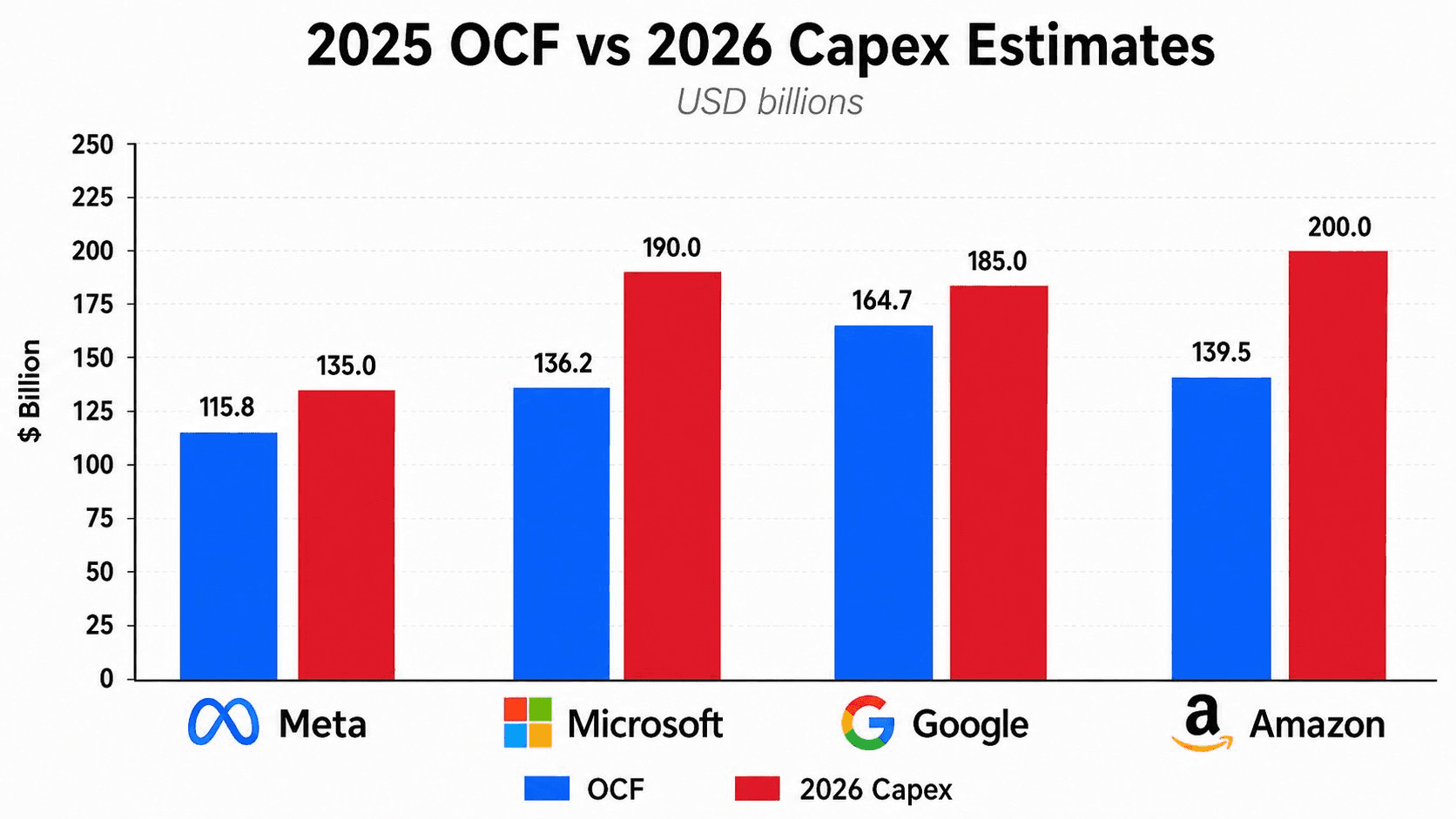
Put those numbers side by side and it's easy to see why analysts are asking sustainability questions. Collectively, that's nearly $480 billion in planned capital deployment from just three companies — in a single year. As we explored in our deep dive on decoding Big Tech CapEx, the numbers that matter most are rarely the ones making headlines.
But focusing on the spending number in isolation is where most investors go wrong. The more important figure sits right next to it. According to Goldman Sachs research on AI infrastructure spending, the real story of this cycle is more about the quality of balance sheets funding it.
Why Free Cash Flow Changes the Entire Conversation
Here's what the coverage tends to miss: all three companies are funding this buildout almost entirely from operating cash flow. No dilution. No dangerous leverage. Just internally generated capital being recycled into infrastructure. If you want a fuller breakdown of how to read these figures, our guide to CapEx and free cash flow walks through the framework investors actually use.
The numbers make this clear.
Alphabet: Spending Big, But Earning Bigger
Alphabet's 2026 estimated CapEx of $181 billion sits against projected operating cash flow of $196 billion. That's full coverage with room to spare — and it follows two consecutive years where cash generation scaled faster than spending commitments. Alphabet's reported financials confirm this trajectory clearly.
Amazon: Infrastructure at Scale, Funded Internally
Amazon's trajectory tells a similar story. With $185 billion in projected operating cash flow against $175 billion in CapEx, the world's largest cloud infrastructure operator is self-funding one of the most aggressive buildouts in technology history. Tech stock free cash flow at this level reframes the risk entirely. Amazon's reported operating cash flow supports this picture across multiple reporting periods.
Meta: The Leanest Spender With the Most to Prove
Meta's $122 billion CapEx projection lands against $130 billion in operating cash flow. Of the three, Meta carries the highest execution risk — its AI monetization thesis is less proven than Google's search dominance or Amazon's AWS margins. But from a pure capital structure perspective, the funding risk simply isn't there. Meta's latest financial disclosures reflect this balance sheet strength consistently.
The conclusion across all three is consistent: debt is optional, not required. That shifts the conversation entirely to ROI.
What This Means for Investors in AI Infrastructure Stocks
Understanding that the spending is sustainable is the starting point, not the finish line. The real investing question is which of these companies generates the strongest return on this capital over the next five to ten years — and how to build exposure without making a concentrated single-stock bet.
The ROI Question Nobody Is Asking Yet
Most retail coverage stops at 'they're spending a lot.' Sophisticated investors are asking what comes back. Google's AI integration into search and cloud, Amazon's AWS expansion, and Meta's advertising infrastructure each represent different risk-return profiles. According to McKinsey's analysis of generative AI's economic potential, the companies that build the strongest AI infrastructure foundations today are likely to hold structural advantages for a decade. Operating cash flow investing discipline tells you the floor — the ceiling depends on execution.
Why a Systematic Approach Beats Stock-Picking Here
Trying to pick the single winner among Meta, Amazon, and Google is a low-probability game, even with strong conviction. Investors who understand sector rotation know that the winning move isn't always picking the best company — it's staying positioned in the right part of the market at the right time. A rules-based systematic investing strategy that allocates across quality tech leaders — weighted by financial strength signals like cash flow coverage and momentum signals — captures the upside of the cycle without requiring a correct single-name call.
How Automated Investing Captures This Trend Without the Guesswork
Automated investing technology stocks approaches remove the emotional decision-making that causes most retail investors to either over-concentrate or rotate out at exactly the wrong time. Automated strategies also solve one of the hardest problems in investing — knowing when to sell — by removing the emotional triggers that cause most retail investors to rotate out at exactly the wrong time. If you're evaluating platforms to execute this kind of systematic approach, our 2026 roundup of automated investing apps breaks down what to look for.
One Way to Play This Theme Systematically: AlphaFactory Protective
Understanding that Meta, Amazon, and Google can sustain their big tech AI spending is valuable. Knowing how to build exposure to that thesis — without making a concentrated single-stock bet or watching every earnings call — is where most investors get stuck.
That's exactly the problem the AlphaFactory Protective strategy on Surmount is built to solve.
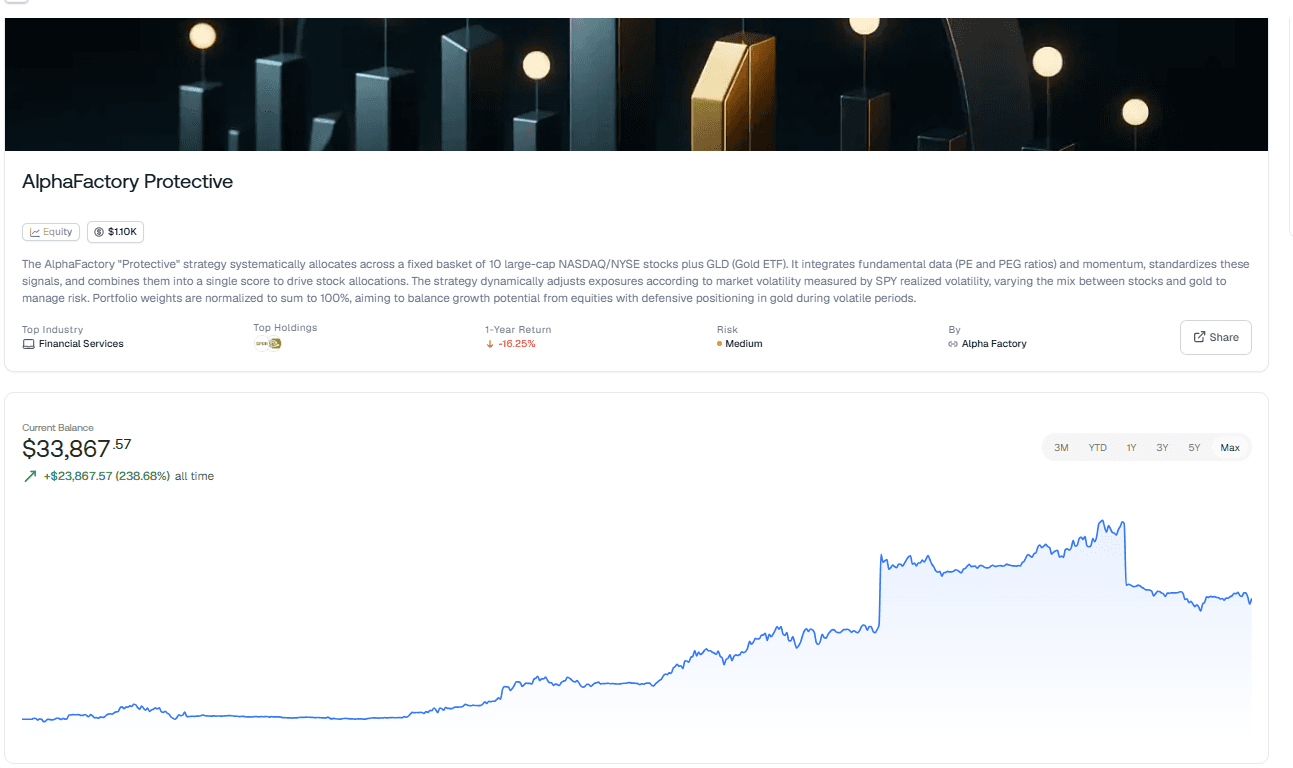
Here's what makes it a strong fit for this moment:
Momentum + value combined: The strategy selects from top NASDAQ/NYSE stocks using both 12-month momentum and value scoring — precisely the signals that identify companies like Alphabet, Amazon, and Meta at the right point in their cycle, not after the market has already priced in the upside.
Financial strength as a filter: Allocations are driven by a combined score that rewards companies with genuine fundamental backing — the same free cash flow discipline this post is built around.
Built-in downside protection: Using SPY realized volatility as a trigger, the strategy automatically shifts toward GLD during high-volatility regimes and returns to full equity allocation when conditions stabilize — so you stay invested through the AI buildout without riding every drawdown.
No guesswork required: The rebalancing, signal calculation, and risk adjustment all happen automatically — you don't need to monitor CapEx reports or parse earnings guidance to stay correctly positioned.
Diversified by design: Rather than forcing a single-name bet on which of Meta, Amazon, or Google wins the ROI race, the strategy spreads exposure across the highest-conviction large-cap opportunities the market is offering at any given time.
If the core argument of this post resonates — that the strongest companies in the AI infrastructure cycle are the ones funding growth from cash flow, not leverage — then AlphaFactory Protective is built to systematically identify and hold exactly those companies, with risk controls that most retail investors don't have access to on their own.
If you're still weighing whether a rules-based approach fits your style, our breakdown of algorithmic vs traditional investing is a good place to start.
Deploy AlphaFactory Protective on Surmount and start investing in this theme the systematic way. →
Frequently Asked Questions
Is big tech AI spending sustainable long term?
Yes. Meta, Amazon, and Google are all funding their AI capital expenditure from operating cash flow, meaning no dangerous leverage is required. The sustainability question is largely settled — the real debate is about ROI.
How does big tech free cash flow affect stock valuations?
When companies fund record CapEx entirely from internal cash generation, it removes balance sheet risk from the equation. Investors can focus on growth potential rather than financing risk, which is generally a positive signal for long-term valuations.
What is the best way to invest in AI infrastructure stocks?
Rather than picking a single winner among Meta, Amazon, or Google, a systematic investing strategy weighted by momentum and financial strength gives you diversified exposure to the AI infrastructure cycle without requiring a correct single-name call.
How does automated investing help with technology stock exposure?
Automated investing removes emotional decision-making from the equation — keeping you invested through volatility and rebalancing systematically based on rules rather than headlines. This is especially valuable in fast-moving sectors like big tech AI spending.
What is AI capital expenditure and why does it matter to investors?
AI capital expenditure refers to the money large technology companies spend building data centers, compute infrastructure, and hardware to power artificial intelligence. For investors, it signals long-term growth commitment — but only matters if the companies can fund it without taking on excessive debt.

Automate any portfolio using data-driven strategies made by top creators & professional investors. Turn any investment idea into an automated, testable, and sharable strategy.