Are REITs a Good Investment Right Now? (2026)
Surmount Blogs
Billionaires are piling into REITs in 2026. Are REITs a good investment for regular investors too? Here's what the data says.

Are REITs a Good Investment Right Now? (2026)
When Blackstone, Brookfield, and Blue Owl start pouring tens of billions of dollars into an asset class, it's worth paying attention. These are among the world's most sophisticated investors — and right now, they're buying real estate investment trusts at scale, often at significant premiums.
So are REITs a good investment for regular investors too? The data suggests yes — and the timing may be better than most people realise.
What Is a Real Estate Investment Trust?
A real estate investment trust (REIT) is a company that owns income-producing properties — apartment buildings, office towers, data centres, warehouses, and more. By law, REITs must distribute at least 90% of taxable income to shareholders, which makes REIT dividend income a core part of their appeal.
For investors, REITs offer something rare: exposure to real estate without the hassle of owning property, managing tenants, or tying up capital in a single asset. Deciding between direct ownership and REITs? Our guide to REITs vs. rental properties breaks down exactly where each makes sense.
Why REIT Returns Have Lagged — And Why That's About to Change
Over the past five years, REIT returns have disappointed. Three headwinds hit simultaneously: the pandemic gutted commercial and retail occupancy, interest rates surged at an unprecedented pace from historic lows, and a wave of new development flooded markets with oversupply.
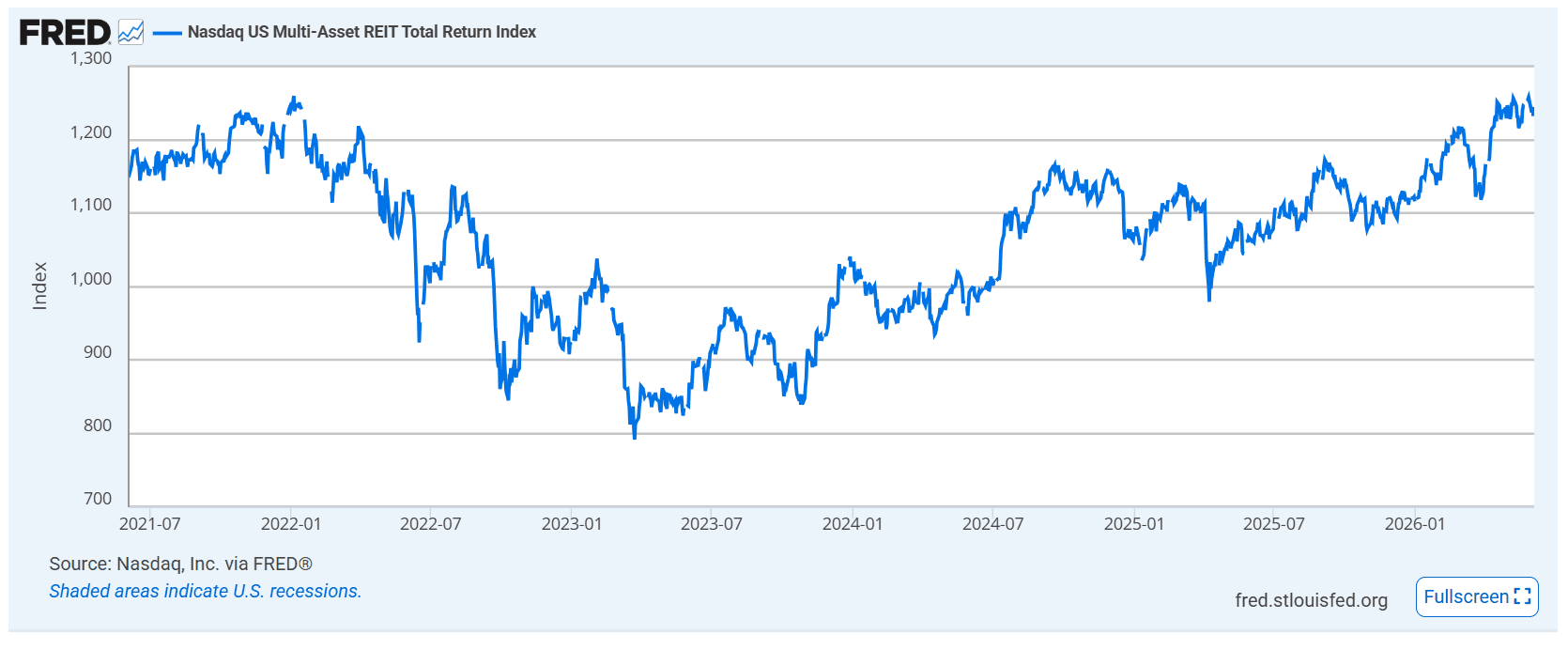
The result was painful. Many investors wrote REITs off entirely.
But markets move in cycles. If the idea of buying into a beaten-down asset class feels uncomfortable, it's worth remembering why volatility creates opportunity rather than risk. The same conditions that crushed REIT returns over the past five years are now reversing — and historically, the best time to buy any asset class is when sentiment is at its worst.
The Valuation Case for REITs Today
Earnings multiples on REITs are currently near historic lows. Higher interest rates have killed new development pipelines, which means less supply is coming to market. Less supply, combined with sustained demand for housing, logistics, and data infrastructure, points toward accelerating rent growth in the years ahead.
According to NAREIT data, REITs have outperformed most equity sectors over 50-plus years — delivering higher total returns, lower volatility, and stronger income than the broader market. Research from Janus Henderson confirms that REITs have historically delivered their strongest forward returns following periods of undervaluation — which is precisely where we are today. That long-run math hasn't changed. What changed was sentiment, and sentiment is mean-reverting.
Why Institutional Investors Are Piling In
Blackstone recently acquired Sila Realty Trust. Brookfield has been aggressively expanding its real estate portfolio. Blue Owl and other major private equity firms continue to deploy capital into income-producing properties at scale.
These firms have access to every asset class on earth. They're choosing REITs — and they're doing it now, after years of underperformance, which is precisely when disciplined investors act.
REITs as Portfolio Diversification in an Uncertain World
Portfolio diversification has always been the textbook argument for REITs. But in today's environment — shaped by geopolitical instability, persistent inflation risk, and AI-driven disruption across entire industries — the case is stronger than usual. For investors thinking beyond stocks and bonds, understanding what makes an alternative investment work is a useful starting point.
Real assets like apartment communities, timberland, and industrial properties hold intrinsic value that doesn't depend on software margins or advertising revenue. They generate cash flow from physical demand that exists regardless of what happens in financial markets.
Are REITs AI Proof Investments?
This is the angle most investors are missing. As artificial intelligence accelerates, it is systematically breaking down barriers to entry across industries — compressing margins, disrupting SaaS businesses, and eroding the competitive moats that once justified high equity valuations. McKinsey's research on AI disruption makes clear that few industries will be left untouched.
REITs are structurally immune to this. The supply of well-located real estate is constrained by land availability, zoning, permits, and construction costs. AI cannot build an apartment building. It cannot replicate a logistics hub in a prime distribution corridor. As capital rotates away from AI-disrupted sectors, real assets stand to benefit directly — what some analysts are already calling the "AI immunity trade." If you want to explore this theme further, our piece on AI proof investments breaks it down in detail.
REIT Dividend Income: The Income Angle
Beyond capital appreciation, REIT dividend income remains one of the most reliable income streams available to retail investors. With earnings multiples compressed, current yields are historically attractive. Before chasing yield, it pays to know what makes a dividend safe — our dividend investing safety checklist walks you through exactly that. Reinvested over time, that income compounds into meaningful long-term wealth — particularly for investors who automate their exposure and avoid emotional timing decisions.
How to Start Passive Real Estate Investing Without Buying Property
You don't need a down payment, a mortgage, or a property manager to get real estate exposure. Passive real estate investing through publicly traded REITs and real estate ETFs gives you diversified access to hundreds of properties across geographies and sectors — with full liquidity.
The challenge most investors face isn't access. It's discipline. Knowing when to rebalance, how to weight different property sectors, and how to stay invested through volatility is where most people fall short.
That's exactly the problem systematic investing solves.
Automate Your Real Estate Exposure With Surmount
Billionaires don't buy REITs by logging in every morning and making decisions under pressure. They deploy capital systematically, rebalance on schedule, and let the underlying assets do the work over time.
That's exactly what the Global Real Estate Exposure strategy on Surmount is built to do.

The strategy holds approximately 30 of the world's top publicly traded real estate assets, selected for financial strength, regional diversification, and risk-adjusted return potential. It rebalances automatically every month — so you stay aligned with the best opportunities across property sectors without having to monitor markets, time entries, or second-guess yourself during volatility.
This is passive real estate investing done properly. No mortgage. No tenants. No single market concentration. Just systematic exposure to an asset class that has outperformed most equity sectors over 50-plus years — and that is now sitting at historically attractive valuations, with institutional capital flowing in and AI disruption acting as a structural tailwind rather than a threat.
The same logic that is driving Blackstone and Brookfield to deploy tens of billions into real estate right now is available to you — automated, diversified, and running 24/7 in your existing brokerage account.
Deploy the Global Real Estate Exposure strategy on Surmount today — and let the world's most resilient asset class work for your portfolio.
Frequently Asked Questions
Are REITs a good investment in 2026?
Yes — REIT valuations are near historic lows, institutional buyers are entering at scale, and the supply headwinds from the post-pandemic building boom are fading. The setup for forward returns is stronger than it has been in years.
What are the best REITs to invest in right now?
Rather than picking individual REITs, most investors get better results through diversified real estate exposure across sectors and geographies. This reduces single-asset risk while capturing the broader recovery in REIT returns.
How do REITs provide passive real estate investing without buying property?
REITs trade like stocks on public exchanges, giving you income-producing property exposure with full liquidity and no management responsibilities. REIT dividend income is distributed regularly, making them one of the most accessible passive income vehicles available.
Are REITs AI proof investments?
REITs are among the most structurally protected assets from AI disruption. Supply is constrained by land, zoning, and construction costs — none of which AI can replicate — while demand for housing, logistics, and data infrastructure remains durable regardless of technological change.
How do REITs help with portfolio diversification?
REITs have historically shown low correlation to traditional equities during periods of market stress, providing a cushion when stock valuations compress. Adding real estate exposure through a diversified real estate ETF or REIT strategy introduces an income-generating, inflation-resistant layer to any portfolio.

Automate any portfolio using data-driven strategies made by top creators & professional investors. Turn any investment idea into an automated, testable, and sharable strategy.