How to Invest in Oil Without Buying Oil (2026)
Surmount Blogs
Discover how to invest in oil through royalties, pipelines, and midstream stocks — no crude exposure needed

How to Invest in Oil Without Buying Oil (2026)
Most investors assume that investing in oil means buying crude futures, oil ETFs, or betting on the next earnings report from a major driller. But there is a smarter way to get energy exposure — one that doesn't require you to predict where oil prices are heading next week.
Here is how to invest in oil by owning the infrastructure, royalties, and toll roads that sit around the commodity itself.
Why Most Investors Get Oil Investing Wrong
Oil is one of the most emotionally charged commodities in the market — and emotional decision-making is one of the core reasons most investors underperform over the long run. Prices swing on geopolitical headlines, OPEC decisions, and inventory reports. Most retail investors who buy oil directly — through futures, leveraged ETFs, or pure-play drillers — end up taking on far more volatility than the underlying thesis warrants.
The smarter approach is to ask: who gets paid regardless of whether the oil price goes up or down? And if you want to understand how to position across the broader market cycle, our sector rotation guide is a good place to start.
The answer is the companies that own the land, the mineral rights, the pipelines, and the processing facilities. These businesses sit around the commodity without being fully exposed to its daily price swings.
The Oil Supply Chain as an Investment Framework
Energy sector investing becomes much clearer when you think about it as a supply chain rather than a single asset class. Oil has to travel through several stages before it reaches the end consumer — and each stage represents a different investment opportunity with a different risk profile.
The chain runs roughly as follows: land and mineral rights → drilling equipment → production → midstream pipelines → refining and distribution.
The International Energy Agency's latest oil market report confirms that global oil demand growth, while moderating, remains positive — underpinning the case for long-term infrastructure investment across the supply chain.
Investors who understand this can choose where in the chain they want exposure, rather than simply buying "oil."
Oil Royalty Stocks — Earning Without Drilling
Oil royalty stocks are one of the most overlooked ways to get energy exposure. Royalty companies own mineral rights — meaning they collect a payment every time an oil or gas producer extracts from their land. They do not drill, they do not operate rigs, and they carry almost no capital expenditure.
The Journal of Accountancy has published guidance on royalty trusts as investment vehicles, noting their pass-through income structure and the importance of understanding underlying production agreements before investing.
The result is extraordinary free cash flow margins — and if you want to understand why that number matters so much, our free cash flow guide breaks it down in detail. Some royalty businesses convert 80 cents of every revenue dollar into free cash flow — a number most technology companies cannot match.
Because royalty income is tied to production volumes rather than spot prices alone, these businesses offer a more stable income profile than pure-play drillers. For income-focused investors, they represent one of the most efficient ways to participate in energy without taking on operational risk.
Midstream Energy Stocks — The Toll Road Model
Midstream energy stocks own and operate the pipelines, processing plants, and storage facilities that move oil and gas from the wellhead to the refinery. The key distinction is how they get paid: most midstream companies operate on long-term fixed-fee contracts, meaning their revenue is largely independent of the oil price.
As Morningstar's energy sector research has noted, midstream companies have historically demonstrated more resilient cash flows than upstream producers during periods of oil price volatility, owing to their fixed-fee contract structures.
The fixed-fee midstream model is not unlike owning a REIT — you collect recurring income from an asset others depend on, without managing the underlying operations yourself, a dynamic we explored in our REITs vs rental properties breakdown. Whether gasoline is cheap or expensive, oil still needs to move through the pipeline. Midstream operators collect their fee either way.
Oil pipeline stocks in this segment often carry distribution yields in the high single digits, making them attractive for income investors. They also tend to hold up better than drillers during commodity downturns, precisely because their cash flows are contractually protected.
Passive Income From Oil — The Income Investor's Case
Combining royalty exposure with midstream positions creates a compelling passive income from oil framework. Royalty businesses provide high free cash flow with variable upside tied to production growth. Midstream businesses provide stable, contractual distributions with lower volatility.
With the Federal Reserve signalling a cautious approach to rate cuts in 2026, yield-bearing assets with contractual cash flows — like midstream pipelines — are increasingly attractive relative to bonds.
Investors who are already building a dividend growth strategy will find that royalty and midstream positions complement that approach well — here is how to structure one from scratch. For income investors evaluating these distributions, running them through a dividend safety checklist before committing capital is always worth the extra step.
Together, royalty and midstream exposure gives an income investor energy participation without the earnings volatility that comes from owning a driller or a refiner. In a higher-for-longer interest rate environment, this kind of yield profile becomes increasingly valuable relative to bonds and cash.
Energy Stocks Without Oil Price Risk — Is It Possible?
Not entirely — but it is possible to significantly reduce direct commodity exposure while still participating in the energy sector. Energy stocks without oil price risk in the purest sense do not exist, but royalty and midstream businesses come close.
Their revenues are driven more by how much oil is being produced and moved than by what price it sells for. According to the U.S. Energy Information Administration, global energy demand is projected to remain elevated through the decade, driven by industrialisation in emerging markets and surging power consumption from data centres.
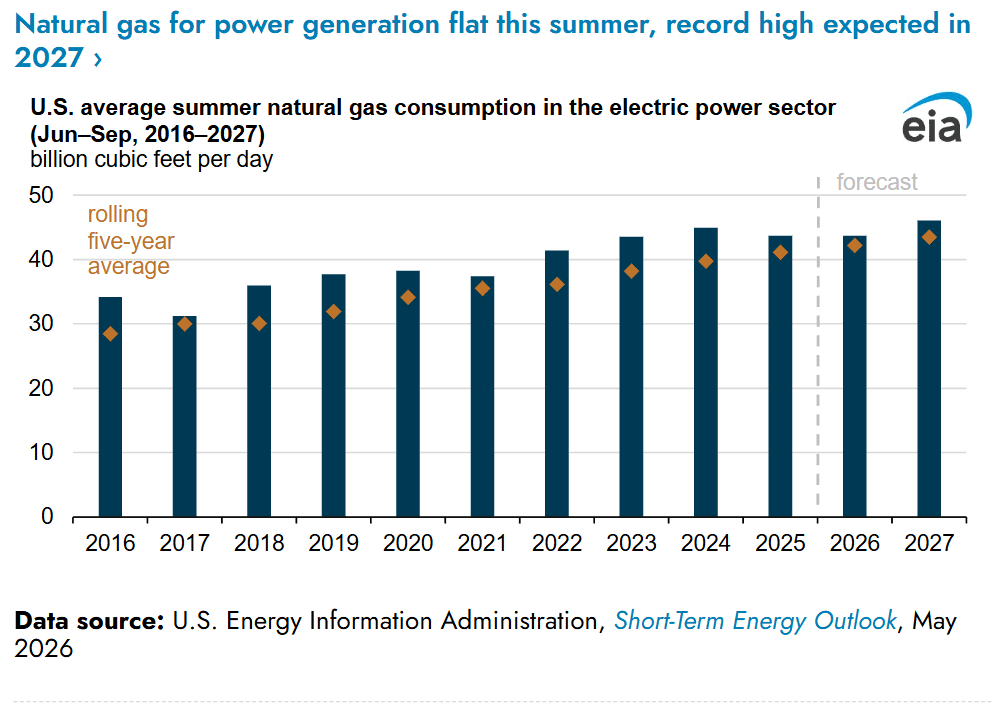
In an environment where global energy demand remains structurally strong — driven by industrialisation, data centre power consumption, and the limits of the shale revolution — production volumes are likely to remain elevated even if prices soften.
This makes energy sector investing through royalties and midstream a more durable long-term position than simply buying oil futures or a leveraged energy ETF.
How to Build a Systematic Energy Position
The challenge with commodity investing strategy in energy is that individual stock selection requires deep sector knowledge. Knowing which royalty company has the best acreage, which pipeline operator has the strongest contract book, and which refiner is buying back the most stock takes significant research time.
Systematic strategies in energy can also incorporate signals beyond simple rebalancing — mean reversion approaches, for example, have historically worked well in commodity-linked equities that tend to oscillate around fair value.
This is where automated energy investing makes sense. Rather than building a position stock by stock, a systematic strategy can allocate across the energy supply chain — balancing royalty exposure, midstream income, and production upside — and rebalance automatically as conditions change.
For self-directed investors who want energy exposure without the homework, deploying a pre-built automated strategy is a practical alternative to picking individual names.
Putting This Strategy to Work Automatically
Understanding the royalty and midstream model is one thing. Building and maintaining that exposure across multiple positions — rebalancing when allocations drift, staying disciplined when oil headlines get noisy — is another challenge entirely.
The AlphaFactory Income strategy on Surmount does the heavy lifting for you. It is built around exactly the kind of income thesis this blog has outlined: steady dividend-generating assets, dynamic allocation based on momentum signals, and a systematic approach to capital preservation that does not rely on predicting where oil prices go next.
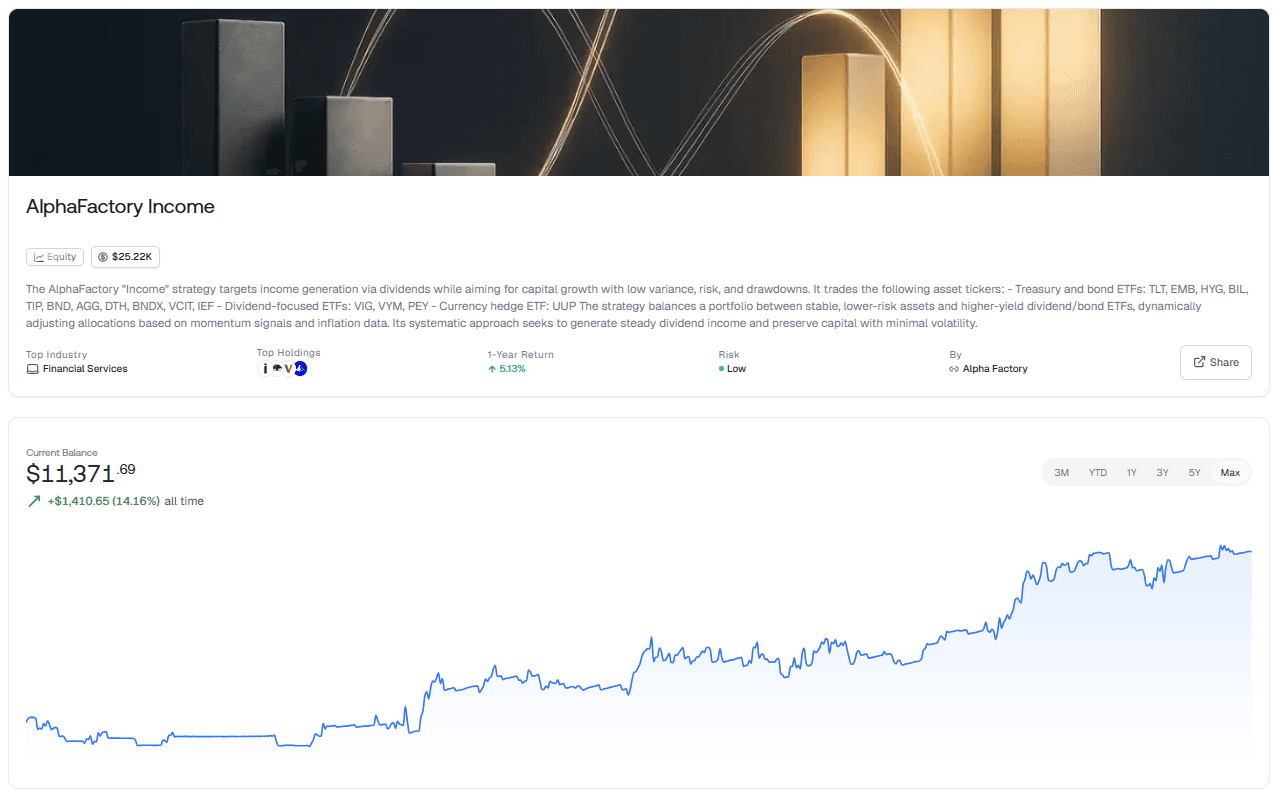
Rather than spending hours researching individual pipeline operators and royalty companies, you can deploy a rules-based strategy that manages the position automatically — rebalancing across treasury ETFs, dividend-focused holdings, and income-generating equities to target consistent returns with minimal volatility.
This is not a buy-and-hope approach. It is a disciplined, data-driven income strategy designed for investors who want their energy and income exposure to work while they focus on everything else.
[Deploy the AlphaFactory Income Strategy on Surmount →]
No coding required. Connect your existing brokerage account and let the strategy run.
Frequently Asked Questions
What does it mean to invest in oil without buying oil?
It means gaining exposure to the energy sector through royalty companies, midstream pipelines, and infrastructure businesses rather than purchasing crude oil directly or through futures contracts.
What are oil royalty stocks and how do they work?
Oil royalty stocks are companies that own mineral rights and collect income every time a producer extracts oil or gas from their land — without bearing any drilling or operational costs.
Are midstream energy stocks affected by falling oil prices?
Less so than drillers. Most midstream energy stocks operate on fixed-fee contracts, meaning their revenue depends on production volumes rather than the spot price of oil.
How do I generate passive income from oil without commodity risk?
By combining oil royalty stocks and midstream pipeline companies, investors can build a passive income from oil portfolio that is driven by production activity and contractual fees rather than daily price swings.
Is automated energy investing a good strategy for retail investors?
Yes — a systematic approach removes the need for deep sector research and ensures disciplined rebalancing across the energy supply chain, which is difficult to maintain manually.

Automate any portfolio using data-driven strategies made by top creators & professional investors. Turn any investment idea into an automated, testable, and sharable strategy.