Should I Invest in Asian REITs? What to Know First
Surmount Blogs
Thinking about Asian REITs? Here’s what most investors miss about the risks before putting money in.

Should I Invest in Asian REITs? What to Know First
Asian REITs have a compelling pitch on paper — lower valuations, rapidly developing economies, and the promise of fast-rising rents. But before you allocate capital across the Pacific, there are some structural risks most investors never see coming.
Here is what you need to know before investing in Asian REITs — and if you’re still weighing whether REITs make sense at all right now, our 2026 REIT breakdown covers the macro case in full.
What Are Asian REITs and Why Do They Look Attractive?
A real estate investment trust (REIT) is a company that owns income-producing properties and distributes at least 90% of its taxable income to shareholders. The REIT structure exists across dozens of markets globally — and Asia has become one of the fastest-growing REIT regions in the world.
Countries like Japan, Singapore, Hong Kong, China, and India all have active REIT markets, with hundreds of listed entities covering everything from retail malls to logistics hubs.
The Valuation and Growth Case for Asian REITs
The surface-level argument for Asian REITs comes down to two things:
Lower valuations — many Asian REITs trade at significant discounts to net asset value (NAV), something that is rarer in the US market
Growth potential — rapidly urbanising economies can produce faster rent growth and asset price appreciation than more mature Western markets
For investors who feel the US REIT market is fully priced, Asia can look like an obvious value play — though as our REITs vs. rental properties guide shows, the quality of the vehicle matters far more than the geography.
Which Countries Have the Biggest REIT Markets?
The largest and most liquid Asian REIT markets are:
Japan — the largest in Asia, with over 60 listed J-REITs covering office, residential, retail, and logistics
Singapore — one of the most institutionally developed markets in the region, with S-REITs known for transparency
Hong Kong — smaller market, but home to several large diversified entities
China and India — emerging markets with growing but still immature REIT frameworks
According to NAREIT, the Asia-Pacific region now accounts for a significant share of the global listed real estate universe — but market size and market quality are very different things.

The Hidden Risks of International REIT Investing
The growth story sounds convincing. The problem is what the pitch decks leave out.
Ground Lease Risk REITs Rarely Disclose
One of the most significant risks in Asian REIT investing is ground lease exposure — and it is almost never prominently disclosed.
In countries like Japan, Singapore, and China, many properties sit on land that the REIT does not actually own. The REIT owns the building. The land beneath it is leased from a government entity or third party, often on a long but finite term.
As MSCI’s property index methodology makes clear, ground lease exposure is a recognised valuation discount factor in institutional real estate analysis. This creates several problems:
Capped appreciation — if you do not own the land, long-term value growth is structurally limited
Lease expiry risk — when the ground lease ends, the asset’s value can deteriorate sharply
Reduced collateral quality — lenders and acquirers price ground lease assets at a discount
This is a layer of risk that most Western investors are not accustomed to evaluating — similar to how sector concentration risk can go unnoticed until a cycle turns against you.
REIT Management Conflicts in Asian Markets
Asian REIT markets are younger and operate under weaker governance frameworks than their US equivalents. The most common issue is external management — and the conflicts of interest that come with it.
In many Asian REITs, the manager is a separate entity that earns fees based on assets under management. As research shows, external management structures in REITs create misaligned incentives that consistently disadvantage minority shareholders. A particularly damaging practice is asset dumping — where the manager or a related party develops properties through a separate vehicle and then sells them into the REIT at inflated prices.
Related party transactions at scale are a significant red flag in any market — the same discipline that goes into evaluating dividend safety applies directly here: if the income source is structurally compromised, the yield means nothing.
Why Low Valuations Do Not Always Mean Good Value
A REIT trading at a 40% discount to NAV is only a bargain if that NAV is real and recoverable. As Morningstar’s REIT analysts have noted, a persistent discount to NAV is only an opportunity if the underlying asset values and governance are sound — otherwise it is a signal of structural impairment, not mispricing.
In markets with ground lease exposure, governance issues, and limited institutional oversight, discounts to NAV can persist indefinitely — or the NAV itself can prove overstated. Cheap valuations without quality management, clean asset ownership, and transparent governance are a value trap, not an opportunity.
Best REITs to Invest In — The Case for Staying Home
None of this means international real estate diversification is a bad idea. It means the method matters enormously.
The best REITs to invest in share a few common characteristics regardless of geography:
Internal management — alignment between management and shareholders
Clean asset ownership — no ground lease complications or undisclosed encumbrances
Transparent governance — regular disclosure, independent boards, minimal related party transactions
Conservative leverage — loan-to-value ratios that can withstand a downturn
By these criteria, the US REIT market — and a small number of well-run Singapore REITs — consistently score higher than the broader Asian REIT universe, which is why building diversification systematically tends to outperform region-picking over a full cycle.
How REIT Diversification Protects Your Portfolio
The legitimate goal behind looking at Asian REITs — geographic diversification — is worth pursuing. REIT diversification across property sectors and regions does reduce drawdown risk and improves risk-adjusted returns over time.
The OECD’s research on Asia-Pacific urban growth confirms the underlying demand story is real — the question is how to capture it without concentrating in markets you cannot easily monitor or govern.
A systematic approach that selects high-quality real estate assets across geographies, weighted by financial strength and risk-adjusted return potential, captures the diversification benefit without the pitfalls of picking individual Asian REITs.
A Smarter Way to Get International Real Estate Exposure
If the thesis behind Asian REITs — faster growth, geographic diversification, lower valuations — appeals to you, there is a better way to express it.
Rather than concentrating in a single market with opaque governance and ground lease risk, a globally diversified real estate strategy gives you exposure to the strongest real estate assets across multiple geographies, selected systematically for quality rather than surface-level valuation metrics.
That is exactly what the Global Real Estate Exposure strategy on Surmount is built to do — and it does it automatically, without requiring you to evaluate ground lease disclosures or monitor management conflicts quarterly.
Passive real estate investing done right means owning the best assets globally, not the cheapest ones regionally — and automated exposure is the most disciplined way to achieve it without emotional interference.
Automate Your Global Real Estate Exposure With Surmount
The case this post has made is simple: the idea behind Asian REITs — geographic diversification, exposure to fast-growing real estate markets, income from global property — is sound. The execution through individual Asian REITs is where most investors run into trouble.
The Global Real Estate Exposure strategy on Surmount solves that problem directly.
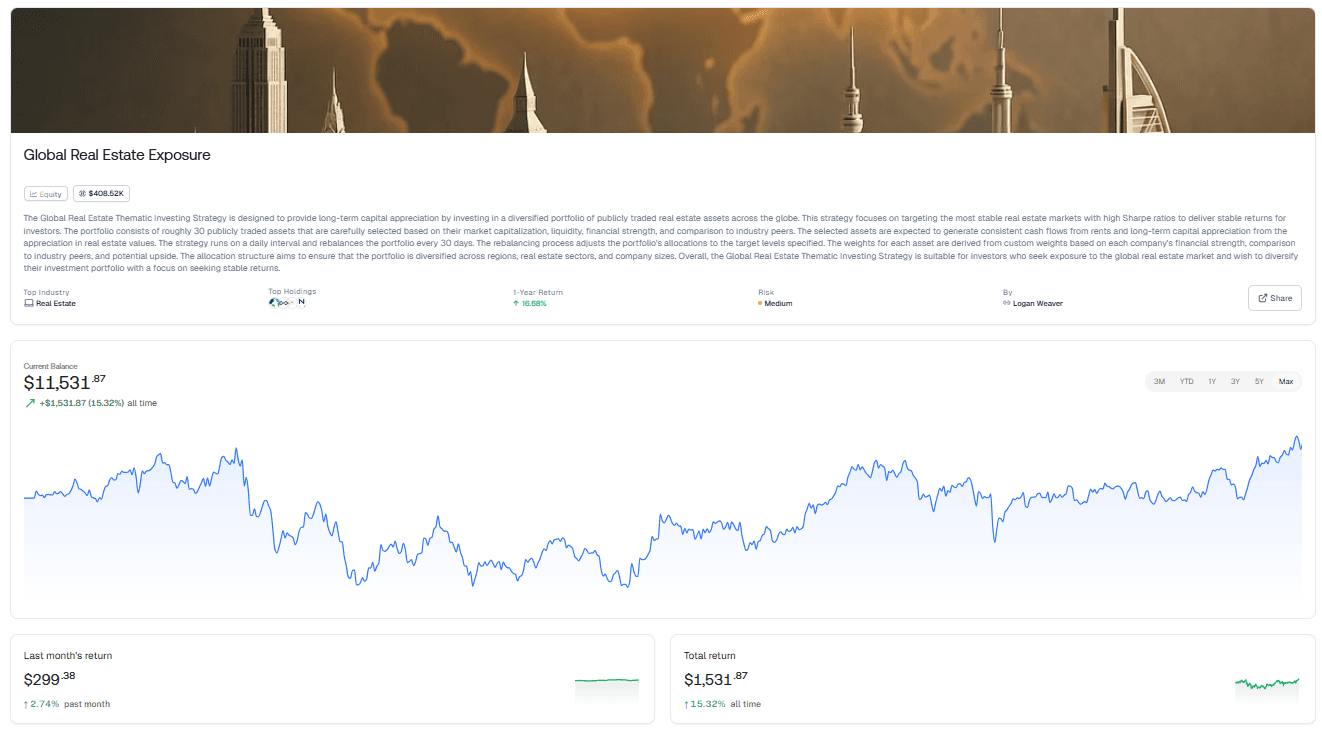
Instead of navigating ground lease disclosures, external management conflicts, and opaque governance structures across a dozen Asian markets, this strategy does the heavy lifting for you — systematically, automatically, and without the concentration risk of betting on a single region.
Here is what you get:
~30 of the world’s highest-quality publicly traded real estate assets — selected for financial strength, regional diversification, and risk-adjusted return potential
Automatic monthly rebalancing — so your allocation stays aligned with the best opportunities across property sectors without you having to monitor markets
True geographic diversification — across residential, industrial, logistics, and infrastructure real estate in multiple regions, not just one
No mortgage, no tenants, no governance headaches — pure systematic exposure to global real estate income and growth
Runs directly inside your existing brokerage account — no transfers, no minimums, no complexity
The same diversification thesis that makes Asian REITs appealing on paper is available to you in a cleaner, more transparent, and more systematically managed form. You get global real estate exposure without the structural risks that come with picking individual markets you cannot easily monitor.
Deploy the Global Real Estate Exposure Strategy →
Frequently Asked Questions
Should I invest in Asian REITs in 2026?
For most investors, the risks outweigh the rewards. Asian REITs face structural challenges including ground lease exposure, external management conflicts, and weaker governance frameworks that are difficult to evaluate from the outside. A globally diversified real estate strategy tends to deliver better risk-adjusted returns without those pitfalls.
What are the biggest risks of investing in Asian REITs?
The two most significant are ground lease risk — where the REIT owns the building but not the land beneath it — and REIT management conflicts arising from external management structures that incentivise asset growth over shareholder returns. Both are common across Asian markets and rarely prominently disclosed.
Are Asian REITs good for international REIT investing and diversification?
The diversification goal is legitimate, but Asian REITs are not the most efficient way to achieve it. International REIT investing through a quality-screened, systematically managed global real estate strategy gives you geographic diversification without concentrating in markets with structural governance weaknesses.
What is ground lease risk in REITs and why does it matter?
Ground lease risk means the REIT owns the building but leases the land from a third party, often a government entity. This caps long-term appreciation potential, introduces lease expiry uncertainty, and reduces the asset’s collateral value — all of which can quietly erode returns over time.
What are the best REITs to invest in for passive real estate investing?
The best REITs to invest in share three qualities: internal management with aligned incentives, clean asset ownership with no ground lease complications, and conservative leverage. For passive real estate investing, a diversified strategy across multiple high-quality REITs in transparent markets consistently outperforms concentrated regional bets over a full market cycle.

Automate any portfolio using data-driven strategies made by top creators & professional investors. Turn any investment idea into an automated, testable, and sharable strategy.