How to Invest for the Next 25 Years (And Not 5)
Surmount Blogs
Learn how to invest for the next 25 years with a resilient, diversified, systematic strategy.

How to Invest for the Next 25 Years (And Not 5)
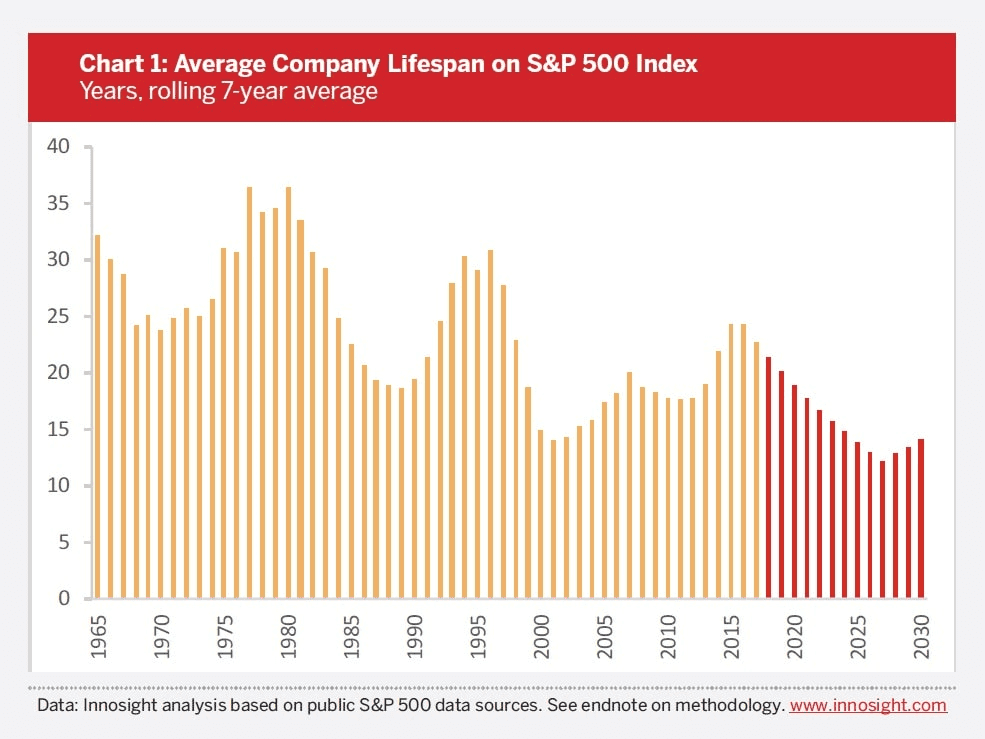
Every generation convinces itself its biggest companies are permanent fixtures. In 2000, the largest U.S. companies included names like GE, Cisco, and Exxon. Today, only one of them remains in the top ten. The lesson isn't that today's tech giants are doomed — it's that certainty about the next 25 years is a losing bet, no matter how dominant a company looks right now.
If you're thinking seriously about how to invest for the next 25 years, the goal isn't picking which company survives. It's building a portfolio that doesn't depend on you guessing correctly.
Why Today's Winners Aren't Guaranteed Tomorrow's
It's tempting to assume today's largest companies are simply too big, too diversified, or too entrenched to lose their footing. IBM was the most dominant technology company in the world for the better part of three decades. General Electric was once the most diversified industrial conglomerate on the planet, with financial arms, media assets, and manufacturing spanning the globe. Kodak invented the digital camera and still lost its entire market. Diversification and scale didn't save any of them from being overtaken.
That's not a reason to panic about the companies leading markets today. It's a reason to think about how to invest for the next 25 years in a way that isn't dependent on any single company, or even a handful of companies, staying on top.
The Case for a Long-Term Investing Strategy
A genuine long-term investing strategy isn't about predicting winners — it's about structuring a portfolio so leadership changes don't derail your progress.
What History Teaches Us About Market Concentration Risk
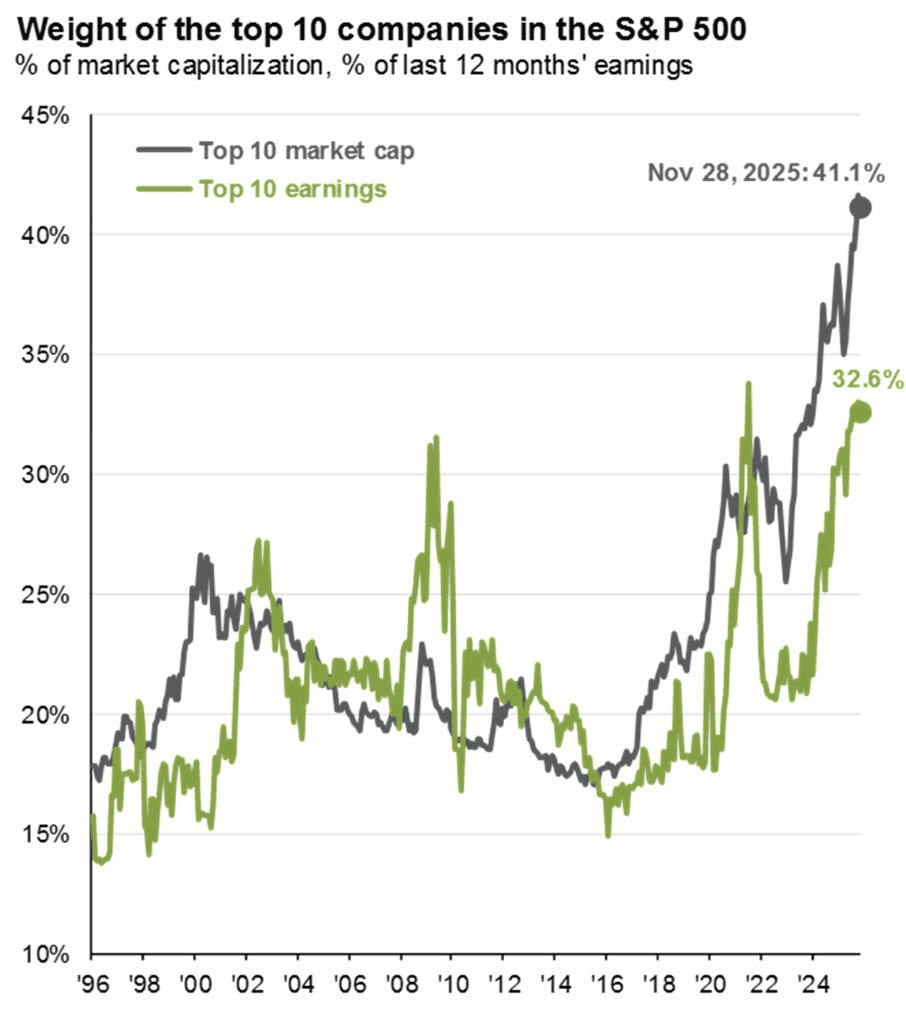
Market concentration risk shows up when a small number of stocks make up an outsized share of an index or portfolio. Right now, a handful of mega-cap technology companies represent a historically large percentage of total U.S. market capitalization (S&P Dow Jones Indices tracks this concentration closely). That concentration has been a powerful tailwind in recent years, but it cuts both ways. When previous market leaders faltered — GE, Nokia, Sears — investors overweighted in those names didn't just underperform, they lost real purchasing power over years of compounding they can't get back.
This isn't a call to abandon large tech companies. It's a reminder that any portfolio leaning heavily on a narrow set of winners is making an implicit bet on those winners staying winners for decades. As we've explored before. History suggests staying concentrated is a coin flip at best.
Diversifying Your Portfolio Beyond the Obvious Winners
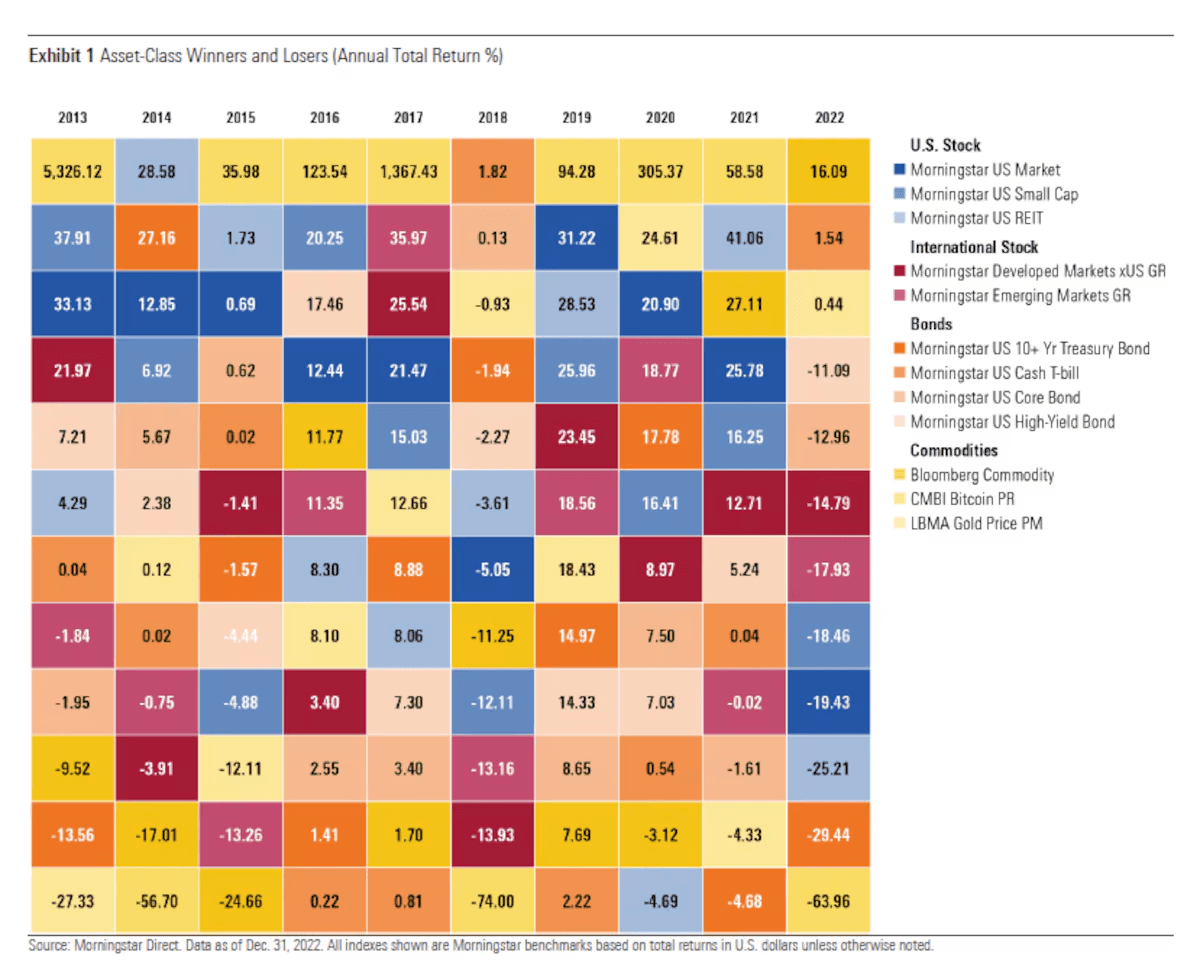
Diversifying your portfolio for a 25-year horizon means looking past what's currently popular — one of the often-overlooked downsides of relying on index investing alone. That includes exposure across sectors, market caps, and geographies, not just a basket of the largest, most talked-about names. It also means considering asset classes and themes that aren't yet mainstream, since some of the next quarter-century's leaders likely don't exist yet, or exist in a form the market hasn't recognized.
Real diversification isn't about owning more stocks for the sake of it — it's the same principle behind Ray Dalio's All Weather approach, built to hold up no matter which regime the market is in. It's about ensuring no single disruption — technological, regulatory, or competitive — can meaningfully derail your long-term outcome.
Building a Future-Proof Investment Strategy
A future-proof investment strategy isn't one that predicts the future correctly. It's one that performs reasonably well across a wide range of possible futures, because you didn't concentrate your bets on one specific outcome.
Why a Systematic Investing Strategy Beats Guesswork
A systematic investing strategy replaces conviction-based stock picking with rules: predefined criteria for what to hold, how much, and when to rebalance — because, as we've covered, diversification alone isn't enough to optimize risk. Instead of trying to identify which company will still be dominant in 2050, a systematic approach continuously evaluates fundamentals, momentum, or other measurable factors, and adjusts holdings accordingly.
This matters because human judgment is bad at long time horizons. Investors consistently overweight recent performance, assuming current trends will simply continue — a pattern McKinsey's research on corporate longevity has documented as company lifespans on major indices have shrunk over time. A systematic investing strategy doesn't carry that bias into 2030, 2040, or 2050 — it responds to what the data shows at the time, not what worked ten years earlier.
How Automation Removes Emotion From Long-Term Decisions
Automation extends this discipline by removing the emotional component from execution. It's one thing to intellectually understand that market concentration risk exists — it's another to actually sell a stock that's been rewarding you for years, because the rules say diversification matters more than recent performance. Morningstar's research on diversification consistently shows that disciplined, rules-based rebalancing outperforms ad hoc decision-making over long horizons. Automated, rules-based strategies enforce that discipline consistently, rebalancing on a set schedule rather than on a hunch or headline.
Putting It Into Practice
Thinking about how to invest for the next 25 years requires accepting a simple truth: you don't know which companies will lead in 2050, and neither does anyone else with certainty. What you can control is whether your portfolio depends on getting that guess right.
A long-term investing strategy built on diversification, systematic rules, and automated execution doesn't require predicting the future. It's designed to hold up reasonably well across whatever future actually arrives — which, for a 25-year horizon, is the only realistic goal worth pursuing.
Put the Next 25 Years on Autopilot with Signal 47 Multi-Factor
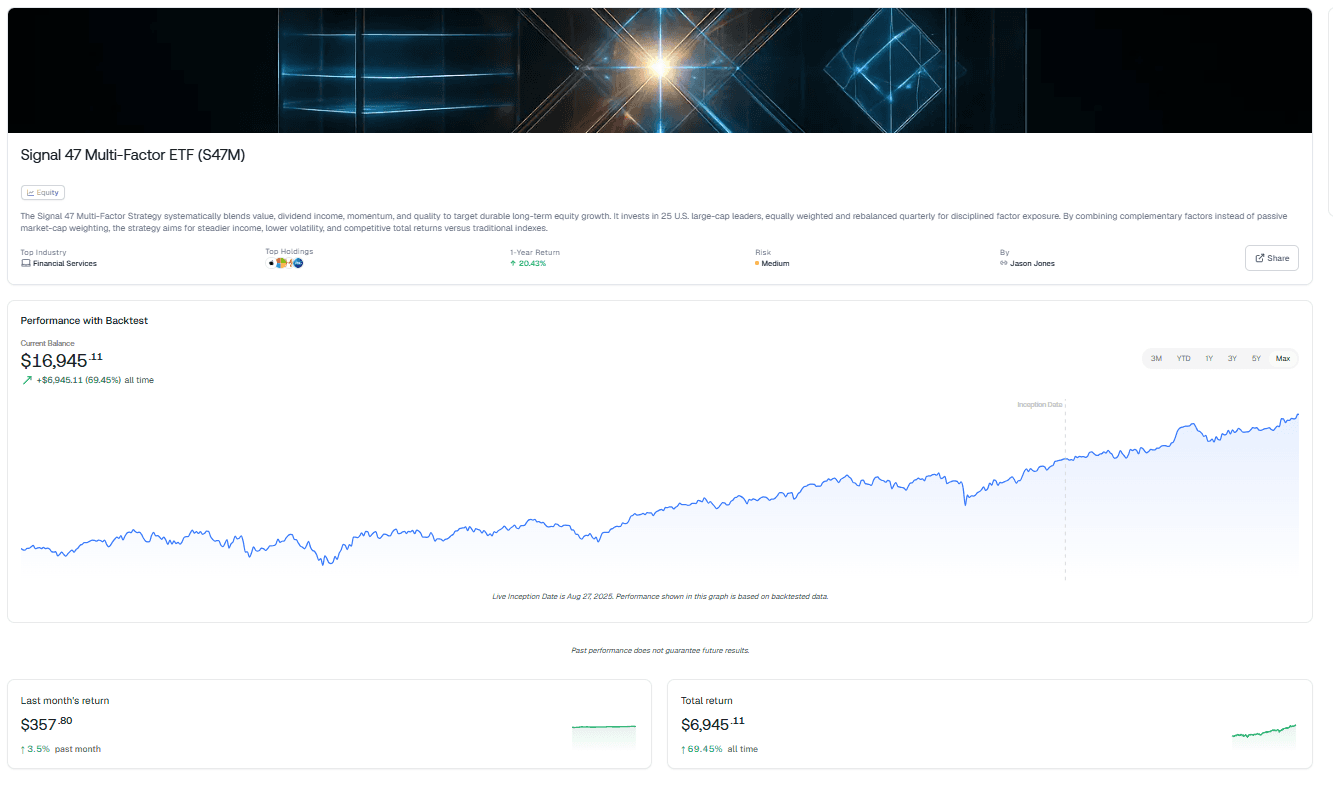
If the biggest risk to a 25-year portfolio is betting too heavily on today's winners, the fix isn't guesswork — it's structure. That's exactly what the Signal 47 Multi-Factor ETF (S47M) is built for.
Instead of chasing whichever mega-cap name is dominating headlines this year, Signal 47 systematically screens 25 U.S. large-cap leaders across sectors like technology, healthcare, financials, energy, and industrials — so no single company or sector can quietly take over your portfolio the way the “obvious winners” always seem to, right up until they aren't.
Why Signal 47 fits a long-term investing strategy:
Built-in diversification — 25 companies across multiple sectors, not a concentrated bet on a handful of names
Multi-factor discipline — screens for value, dividend strength, momentum, and quality, so no single trend has to keep working forever
Equal-weighted structure — avoids the concentration creep that happens when a handful of winners grow to dominate cap-weighted indexes
Quarterly rebalancing — enforces the discipline of trimming winners and adding to laggards, automatically, without emotion
Benchmarked transparency — measured against SPY, VTV, VYM, and MTUM, so you always know exactly what you're getting
History has shown, again and again, that today's largest companies aren't guaranteed to be tomorrow's. Signal 47 doesn't ask you to predict which ones will make it — it's designed to perform across whichever companies end up leading, because it isn't betting on any single outcome in the first place.
Deploy Signal 47 Multi-Factor to your portfolio today and let a systematic, rules-based strategy handle the next 25 years — so you don't have to guess.
Frequently Asked Questions: How to Invest for the Next 25 Years
How do I invest for the next 25 years?
Focus on a long-term investing strategy built around diversification and systematic rules, not predictions about which companies will still be dominant decades from now.
What is market concentration risk?
Market concentration risk happens when a small number of stocks make up an outsized share of an index or portfolio, increasing vulnerability if those companies underperform.
Why is diversifying your portfolio important for long-term investing?
Diversifying your portfolio reduces reliance on any single company or sector, so no one disruption can derail your progress over a multi-decade horizon.
What is a systematic investing strategy?
A systematic investing strategy uses predefined rules — rather than emotion or conviction — to decide what to hold, how much, and when to rebalance.
How can I build a future-proof investment strategy?
A future-proof investment strategy combines diversification, systematic rules, and automation, so your portfolio holds up across many possible futures rather than one predicted outcome.

Automate any portfolio using data-driven strategies made by top creators & professional investors. Turn any investment idea into an automated, testable, and sharable strategy.