Investing in 2025: Markets Absorbed Chaos—Can Your Strategy Handle What's Next?
Surmount Blogs
Markets gained 15% in 2025 despite tariffs, Fed uncertainty, and AI volatility. Why systematic investing strategies outperformed manual portfolio management.

Investing in 2025: Markets Absorbed Chaos—Can Your Strategy Handle What's Next?
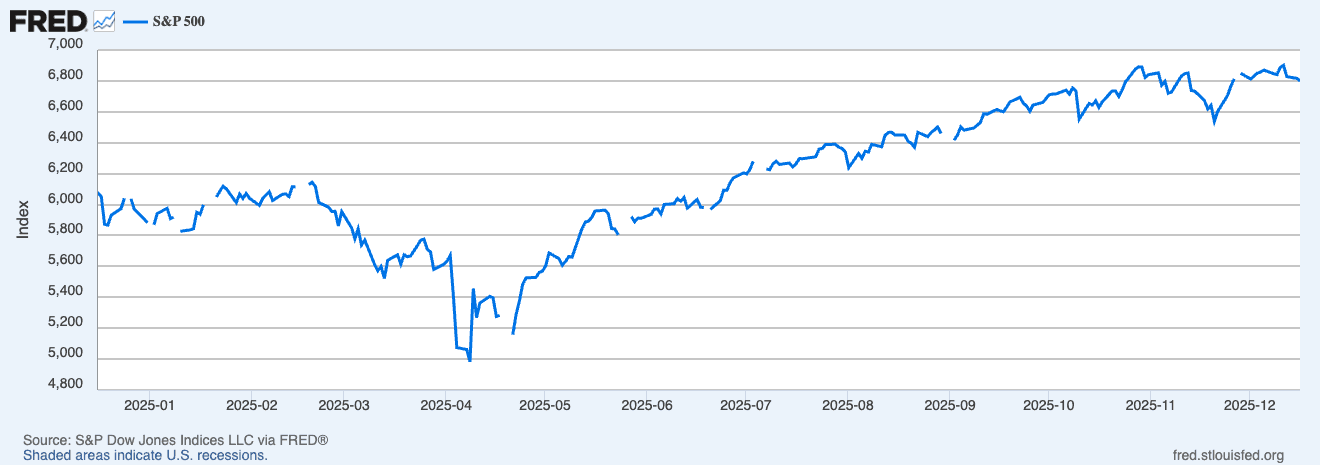
The S&P 500 gained roughly 15% in 2025, tech giants maintained record valuations, and small-cap stocks surged nearly 15% year-to-date. Yet beneath these gains sat a market wrestling with tariff upheaval, inflation stuck around 3%, and a Federal Reserve caught between cautious rate cuts and political pressure.
For investors trying to make sense of this year, the lesson isn't that markets defied gravity—it's that 2025 exposed how fragile conventional strategies become when every tailwind carries crosswinds.
April's Tariff Crisis: Markets Learned to Adapt
When President Trump unveiled "Liberation Day" tariffs in April, panic ensued:
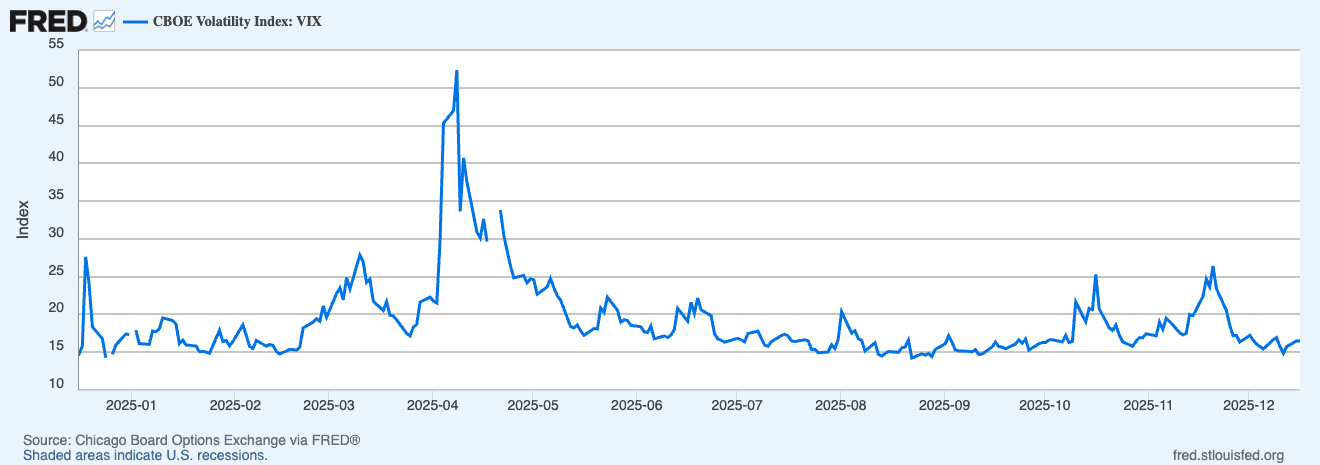
VIX volatility index spiked above 50—levels unseen outside 2008 and COVID
S&P 500 hemorrhaged value as trade war fears escalated
Markets normalized by late April as trade deals materialized faster than feared
The reality: U.S. import taxes hit highest levels since the 1930s, adding $1,100-$1,200 per household in costs. Yet the AI-fueled economy absorbed the shock without recession.
Global pain was real: Switzerland's GDP contracted, Japan's economy shrank nearly 2% in Q3. But policy chaos didn't automatically destroy portfolios when fundamentals held.
The Fed's Impossible Balancing Act
The Federal Reserve cut rates three times from September through December, bringing the federal funds rate to 3.50%-3.75%. But the December decision revealed deep divisions:
9-3 vote split with dissenters on both sides
Some wanted no cut (citing persistent inflation)
One governor pushed for 50 basis points (arguing labor needs support)
Fed Chair Powell signaled a likely pause ahead
The problem: Inflation remained stuck around 3%—well above the 2% target—while job gains slowed. The dual mandate pulled policy in opposite directions.
Consumer impact lagged: Despite 175 basis points of cuts since September 2024:
Auto loan rates dropped only 50 basis points
High-yield savings fell 83 basis points
Mortgage rates remained stubbornly elevated
AI Boom Meets Reality Check
The "Magnificent Seven" tech giants continued outperforming through November, powered by staggering AI infrastructure spending:
IT capital spending accounted for nearly 90% of U.S. GDP growth in H1 2025
Nvidia briefly topped $5 trillion in market cap
Global AI market projected to grow from $235B in 2024 to $631B in 2028
But November brought a reckoning: VIX surged above 26 as investors questioned valuations. A damning report found 95% of organizations getting zero return despite significant AI investments.
The shift: from "fund ambition" to "show me the money." Companies without concrete revenue or margin improvement faced harsh selloffs.
Small Caps Finally Break Through
Perhaps 2025's biggest surprise: the Russell 2000 resurrection after years of underperformance.
The numbers:
Surged 13.5% since August, outpacing S&P 500's 6.9% and Nasdaq's 10.3%
Gained approximately 15% year-to-date
Hit all-time highs in early December
Why it happened:
Lower rates disproportionately benefit debt-heavy small caps
Earnings projections showed 22% profit growth vs. 15% for large caps
Valuations became historically cheap relative to large caps
Investor appetite for diversification beyond mega-cap concentration
📊 Visual Reference: Russell 2000 vs S&P 500 Performance Comparison
What 2025 Taught Investors
Five uncomfortable truths emerged:
Policy volatility is permanent — Markets absorbed chaos without collapsing, but wild swings became normalized
Inflation won't surrender easily — The 3% floor proved stickier than forecasters expected
Sector rotation matters more than ever — Static allocations underperformed as leadership shifted constantly
AI's promise remains real but timing uncertain — Investors demand proof over promises
Market breadth returned — Multiple sectors contributed to gains after years of dangerous concentration
Why Systematic Investing Makes Sense Now
If you managed portfolios manually in 2025, you likely experienced whiplash. Tariff announcements, Fed pivots, sector rotations, and volatility spikes demanded constant attention.
Systematic, rules-based platforms like Surmount offer a fundamentally different approach:
Disciplined rebalancing without emotional bias or timing guesswork
Tactical tilts based on quantifiable metrics rather than headlines
Downside protection through programmatic rules that activate during volatility
Opportunity capture in mean-reversion scenarios emotional investors miss
The counterargument that automation can't handle unprecedented events fell apart in 2025. Systematic strategies navigated April's tariff crisis, adjusted to Fed pivots, and participated in small-cap rallies without requiring 24/7 monitoring.
The advantage: responding to changing conditions faster and more consistently than manual management allows, with transparency and customization unavailable in opaque black-box algorithms.
The 2026 Question
As 2025 closes, investors face contradictions that will define 2026: The Fed projects one additional rate cut, markets price in two. Inflation plateaus but stays elevated. Small caps offer compelling valuations but need economic stability. AI investment continues but demands clearer ROI.
What worked in 2025—adaptability over rigidity, systematic execution over emotional reactions, diversification beyond concentration—will inform what succeeds next year.
The investors who thrive won't predict the next crisis. They'll have frameworks flexible enough to respond when conditions inevitably shift. That's the case for systematic investing: in an environment where policy volatility, sticky inflation, and rapid rotations define the landscape, automation beats intuition. Rules beat hunches. Systematic execution beats reactive decision-making under pressure.
2025 rewrote assumptions about what markets can absorb. The question for 2026 isn't whether turbulence continues—it will. The question is whether your investment approach is built to handle it.

Automate any portfolio using data-driven strategies made by top creators & professional investors. Turn any investment idea into an automated, testable, and sharable strategy.