Outgrowing the Pie: The Best M1 Finance Alternative for Automated Algorithmic Trading
Surmount Blogs
Looking for a powerful M1 Finance alternative? Upgrade from passive pies to automated, rules-based strategies that connect directly to your favorite broker

Outgrowing the Pie: The Best M1 Finance Alternative for Automated Algorithmic Trading
If you are an investor who loves automated investing, you likely found M1 Finance. They revolutionized the concept of "set and forget" with their innovative "Pie" system, automated dynamic rebalancing, and fractional shares. For years, M1 has been the benchmark for passive, long-term investors looking to build diversified portfolios with absolute minimal effort.

But financial goals evolve. Markets change. And eventually, many users reach a ceiling, seeking out a reliable M1 Finance Alternative.
You start asking deeper questions. Instead of just maintaining a strict 10% allocation to Tech (M1's approach), what if you wanted to reduce that allocation automatically when tech valuations get too high? What if you wanted your automated portfolio to shift to cash during a market crash, rather than blindly buying more on the way down? What if you wanted to implement a proven strategy, like Momentum or Sector Rotation, without managing it manually every day?
You can’t do that in a straightforward way. M1 Finance is built for asset allocation, not market participation.
This fundamental limitation is driving sophisticated investors to seek a powerful M1 Finance alternative. While they have their strengths, M1 is a passive bucket. If you want a portfolio driven by data, logic, and active rules, you need an alternative that enables systematic, algorithmic trading.
That’s where Surmount enters the conversation.
Quick Verdict: Is Surmount the Best M1 Finance Alternative for You?
When to Choose Surmount: If your primary goal is to automate complex, rules-based strategies (like momentum or mean reversion) without leaving your current brokerage, Surmount is the superior choice. It is a "co-pilot" that turns your existing fidelity, Schwab, or Robinhood account into an automated trading powerhouse, offering a significant upgrade in automation depth and strategy logic.
When to Stick with M1 Finance: If you want a passive, all-in-one financial app that combines simplified "Pie" investing with high-yield banking, personal loans (M1 Borrow), and a credit card, stick with M1. It is the king of "set and forget."
If you’re ready for strategies driven by data, not just static allocation, you’re ready for Surmount.
M1 Finance vs. Surmount: At a Glance
We are comparing two different paradigms: Asset Allocation (M1) vs. Systematic Trading (Surmount). Both are automated, but their "automation depth" is worlds apart.
Feature | M1 Finance | Surmount |
Philosophy | Long-term Passive Allocation. | Active Systematic Trading. |
"Automation Depth" | Shallow: Automatically rebalances and reinvests new cash. | Deep: Executes complex rules like "If RSI > 70, then Sell." |
Strategy Control | High-level (Asset Allocation %). | Granular (Buy/Sell logic based on indicators). |
Strategy Type | Passive ETFs, long-only stocks. | Rules-based (Momentum, Value, Mean Reversion). |
Assets Supported | Stocks & ETFs only. | Stocks, ETFs, Crypto, Options (support varies). |
Brokerage Model | Integrated: Your assets must be held at M1. | Broker-Agnostic: Connects to your existing broker (Fidelity, etc.). |
Ancillary Services | High-Yield Cash, Margin Loans (M1 Borrow), Credit Card. | None (Focuses purely on strategy and automation). |
Pricing | Free for accounts over $10,000; otherwise $3/mo platform fee. | Fixed $20/month or $120/year subscription. |
Learning Curve | Very Low (minutes to learn). | Moderate (requires understanding of strategy logic). |
What M1 Finance Does Well: The Master of the "Set and Forget"
To be fair, M1 Finance is fantastic for what it is designed to do. We should give credit where it's due.
1. The Brilliant "Pie" Interface
M1’s core feature—allowing you to create "Pies" with custom slices representing individual stocks or ETFs—is a stroke of visual genius. It makes portfolio construction intuitive and fun, simplifying a complex process for beginner and intermediate investors.
2. Truly Hassle-Free Dynamic Rebalancing
This is M1’s single best automated feature. When you deposit new cash, M1 doesn’t simply distribute it proportionally. Instead, it automatically buys underweight slices in your Pie, working to keep your target allocation balanced without triggering a taxable event (selling). It makes maintenance completely frictionless.
3. Fractional Shares and Automatic Dividend Reinvestment
M1 was an early adopter of fractional shares, enabling you to invest every single dollar in your Pie, regardless of stock price. When dividends hit your account, M1 reinvests them using its Dynamic Rebalancing logic once your cash balance hits a certain threshold. It is the ultimate compound interest machine.
4. Cost Efficiency for Large Portfolios
If your portfolio exceeds $10,000, M1 Finance is effectively free. This makes it an incredibly low-cost option for managing a large, diversified, passive portfolio over the long term.
Summary: M1 Finance is an excellent choice for a busy professional who wants to take 30 minutes to set a smart asset allocation and then not think about their portfolio over the long term.
Where M1 Finance Falls Short: The Passive Trap
The same simplicity that makes M1 Finance great also creates severe limitations for investors who want to move beyond a beginner mindset. As you become a more experienced, systematic investor, M1's limitations become frustrating roadblocks.
1. Limited Strategic Depth: Rules, Not Just "Pies"
The single biggest limitation of M1 Finance is that your automation is limited to a fixed percentage allocation. You can automate what percentage of your portfolio is in a sector, but you cannot automate how that sector should be traded.
An M1 user says: "Automate buying 20% tech, always."
A systematic investor wants to say: "Automate buying 20% tech ONLY WHEN the QQQ ETF is above its 200-day moving average, but rotate to cash if the unemployment rate rises above 6%."
This level of rules-based logic is impossible within M1’s architecture. As an M1 user, you are a passive passenger. If a specific asset class becomes radically overvalued, you have two choices: login and manually change your Pie, or keep blindly buying it through your automated deposits. This "passive trap" can drag down performance in volatile or trending markets.
2. The Integrated Brokerage Trap
M1 is not a tool; it is a full-service, integrated brokerage. If you want to use its automation, you must move your assets to M1.
For many investors, this is a non-starter. Perhaps you have a legacy Fidelity account you’ve had for decades. Maybe you have institutional-grade research access or discounted pricing at Schwab or Interactive Brokers. You love your broker, but you hate that they lack modern automation tools.
To use M1's Pies, you must endure the administrative headache of a formal ACATS transfer (moving your whole account). Worse, it often results in uninvested cash during the transfer period, known as being "out of the market." An integrated broker limits your flexibility.
3. No Algorithmic or AI-Driven Trading
Let’s be clear: M1 Finance offers zero support for algorithmic trading. You cannot backtest a strategy. You cannot use market indicators (like RSI, MACD, or Bollinger Bands) to trigger trades. You cannot build or even copy a complex trading strategy that uses logic.
In an era where quantitative and systematic investing is dominating the landscape, M1 Finance’s tools are functionally frozen in the early 2010s. For an active M1 alternative, you need a platform built on code and rules, not just percentages.
How Surmount Fills the Gap: Introducing Systematic Automation
Surmount is not trying to be a bank. It is not trying to manage your mortgage. Surmount exists for one reason: to democratize complex, algorithmic trading and allow anyone to automate strategies with real logic.

This focus makes it the clear automated investing alternative to M1 for investors who outgrow "Pies."
1. Move Beyond Allocation to Active Logic
With Surmount, your automation can have intellect. Instead of just setting a 5% allocation to "gold" (an M1 Pie approach), you can deploy an automated, rules-based strategy like Sector Rotation:
RULE 1: On the first day of every month, analyze the performance of the Top 5 sectors over the last six months (a standard Momentum logic).
RULE 2: Buy the top-performing sector (e.g., Energy).
RULE 3: Set a trailing stop-loss of 10% to protect your capital.
This entire process—data analysis, asset selection, order execution, and risk management—can be fully automated on Surmount. You don't just own assets; you apply a quantitative logic to them.
Surmount offers this capability with a simple no-code strategy builder (great for beginners) and a robust Python IDE (for professional "quants"), making it a potent "co-pilot" for any investor interested in systematic returns.
2. Keep the Broker You Love: The "Broker-Agnostic" Revolution
This is arguably Surmount’s single greatest advantage as an alternative to M1. Surmount doesn't ask you to open a new brokerage account and transfer your assets.
Surmount is a broker-agnostic automation layer. It connects directly to your existing, trusted account (Fidelity, Schwab, Robinhood, Alpaca, etc.) using sophisticated automated programming interfaces (APIs).
This is a game-changer. You keep the security, established history, and benefits of your current broker while "supercharging" it with a level of automation they will never build themselves. There's no messy account migration, no being "out of the market," and you can disconnect Surmount instantly if you choose.
3. Data-Driven Backtesting and Strategy Marketplaces
M1’s approach is fundamentally based on belief. You believe that your chosen allocation will perform well. Surmount’s approach is based on data.
Before you invest a single dollar, Surmount lets you backtest any strategy with a single click. You can see how your custom-built momentum strategy would have performed over the last 15 years, analyzing critical data points like its Maximum Drawdown (the worst loss it would have experienced), its risk-adjusted returns (Sharpe ratio), and its performance versus the S&P 500 benchmark.
If you don’t want to build your own strategy, you can explore Surmount’s Strategy Marketplace. Here, you can find proven, rules-based strategies developed by other experienced investors and quants, review their complete historical data, and with one click, copy and deploy them into your own brokerage account.
4. Dynamic Risk Management (More Than Just Rebalancing)
M1’s dynamic rebalancing manages allocation risk. It cannot manage market risk.
Surmount can. You can build automation rules that say: "If the S&P 500 falls below its 200-day moving average, immediately move 100% of my portfolio to cash or short-term treasury ETFs." This automated risk management can be the difference between a 30% drawdown and a 5% loss during a true bear market. M1 Finance has no feature even remotely capable of this proactive defense.
Migration: How to Move from M1 to Surmount
Moving from M1 to Surmount is simpler than moving your entire financial life from a traditional broker to M1, but it still requires some steps.
Because Surmount is broker-agnostic, you can't just "connect" Surmount to M1's special account structure. You first need to land your assets at a "traditional" broker that Surmount supports.
Here is the step-by-step migration process:
Open an Account at a Surmount-Supported Broker: Open an account at an established broker known for good API connectivity, such as Fidelity, Charles Schwab (now including TD Ameritrade's systems), or a newer option like Alpaca or Robinhood.
Initiate an ACATS Transfer: Formally request your new broker to initiate an ACATS transfer from M1. This is the official, seamless way to move securities between institutions without liquidating your portfolio. Note: M1 often charges an account closure fee ($100+), so budget for this.
Wait for the Transfer: This process typically takes 5-10 business days. While the transfer is pending, your assets are frozen, so be prepared for a short period without trading capability.
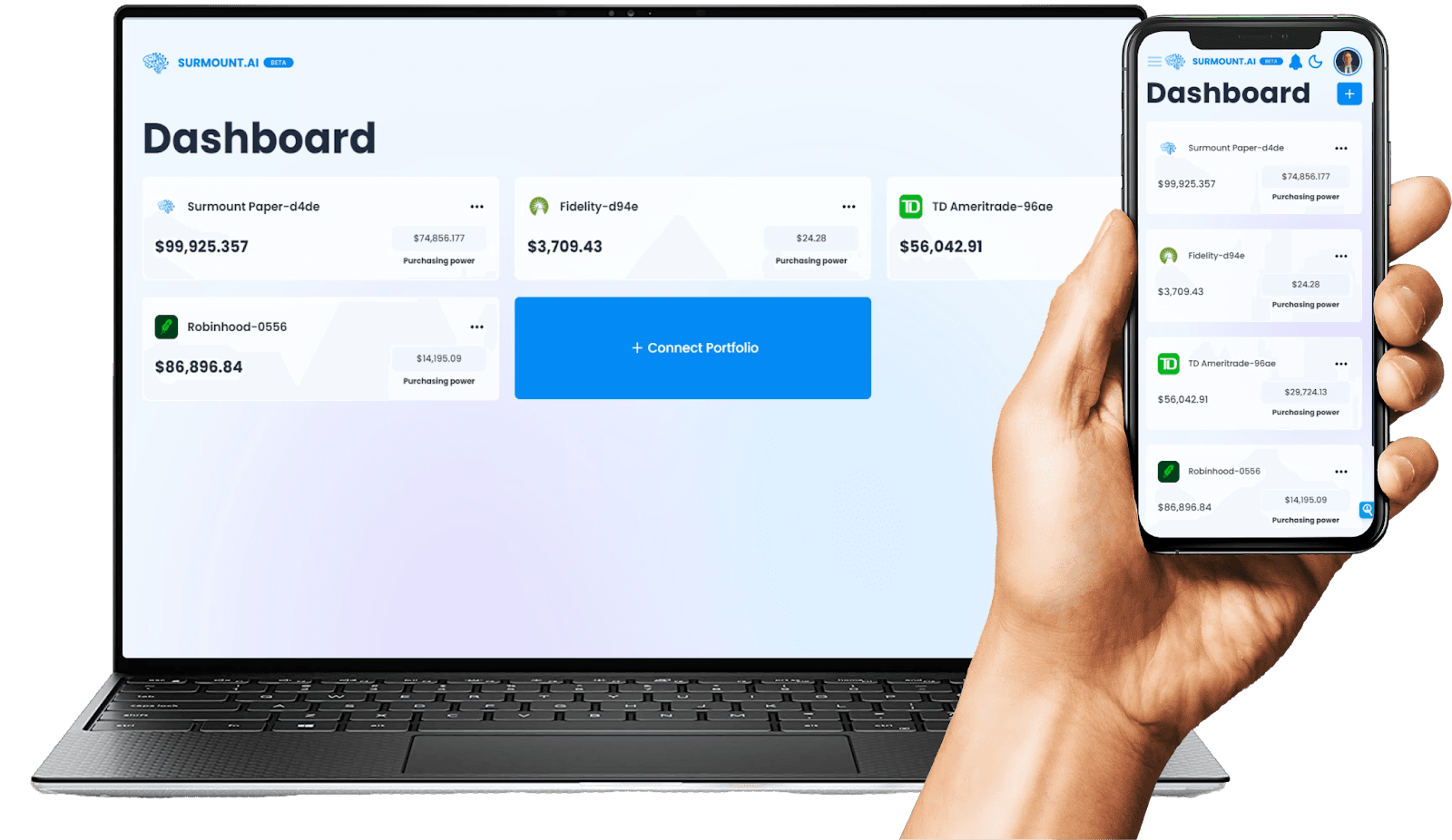
Connect Surmount to Your New Broker: Once your assets are fully settled in your new brokerage account, log in to Surmount, navigate to "Connected Brokers," and follow the simple on-screen instructions to authorize Surmount to read and place trades in your new account.
Build or Copy Your First Strategy: You’re ready! Now you can deploy the rules-based, systematic strategies that were impossible on M1.
The Final Step in Your Automation Journey
If your financial journey began with M1, you should be proud. You prioritized diversified, automated investing early.
But the moment you wish your automation could react to market data—the moment you wish it was a strategy with a quantifiable logic, not just a static Pie—is the moment you have outgrown it.
M1 Finance is a "bucket." Surmount is a "co-pilot."
You can keep your assets in a bucket, or you can deploy an intelligent, data-driven system to actively navigate the markets. Surmount lets you add true algorithmic intelligence to your portfolio while keeping the established broker you love. It’s not just an alternative to M1; it’s an evolution.
See Surmount's strategy marketplace →
Frequently Asked Questions
Is Surmount a direct brokerage like M1 Finance?
No. This is the biggest difference for those seeking an M1 finance alternative. M1 is a full-service brokerage where you must hold your assets. Surmount is a "broker-agnostic" automation layer. It connects to your existing accounts (like Fidelity, Schwab, or Robinhood) and executes strategies on your behalf using their API.
Can I connect Surmount directly to my M1 Finance account?
Currently, you cannot. M1 Finance’s unique "Pie" structure and restricted trading windows make it technically incompatible with the real-time, logic-based execution Surmount requires. To use Surmount, you would typically move your assets to a supported broker like Fidelity or Alpaca.
Does Surmount support fractional shares?
Yes, provided your underlying broker (like Robinhood or Fidelity) supports them. Surmount can execute trades in dollar amounts, allowing you to maintain the precise percentage-based allocations you loved in M1 while adding advanced logic on top.
Is Surmount’s automation safer than M1's "Pies"?
"Safety" depends on your strategy. M1's safety comes from its simplicity—it forces you into long-term holding. Surmount offers "Active Safety"—you can program automated stop-losses or "risk-off" rules (e.g., "move to cash if the market drops 10%") that M1 simply cannot do.
How does the pricing compare for small vs. large accounts?
M1 is more cost-effective for accounts over $10,000, as they waive their $3 monthly fee. Surmount charges a flat subscription (approx. $20/month). For serious investors, this cost is often seen as a "software fee" for the ability to run institutional-grade strategies that can potentially save or earn much more than the subscription price.
Can I still do "Set and Forget" investing with Surmount?
Absolutely. You can choose a pre-built strategy from the Marketplace, click "Deploy," and let it run. The difference is that while you are "forgetting" it, the strategy is actively monitoring the market and making intelligent adjustments based on data, rather than just waiting for your next deposit to rebalance.

Automate any portfolio using data-driven strategies made by top creators & professional investors. Turn any investment idea into an automated, testable, and sharable strategy.