Flash Crashes in Precious Metals: Liquidity, Leverage, and Long-Term Trends
Surmount Blogs
Explore the causes and lessons of flash crashes in precious metals, analyzing the roles of liquidity, leverage, and structural long-term trends for informed investing.

Late in January, as President Trump announced the nomination of Kevin Warsh for Federal Reserve Chair, market participants were faced with one of the sharpest jolts in the precious metals market in recent memory.
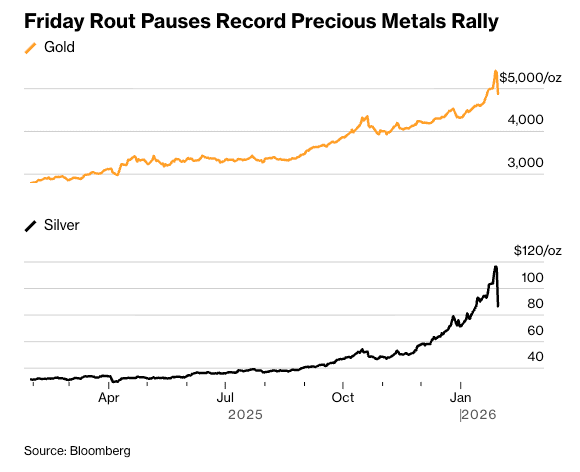
That moment, now widely referred to as the "Warsh Shock," marked the end of an almost vertical ascent for precious metals. In fact, in a single afternoon:
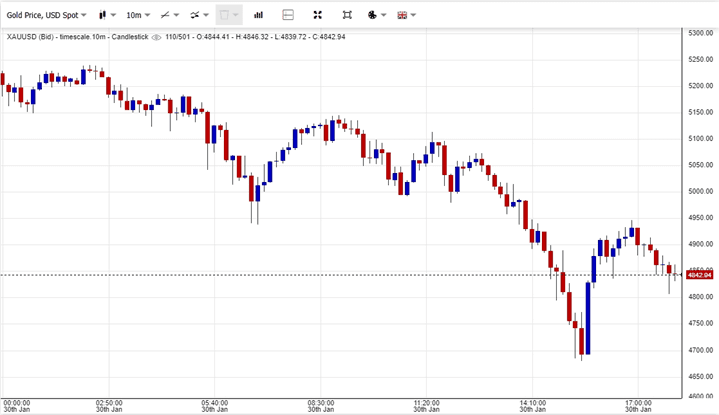
Gold plunged more than 9% (over $500/oz), its sharpest one-day dollar drop since 1983.
Silver essentially entered a freefall, collapsing 27–31% intraday as liquidity evaporated.
The U.S. Dollar Index (DXY) surged as investors pivoted from "inflation protection" to "dollar confidence," assuming Warsh would prioritize a stronger greenback and higher-for-longer interest rates.
Remarkably, however, in the two weeks since the “crash”, precious metals have been staging quite the recovery. This rebound highlights, of course, that not every extreme market reaction signals a fundamental shift.
Seeing Beyond the Noise: Flash Crashes and Forced Liquidity
Markets are full of short-term noise, and commodities like precious metals are no exception. If you rewind back about two weeks, when gold had just touched an astronomical all-time high of $5,602/oz, while silver was screaming toward $122/oz, fundamentals had seemingly left the building with greedy euphoria taking over the scene.
Many retrospectively point out that the hard correction was long overdue, and that the signs had become obvious well in advance.
Now that the dust has settled enough to see that while the "noise" was deafening, the "signal" remained intact:
1. The Anatomy of the "Noise"
When gold was at $5,602/oz and silver at $122/oz just before the crash, the market was "priced for perfection."
The Emotional Noise: Retail FOMO (Fear Of Missing Out) had pushed prices into a vertical, parabolic state.
The Mechanical Noise: An estimated 79% of the crash was driven by mechanical factors—algorithmic sell-stops, ETF rebalancing, and margin calls—rather than a sudden drop in global demand.
The Cross-Asset Contagion: Interestingly, a simultaneous $1.7 billion liquidation in the crypto markets forced many diversified hedge funds to sell their "liquid" gold to cover losses in Bitcoin, which fell from $88,000 to $85,000 that same day.
1. The Fundamental "Signal" (The Recovery)
Since the dip below $5,000/oz (Gold) and $80/oz (Silver), we’ve seen a "V-shaped" resilience. This recovery is the market "seeing beyond the noise" for three specific reasons:
Central Bank Dip-Buying: While "paper" traders panicked, the People's Bank of China (PBoC) announced its 15th consecutive month of gold reserve increases. Central banks are price-insensitive; they saw $4,700 gold as a gift, not a crisis.
The Silver Deficit: Silver is currently in its sixth consecutive year of structural deficit. Industrial demand from AI data centers (which require significantly more silver per server) and N-type solar cells means the physical metal is literally disappearing from vaults, regardless of what Kevin Warsh says about interest rates.
Supply Constraints: China’s recent export controls on silver (effective Jan 1, 2026) have restricted global supply by up to 50% for some manufacturers. This creates a "floor" that speculative selling can't easily break.
Turning Precious Metals into a Built-In Portfolio Shock Absorber
One of the smartest ways to play these volatile cycles—especially after a liquidity event like the "Warsh Shock"—is to stop viewing Gold and Silver as isolated bets and start viewing them as dynamic risk-management tools.
This can optimally be achieved through Surmount’s AlphaFactory Protective strategy, which functions as a high-conviction "safety valve" for equity investors.
How the AlphaFactory Protective Strategy Navigates Crashes
The strategy works because it doesn't wait for a crash to be "over" to protect you; it reacts to the conditions that cause crashes. Here’s why it is uniquely suited for the current 2026 landscape:
Dynamic Volatility Scaling: The core of the "Protective" logic is its reliance on SPY Realized Volatility. During the "Warsh Shock" on January 30, as volatility spiked, the strategy would have automatically scaled down its 10-stock equity basket. Unlike a human trader who might freeze in fear, the algorithm mechanically shifts the portfolio's "weight" toward GLD or cash as the risk environment heats up.
The GLD Pivot: By blending top NASDAQ/NYSE stocks with GLD (Gold ETF), the strategy treats gold as a "stabilizer." In a moderate volatility regime, it holds both stocks and gold. In a high-volatility "flash crash" regime, it can exit stocks entirely, leaving you in the defensive safety of gold while the "paper" selling in equities reaches its peak.
Momentum & Value Quality Control: Even when it is in stocks, it isn't just buying anything. By using Z-scores to rank stocks on both Momentum (12-month return) and Value (Negative PEG ratio), it ensures that the "High-Conviction" portion of your portfolio is anchored in companies that are both fundamentally sound and technically resilient.
When precious metals are either clouded by intense greed or panic, this strategy works so well because it replaces emotional decision-making with a cold, mathematical "Circuit Breaker.
Investor Takeaway
The “Warsh Shock” was a reminder that markets often confuse liquidity events with lasting regime shifts. Emotional excess and mechanical selling can violently distort prices, but structural demand, supply constraints, and disciplined capital allocation ultimately reassert themselves. Investors who distinguish noise from signal, and who embed systematic risk controls, position themselves to survive volatility and compound through it rather than react to it.

Automate any portfolio using data-driven strategies made by top creators & professional investors. Turn any investment idea into an automated, testable, and sharable strategy.