What Is Arbitrage Trading? An Beginner’s Guide
Surmount Blogs
Wondering what is arbitrage trading and how it works? This guide breaks down the core concept, common strategy types, and how to deploy a live arb strategy automatically through Surmount.

What Is Arbitrage Trading? An Beginner’s Guide
Arbitrage trading sounds like something reserved for Wall Street quants — but the concept is straightforward. You buy an asset in one place, sell it in another, and pocket the price difference. That's the core of what is arbitrage trading. It involves neither speculation nor directional bets. It is all about exploiting the price gaps that exist in the market.
The catch, however, is that these gaps close almost instantaneously. That's why the strategy has evolved dramatically, and why automation matters more than ever.
How Does Arbitrage Work?
Price inefficiencies happen constantly across markets. Two exchanges might price the same stock slightly differently for a few milliseconds. A currency pair might be misaligned across three brokers. A company's acquisition price might not fully reflect in its share price yet.
An arbitrageur spots the gap, executes both sides of the trade simultaneously, and captures the spread before the market corrects.
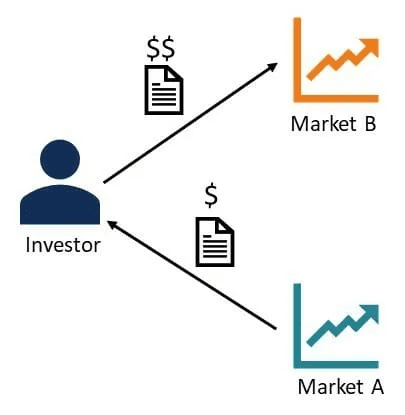
Here's a simple example of stock arbitrage:
Stock XYZ trades at $100.00 on Exchange A
Stock XYZ trades at $100.15 on Exchange B
You buy on A, sell on B, and capture $0.15 per share — risk-free
At scale, that adds up. Run it thousands of times a day and you have a serious strategy.
Types of Arbitrage Trading Strategies
Not all arbitrage looks the same. Here are the most common forms you'll encounter:
Exchange Arbitrage
Same asset, two markets, different prices. The most straightforward version — and the hardest to execute manually since gaps close in milliseconds.
Triangular Arbitrage
A three-step currency trade that exploits misalignment between exchange rates. For example: convert USD → EUR → GBP → USD, and come out ahead if the rates don't perfectly cancel.
Statistical Arbitrage
Instead of identical assets, you're trading correlated ones. If two stocks historically move together and suddenly diverge, you go long the cheaper one and short the more expensive one — betting on mean reversion.
Merger Arbitrage
When Company A announces it will acquire Company B at $50/share, and Company B is trading at $47, that $3 gap reflects deal risk. Merger arb means buying the target and betting the deal closes.
Pairs Trading (like AAPL/GOOG)
Two correlated stocks that tend to move in tandem. When one gets cheap relative to the other, you buy the laggard and short the leader — then close both when the spread normalizes.
The Real Challenge With Arbitrage Trading Strategy
Understanding the concept is easy. Executing stock arbitrage profitably is hard.
Speed. By the time a human spots a gap and clicks, it's gone. High-frequency trading firms co-locate servers next to exchanges specifically to shave milliseconds off execution time.
Transaction costs. Commissions, spreads, and slippage can wipe out thin margins entirely. Your arbitrage trading strategy only works if the captured spread exceeds total costs.
Capital efficiency. You often need significant position sizes to make small spreads worth trading.
Execution risk. If one leg of your trade fails or fills at a different price, you're no longer neutral — you have a position, and now you have risk.
This is why modern arbitrage is overwhelmingly algorithmic. The math is simple; the execution infrastructure is not.
What Is Arbitrage Trading in Practice Today?
For most retail investors, pure high-frequency stock arbitrage isn't accessible. But pairs trading and statistical arbitrage are — especially with the right tools.
Pairs trading is the most retail-friendly form of arbitrage trading strategy because:
You're not racing against HFT firms on microsecond gaps
The edges are based on fundamental correlations, not pure speed
Positions can be held for hours or days, not milliseconds
Both legs can be executed through a standard brokerage account
The AAPL/GOOG pair is a classic example. Both are mega-cap tech stocks with overlapping revenue drivers — advertising, consumer hardware, services. They tend to move together. When they diverge meaningfully, history suggests they'll converge again.
Running an Arbitrage Strategy Without Building It Yourself
The hardest part of any arbitrage trading strategy isn't the idea — it's systematic execution. Identifying divergences, sizing positions correctly, managing both legs, and knowing when to exit.
Surmount's AAPL/GOOG Arb strategy automates exactly this. It monitors the spread between the two stocks in real time, enters when divergence hits a statistically significant threshold, and manages the exit automatically when the spread closes.
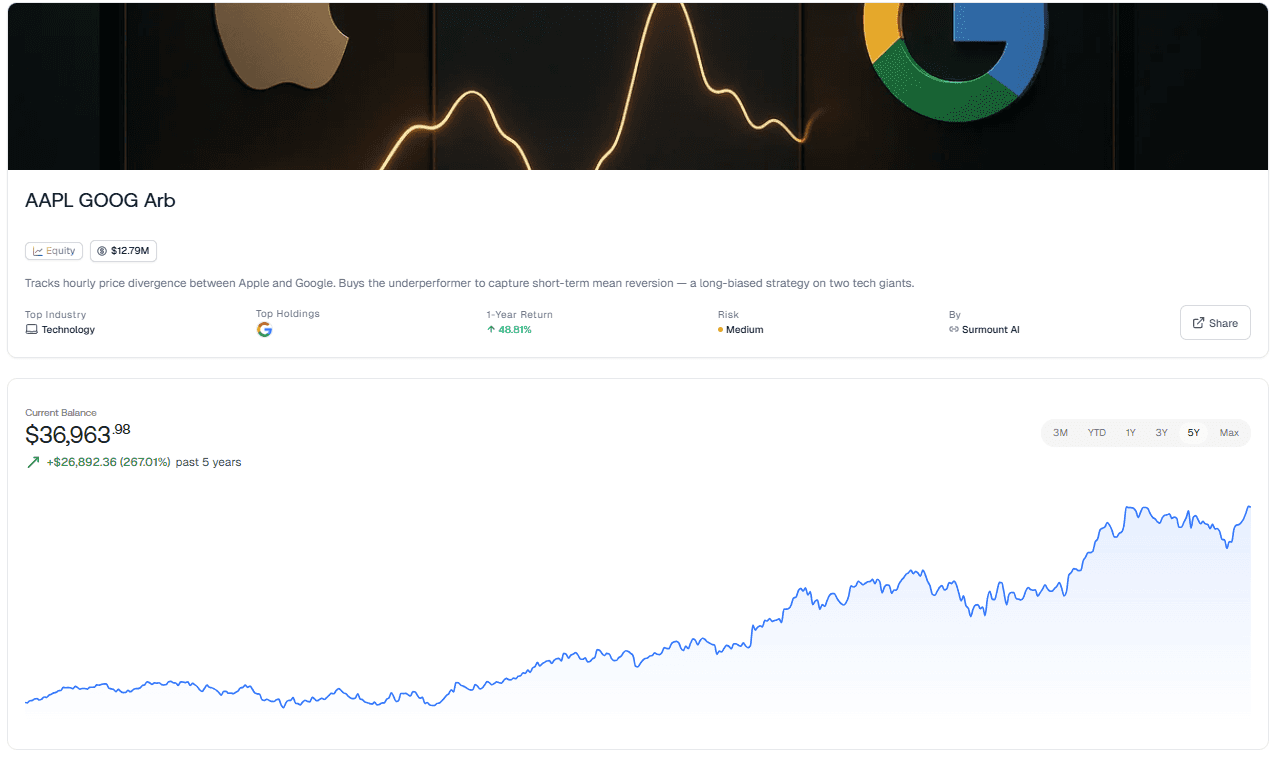
You connect your own brokerage account — Surmount never holds your funds. The strategy runs on your capital, on your account, with full transparency into every trade.
You can browse live strategy performance, see the current signal, and deploy it with a few clicks via the Surmount Strategies Page.
If you're evaluating platforms, the brokers page covers which accounts are currently supported, and pricing breaks down what it costs to run automated strategies.
Deploy This Strategy
Ready to run a live arbitrage strategy without building the infrastructure yourself?
Deploy a live arbitrage strategy on Surmount →
The AAPL/GOOG Arb strategy is live in the app. Connect your brokerage, review the strategy card, and activate — the system handles execution from there.
Frequently Asked Questions About Arbitrage Trading
What is arbitrage trading in simple terms?
It's the practice of buying and selling the same — or closely related — asset across different markets to profit from a price difference. The goal is to lock in a spread before the market closes the gap.
Is arbitrage trading legal?
Yes, completely. Arbitrage is legal in all major markets and is actually considered beneficial — it helps prices stay consistent across exchanges.
Is arbitrage trading risk-free?
In theory, pure arbitrage has no directional risk. In practice, execution risk, transaction costs, and slippage mean no strategy is entirely risk-free. Pairs trading in particular carries correlation risk if two assets decouple unexpectedly.
How does arbitrage work for retail investors?
Most pure arbitrage (exchange, triangular) requires institutional speed and infrastructure. The most accessible form for retail is pairs trading — going long one correlated stock and short another when they diverge — which is what Surmount's AAPL/GOOG Arb strategy automates.
What is an arbitrage trading strategy based on?
It depends on the type. Pure arbitrage exploits identical assets priced differently. Statistical arbitrage uses historical correlations between assets. Merger arbitrage is based on deal spread — the gap between a stock's current price and the announced acquisition price.
Do I need a lot of capital to start?
It depends on the strategy. Some pairs strategies can be run with moderate capital, though position sizing matters — thin spreads require meaningful size to generate worthwhile returns. Surmount shows strategy performance data upfront so you can evaluate fit before deploying.

Automate any portfolio using data-driven strategies made by top creators & professional investors. Turn any investment idea into an automated, testable, and sharable strategy.