Momentum Investing Strategy Explained
Surmount Blogs
Momentum investing strategy explained — how it works, why the research supports it, and how to automate it across stocks, ETFs, and crypto.

Momentum Investing Strategy Explained
Momentum investing strategy is one of the most well-documented edges in finance — and one of the most underused by individual investors. The concept is simple: assets that have been rising tend to keep rising. Assets that have been falling tend to keep falling. You trade with the trend, not against it.
This post breaks down how momentum works, what the research says, how to apply it across stocks, ETFs, and crypto, and how to automate it so you're not manually tracking signals every week.
What Is Momentum Investing?
Momentum investing is a rules-based approach where you buy assets showing strong recent performance and avoid (or short) assets showing weak performance. You're not making a bet on fundamentals. You're betting that price trends persist long enough to profit from.
The typical setup: rank assets by their return over the past 3–12 months, buy the top performers, and rebalance on a set schedule. That's it. The edge isn't in complexity — it's in consistency.
This isn't the same as chasing hype. A proper momentum strategy has defined entry rules, exit rules, a lookback window, and a rebalancing cadence. It's systematic, not reactive.
The Academic Research Behind Momentum Investing Strategies
The foundational study is Jegadeesh & Titman (1993), which showed that U.S. stocks with strong 3–12 month returns continued to outperform over the following 3–12 months. The effect was statistically significant and persisted after controlling for risk, and was eventually referred to as the ‘momentum effect’.
Since then, momentum has been replicated across asset classes (equities, bonds, commodities, currencies), geographies (U.S., Europe, emerging markets), and time periods stretching back over a century. Quantitative firms such as the AQR research team and others have confirmed it's one of the most robust return premia in all of finance.
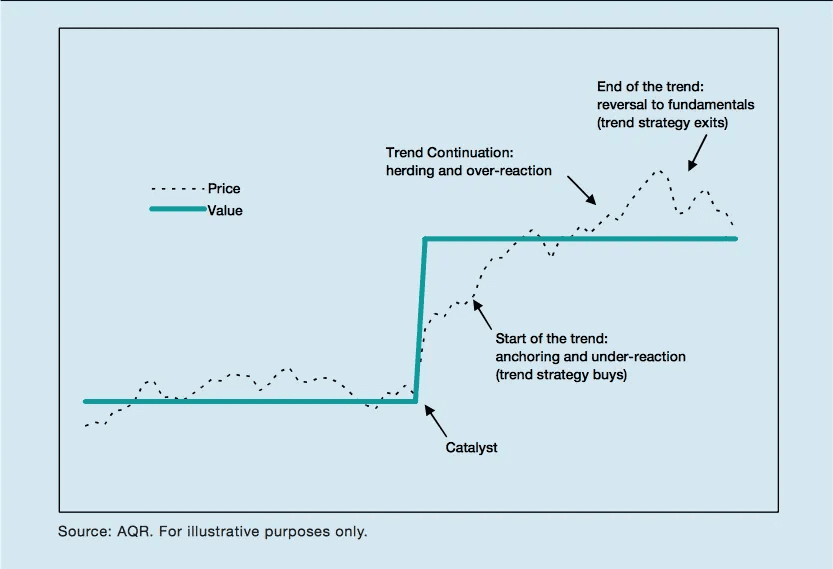
The behavioral explanation is that investors underreact to good news initially, causing gradual price appreciation. Later, overreaction extends the trend before eventual reversal. Momentum strategies capture the middle of that arc.
How Momentum Strategies Work in Practice
There are two main types of momentum investing strategy you should know:
Cross-Sectional Momentum
You rank a universe of assets relative to each other. Take 100 ETFs, sort by 6-month return, buy the top 20%, avoid or short the bottom 20%. The bet is that relative outperformers keep outperforming.
This approach works well for stock selection and sector rotation — you're always long something, just rotating into whatever is leading.
Time-Series (Absolute) Momentum
Here you compare each asset only to its own history — or to a cash benchmark. If an asset has a positive return over the past 12 months, it has positive momentum. If it's negative, you exit to cash or bonds.
This is more of a risk-on / risk-off filter.
Momentum Investing Examples Across Asset Classes
Momentum ETF Strategy
This is one of the most practical applications for individual investors. You take a set of asset class ETFs — U.S. equities (SPY), international equities (EFA), bonds (AGG), commodities (DJP), real estate (VNQ) — and let momentum signals tell you where to concentrate.
The cleaner approach isn't binary in/out rotation. It's proportional allocation based on signal strength.
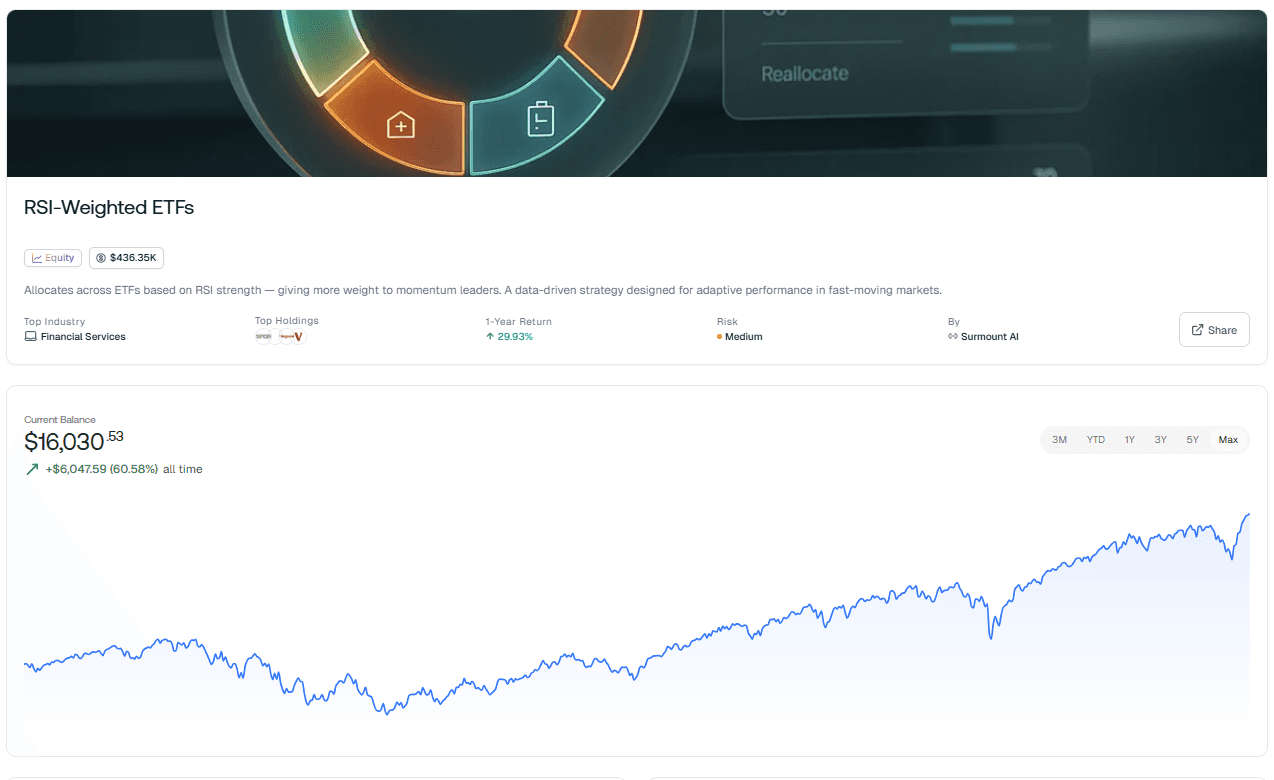
That's the logic behind RSI-weighted positioning: instead of rotating entirely into the top 1–2 ETFs, you allocate in proportion to each ETF's RSI value. The stronger the momentum, the larger the weight. Assets losing momentum get underweighted automatically — no manual rebalancing judgment required.
This approach does two things well. First, it avoids the cliff-edge problem of all-or-nothing rotation, where a single rebalance date can catch you wrong-footed. Second, it scales exposure continuously as momentum builds or fades, so your portfolio is always leaning toward current leaders without making concentrated bets on a single asset.
Surmount's RSI-Weighted ETFs strategy is built on exactly this logic — it reads RSI across a diversified ETF universe and sizes positions accordingly. It's a straightforward, data-driven setup with no discretionary overrides. You can review how it fits your portfolio at /strategies.
Stock Momentum
This is classic equity momentum.
Within the S&P 500, rank stocks by 12-1 month return (12-month return, excluding the most recent month).
Buy the top decile, short the bottom decile, rebalance monthly or quarterly. Transaction costs matter here — this works best in larger-cap stocks where spreads are tight.
Momentum Trading Strategy in Crypto
Crypto is one of the most momentum-driven markets in existence. Bitcoin and altcoins exhibit strong trend behavior, driven by retail sentiment, liquidity cycles, and macro risk appetite.
A Bitcoin Momentum strategy typically uses a moving average crossover or trend filter: when BTC is above its 200-day moving average (or shows positive 3-month return), you're long. When it breaks below, you move to cash. Simple, but it has historically kept you out of the worst drawdowns (-50% to -80% crypto crashes).
Surmount's Bitcoin Momentum Follower strategy automates this logic — you set it up once and it handles the signals and execution.

Pros and Cons of a Momentum Investing Strategy
Why Momentum Works
It's one of the few factors with a century of evidence. Not a backtest artifact — momentum has been observed in live market conditions across multiple decades and geographies.
It's emotionally aligned with trend behavior. Rather than fighting a falling asset (as value investors sometimes do), you wait for confirmation that a trend has started.
It works across asset classes. Stocks, ETFs, commodities, crypto — the signal generalizes, which makes it useful for multi-asset portfolio construction.
It pairs well with other factors. Combining momentum with quality or value reduces crash risk and smooths drawdowns.
The Real Risks
Momentum crashes are real and sudden. When trends reverse — especially after a sharp market shock — momentum portfolios can lose 20–30% in weeks. March 2009 and the 2020 COVID recovery were brutal for long-only momentum strategies.
Transaction costs erode returns if you're not careful. High-turnover momentum strategies applied to individual stocks can lose their edge after fees. ETF-based momentum sidesteps much of this.
Psychological difficulty. You're buying things that have already gone up and selling things that have gone down — the opposite of "buy low, sell high" intuition. Without a rules-based system, most people abandon it at the worst time.
Crowding. As more capital tracks momentum factors, some of the edge compresses in heavily-followed markets.
How to Automate a Momentum Investing Strategy
Using Surmount AI to automate a momentum strategy allows you to build, backtest, and deploy a strategy that buys assets (like stocks or ETFs) experiencing strong recent price performance. Surmount provides a no-code/low-code platform, allowing you to create this without needing to write complex code.
Here is how to set up a momentum strategy on Surmount:
1. Build the Strategy (No-Code Builder)
Define Your Universe: Start by selecting the asset universe, such as the S&P 500, to identify potential winners.
Set Momentum Criteria: Utilize Surmount’s strategy builder to define the "rules" for buying and selling. A common momentum approach is to rank assets based on their performance over the past 12 months, excluding the most recent month (often called "12-minus-1").
Set Technical Indicators: You can program the bot to buy when technical indicators, such as a 50-day moving average crossing above a 200-day moving average, are met.
Define Rebalancing: Configure the strategy to rebalance (e.g., monthly) to sell assets that have fallen out of the top performers and buy new ones.
2. Backtest Your Strategy
Run Simulations: Before using live money, use Surmount’s backtesting tools to apply your momentum rules to years of historical data.
Analyze Performance: Review key metrics like total returns, maximum drawdowns, and volatility to ensure the strategy meets your goals.
Tweak Parameters: If necessary, adjust your look-back periods (e.g., changing from 6 months to 12 months) to optimize performance.
3. Paper Trade (Simulate Live Trading)
Test in Real-Time: Enable paper trading on Surmount to test your strategy in a simulated environment using real-time market data without financial risk.
Monitor and Refine: Use this period to confirm the bot behaves as expected during volatile markets before fully committing capital.
4. Go Live and Automate
Connect Your Brokerage: Connect your existing brokerage account to Surmount, which uses secure APIs for execution.
Activate the Strategy: Once satisfied with the backtest and paper trade results, activate the strategy to allow Surmount to manage the portfolio on autopilot.
Key Tips for Surmount Momentum Strategies:
Enhance with Volatility Scaling: To improve performance, add rules that reduce exposure when market volatility is high.
Stay Disciplined: The benefit of this platform is that it removes emotional, impulsive decisions, allowing for consistent execution of your strategy.
Deploy This Strategy
Deploying a strategy on Surmount AI is designed to be simple, particularly because it uses a "broker-agnostic" approach that lets you automate existing accounts without writing new code.
The process generally involves three main steps:
Connect Your Brokerage: You can link existing accounts from platforms like TradeStation, Alpaca, Webull, and Coinbase.
Select or Build a Strategy: Choose a pre-tested strategy from the Quant Marketplace or use the visual, no-code builder to create your own.
Toggle to "Live": Once connected, you simply select your strategy and toggle it to live trading. Surmount then handles the execution layer, monitoring, and rebalancing automatically.
For added confidence before going live, you can transition "seamlessly" from Paper Trading (simulated) to live execution with one click once you are satisfied with your results
Frequently Asked Questions
What is momentum investing?
Momentum investing means buying assets that have been rising and avoiding (or selling) assets that have been falling. The core idea is that recent price trends tend to persist for weeks or months before reversing — and you can profit by trading in the direction of those trends rather than against them.
Is momentum investing the same as momentum trading strategy?
They overlap but aren't identical. "Momentum trading" often refers to short-term, intraday or multi-day trend following. "Momentum investing" typically refers to medium-term strategies with holding periods of weeks to months, often based on 3–12 month return signals. The academic research on momentum is almost entirely about the medium-term variety.
What is a momentum ETF strategy?
A momentum ETF strategy applies momentum signals to a universe of ETFs rather than individual stocks. You rank ETFs by recent performance, rotate into the top performers, and exit to defensive positions when momentum turns negative. This approach has lower turnover and transaction costs than stock-level momentum, making it more practical for most investors to implement.
What are the biggest risks of a momentum investing strategy?
The main risks are momentum crashes (sharp, sudden reversals when trends break), high transaction costs from frequent rebalancing, and behavioral failure — abandoning the strategy at the wrong time. Automation reduces the behavioral risk significantly. Using ETFs rather than individual stocks reduces transaction costs. Position sizing and diversification help manage crash risk.
Explore all available strategies at Surmount's strategy library. Compare plan options via the pricing page. See which brokers are supported here.

Automate any portfolio using data-driven strategies made by top creators & professional investors. Turn any investment idea into an automated, testable, and sharable strategy.